

192 unifying physics of accelerators, lasers and plasma
on the beam is very close to the estimate Eq. 10.18 and contains an extra term: the shape function F 0 , which depends on
the position of the particle within the bunch.
2N r e mc 2
F || ≈
3R 2/3 σ 4/3 F 0
(10.19)
The shape of the CSR shape function is shown in Fig. 10.8.
As we can see, its amplitude is close to one, confirming the
back-of-the-envelope estimate. The shape function changes
its sign. While the head of the bunch slightly accelerates due
to the CSR effect, the major part of the bunch decelerates.
The effects of CSR are particularly important in bunch
compressors and can prevent achieving ultra-short bunches.
CSR can cause bunch instability and microbunching, and
can therefore deteriorate the longitudinal phase space of the
beam.
To conclude, one should note that the mechanism of CSR’s
creation — depicted in Fig. 10.7 — suggests that, in certain
parameters, there may be a “cure” for CSR, because the vacuum chamber where the beam and fields propagate can partially shield the fields and reduce the CSR effects.
10.1.4 Short laser pulse and Q-switching techniques
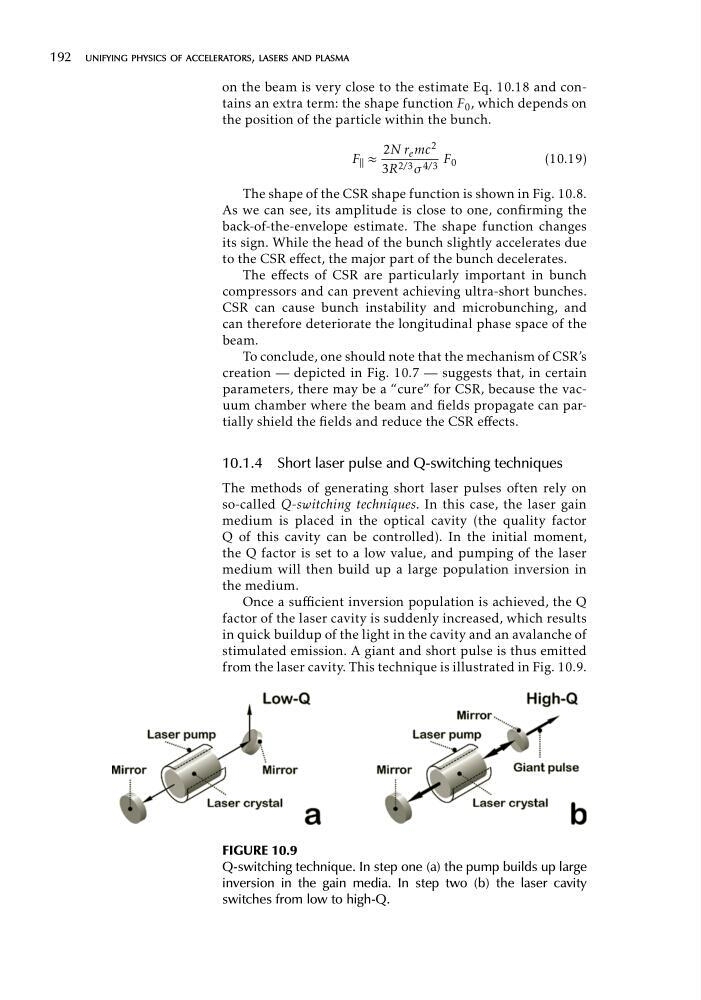
The methods of generating short laser pulses often rely on
so-called Q-switching techniques. In this case, the laser gain
medium is placed in the optical cavity (the quality factor
Q of this cavity can be controlled). In the initial moment,
the Q factor is set to a low value, and pumping of the laser
medium will then build up a large population inversion in
the medium.
Once a sufficient inversion population is achieved, the Q
factor of the laser cavity is suddenly increased, which results
in quick buildup of the light in the cavity and an avalanche of
stimulated emission. A giant and short pulse is thus emitted
from the laser cavity. This technique is illustrated in Fig. 10.9.
FIGURE 10.9
Q-switching technique. In step one (a) the pump builds up large
inversion in the gain media. In step two (b) the laser cavity
switches from low to high-Q.
on the beam is very close to the estimate Eq. 10.18 and contains an extra term: the shape function F 0 , which depends on
the position of the particle within the bunch.
2N r e mc 2
F || ≈
3R 2/3 σ 4/3 F 0
(10.19)
The shape of the CSR shape function is shown in Fig. 10.8.
As we can see, its amplitude is close to one, confirming the
back-of-the-envelope estimate. The shape function changes
its sign. While the head of the bunch slightly accelerates due
to the CSR effect, the major part of the bunch decelerates.
The effects of CSR are particularly important in bunch
compressors and can prevent achieving ultra-short bunches.
CSR can cause bunch instability and microbunching, and
can therefore deteriorate the longitudinal phase space of the
beam.
To conclude, one should note that the mechanism of CSR’s
creation — depicted in Fig. 10.7 — suggests that, in certain
parameters, there may be a “cure” for CSR, because the vacuum chamber where the beam and fields propagate can partially shield the fields and reduce the CSR effects.
10.1.4 Short laser pulse and Q-switching techniques
The methods of generating short laser pulses often rely on
so-called Q-switching techniques. In this case, the laser gain
medium is placed in the optical cavity (the quality factor
Q of this cavity can be controlled). In the initial moment,
the Q factor is set to a low value, and pumping of the laser
medium will then build up a large population inversion in
the medium.
Once a sufficient inversion population is achieved, the Q
factor of the laser cavity is suddenly increased, which results
in quick buildup of the light in the cavity and an avalanche of
stimulated emission. A giant and short pulse is thus emitted
from the laser cavity. This technique is illustrated in Fig. 10.9.
FIGURE 10.9
Q-switching technique. In step one (a) the pump builds up large
inversion in the gain media. In step two (b) the laser cavity
switches from low to high-Q.