

WDLO
) V
KHDG
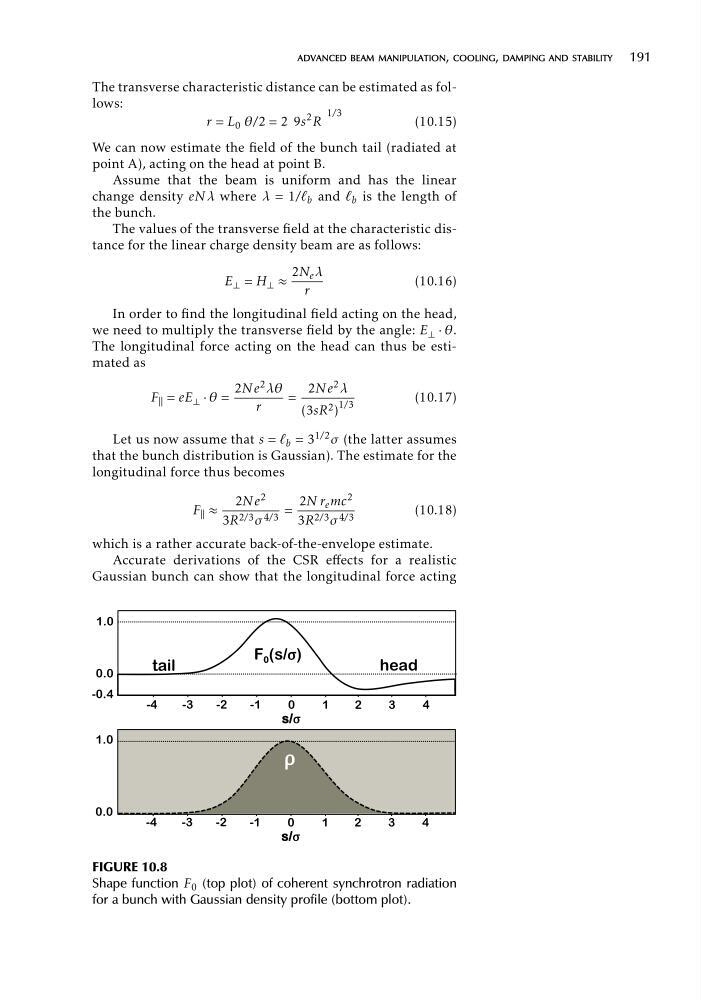
FIGURE 10.8
Shape function F 0 (top plot) of coherent synchrotron radiation
for a bunch with Gaussian density profile (bottom plot).
advanced beam manipulation, cooling, damping and stability 191
The transverse characteristic distance can be estimated as follows:
1/3
r =
2
L 0 θ/2 = 2 9s R
(10.15)
We can now estimate the field of the bunch tail (radiated at
point A), acting on the head at point B.
Assume that the beam is uniform and has the linear
change density eN λ where λ = 1/e b and e b is the length of
the bunch.
The values of the transverse field at the characteristic distance for the linear charge density beam are as follows:
2N λ
E ⊥ =
e
H ⊥ ≈
(10.16)
r
In order to find the longitudinal field acting on the head,
we need to multiply the transverse field by the angle: E ⊥ θ.
The longitudinal force acting on the head can thus be esti·
mated as
2N e 2 λθ
2N e 2 λ
F = eE ·
||
θ =
=
(10.17)
⊥
r
(3sR 2 )
1/3
Let us now assume that s = e b = 3 1/2 σ (the latter assumes
that the bunch distribution is Gaussian). The estimate for the
longitudinal force thus becomes
2N e 2
2N r mc 2
F || ≈
=
e
(10.18)
3R 2/3 σ 4/3 3R 2/3 σ 4/3
which is a rather accurate back-of-the-envelope estimate.
Accurate derivations of the CSR effects for a realistic
Gaussian bunch can show that the longitudinal force acting
) V
KHDG
FIGURE 10.8
Shape function F 0 (top plot) of coherent synchrotron radiation
for a bunch with Gaussian density profile (bottom plot).
advanced beam manipulation, cooling, damping and stability 191
The transverse characteristic distance can be estimated as follows:
1/3
r =
2
L 0 θ/2 = 2 9s R
(10.15)
We can now estimate the field of the bunch tail (radiated at
point A), acting on the head at point B.
Assume that the beam is uniform and has the linear
change density eN λ where λ = 1/e b and e b is the length of
the bunch.
The values of the transverse field at the characteristic distance for the linear charge density beam are as follows:
2N λ
E ⊥ =
e
H ⊥ ≈
(10.16)
r
In order to find the longitudinal field acting on the head,
we need to multiply the transverse field by the angle: E ⊥ θ.
The longitudinal force acting on the head can thus be esti·
mated as
2N e 2 λθ
2N e 2 λ
F = eE ·
||
θ =
=
(10.17)
⊥
r
(3sR 2 )
1/3
Let us now assume that s = e b = 3 1/2 σ (the latter assumes
that the bunch distribution is Gaussian). The estimate for the
longitudinal force thus becomes
2N e 2
2N r mc 2
F || ≈
=
e
(10.18)
3R 2/3 σ 4/3 3R 2/3 σ 4/3
which is a rather accurate back-of-the-envelope estimate.
Accurate derivations of the CSR effects for a realistic
Gaussian bunch can show that the longitudinal force acting