

190 unifying physics of accelerators, lasers and plasma
mation of the two-particle model. In this instance, the beam is
represented just by two particles — at the head and in the tail
of the bunch, as illustrated in Fig. 10.6, where the particles —
as well as its field — are shown qualitatively. As we will see,
the CSR effects are essentially caused by the possibility for
the tail field to overtake the head particle while the beam is
moving on a curved trajectory.
Let us thus define the bunch as a two-particle system with
the length between the head and the tail s equal to rms bunch
length of the initial beam σ. The EM fields of the relativistic
bunch are distributed primarily in transverse directions, as
indicated in Fig. 10.6.
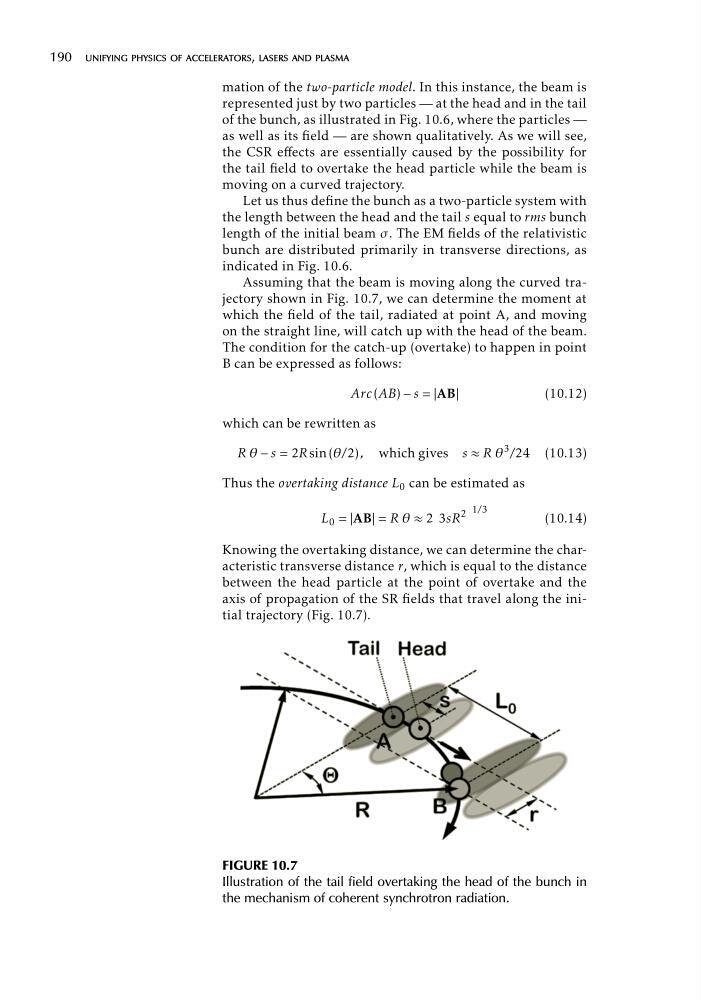
Assuming that the beam is moving along the curved trajectory shown in Fig. 10.7, we can determine the moment at
which the field of the tail, radiated at point A, and moving
on the straight line, will catch up with the head of the beam.
The condition for the catch-up (overtake) to happen in point
B can be expressed as follows:
Arc (AB) − s = |AB|
(10.12)
which can be rewritten as
R θ − s = 2R sin (θ/2) , which gives s ≈ R θ
3 /24 (10.13)
Thus the overtaking distance L 0 can be estimated as
L 0 = |AB| = R θ ≈ 2 3sR
2 1/3
(10.14)
Knowing the overtaking distance, we can determine the characteristic transverse distance r, which is equal to the distance
between the head particle at the point of overtake and the
axis of propagation of the SR fields that travel along the initial trajectory (Fig. 10.7).
FIGURE 10.7
Illustration of the tail field overtaking the head of the bunch in
the mechanism of coherent synchrotron radiation.
mation of the two-particle model. In this instance, the beam is
represented just by two particles — at the head and in the tail
of the bunch, as illustrated in Fig. 10.6, where the particles —
as well as its field — are shown qualitatively. As we will see,
the CSR effects are essentially caused by the possibility for
the tail field to overtake the head particle while the beam is
moving on a curved trajectory.
Let us thus define the bunch as a two-particle system with
the length between the head and the tail s equal to rms bunch
length of the initial beam σ. The EM fields of the relativistic
bunch are distributed primarily in transverse directions, as
indicated in Fig. 10.6.
Assuming that the beam is moving along the curved trajectory shown in Fig. 10.7, we can determine the moment at
which the field of the tail, radiated at point A, and moving
on the straight line, will catch up with the head of the beam.
The condition for the catch-up (overtake) to happen in point
B can be expressed as follows:
Arc (AB) − s = |AB|
(10.12)
which can be rewritten as
R θ − s = 2R sin (θ/2) , which gives s ≈ R θ
3 /24 (10.13)
Thus the overtaking distance L 0 can be estimated as
L 0 = |AB| = R θ ≈ 2 3sR
2 1/3
(10.14)
Knowing the overtaking distance, we can determine the characteristic transverse distance r, which is equal to the distance
between the head particle at the point of overtake and the
axis of propagation of the SR fields that travel along the initial trajectory (Fig. 10.7).
FIGURE 10.7
Illustration of the tail field overtaking the head of the bunch in
the mechanism of coherent synchrotron radiation.