

advanced beam manipulation, cooling, damping and stability 193
10.1.5 Q-switching methods
The methods used to switch the Q factor in the laser cavity
can be divided into two categories: passive and active. Active
methods may involve mechanical effects, e.g., rotation of the
laser cavity mirrors or applying an EM field to a substance
inserted into the cavity (which changes its optical properties
under the influence of the field). Passive methods involve special mirrors that can change the Q factor reflectivity when the
power level of radiation reaches a certain level.
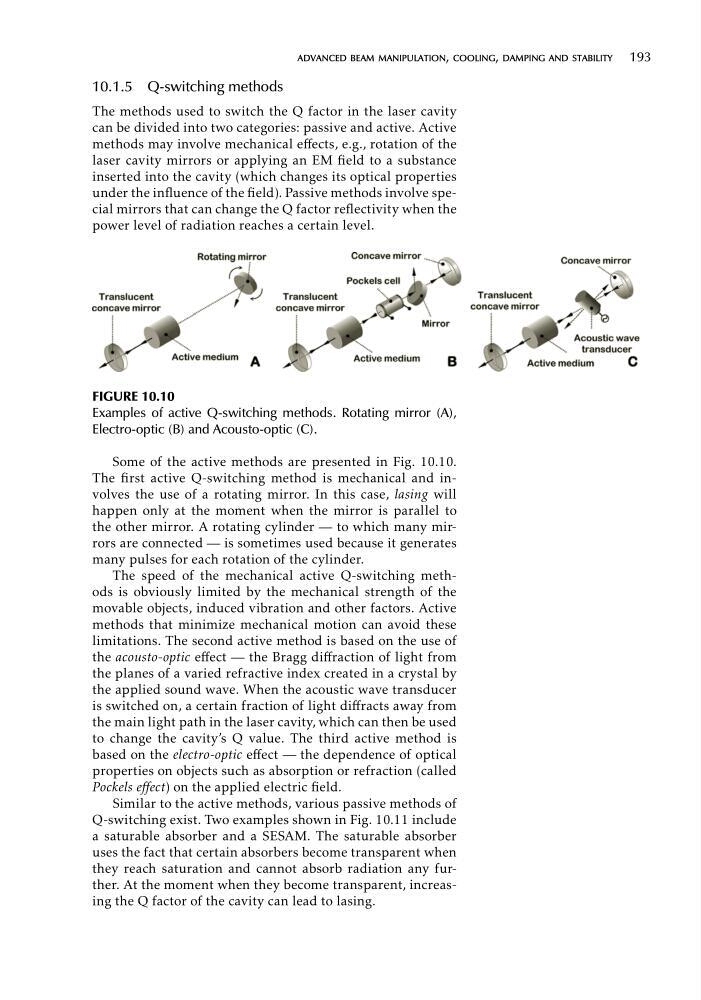
FIGURE 10.10
Examples of active Q-switching methods. Rotating mirror (A),
Electro-optic (B) and Acousto-optic (C).
Some of the active methods are presented in Fig. 10.10.
The first active Q-switching method is mechanical and involves the use of a rotating mirror. In this case, lasing will
happen only at the moment when the mirror is parallel to
the other mirror. A rotating cylinder — to which many mirrors are connected — is sometimes used because it generates
many pulses for each rotation of the cylinder.
The speed of the mechanical active Q-switching methods is obviously limited by the mechanical strength of the
movable objects, induced vibration and other factors. Active
methods that minimize mechanical motion can avoid these
limitations. The second active method is based on the use of
the acousto-optic effect — the Bragg diffraction of light from
the planes of a varied refractive index created in a crystal by
the applied sound wave. When the acoustic wave transducer
is switched on, a certain fraction of light diffracts away from
the main light path in the laser cavity, which can then be used
to change the cavity’s Q value. The third active method is
based on the electro-optic effect — the dependence of optical
properties on objects such as absorption or refraction (called
Pockels effect) on the applied electric field.
Similar to the active methods, various passive methods of
Q-switching exist. Two examples shown in Fig. 10.11 include
a saturable absorber and a SESAM. The saturable absorber
uses the fact that certain absorbers become transparent when
they reach saturation and cannot absorb radiation any further. At the moment when they become transparent, increasing the Q factor of the cavity can lead to lasing.
10.1.5 Q-switching methods
The methods used to switch the Q factor in the laser cavity
can be divided into two categories: passive and active. Active
methods may involve mechanical effects, e.g., rotation of the
laser cavity mirrors or applying an EM field to a substance
inserted into the cavity (which changes its optical properties
under the influence of the field). Passive methods involve special mirrors that can change the Q factor reflectivity when the
power level of radiation reaches a certain level.
FIGURE 10.10
Examples of active Q-switching methods. Rotating mirror (A),
Electro-optic (B) and Acousto-optic (C).
Some of the active methods are presented in Fig. 10.10.
The first active Q-switching method is mechanical and involves the use of a rotating mirror. In this case, lasing will
happen only at the moment when the mirror is parallel to
the other mirror. A rotating cylinder — to which many mirrors are connected — is sometimes used because it generates
many pulses for each rotation of the cylinder.
The speed of the mechanical active Q-switching methods is obviously limited by the mechanical strength of the
movable objects, induced vibration and other factors. Active
methods that minimize mechanical motion can avoid these
limitations. The second active method is based on the use of
the acousto-optic effect — the Bragg diffraction of light from
the planes of a varied refractive index created in a crystal by
the applied sound wave. When the acoustic wave transducer
is switched on, a certain fraction of light diffracts away from
the main light path in the laser cavity, which can then be used
to change the cavity’s Q value. The third active method is
based on the electro-optic effect — the dependence of optical
properties on objects such as absorption or refraction (called
Pockels effect) on the applied electric field.
Similar to the active methods, various passive methods of
Q-switching exist. Two examples shown in Fig. 10.11 include
a saturable absorber and a SESAM. The saturable absorber
uses the fact that certain absorbers become transparent when
they reach saturation and cannot absorb radiation any further. At the moment when they become transparent, increasing the Q factor of the cavity can lead to lasing.