

174 unifying physics of accelerators, lasers and plasma
In contrast to a standard cyclotron, a synchrocyclotron can
have variable energies of the accelerated beam and it can also
achieve higher energies — several hundreds of MeV.
In the synchrocyclotron, the relativistic effects are compensated by continuously decreasing the frequency of the accelerating voltage during acceleration so that
ω 0
ω =
(9.3)
γ(t)
The time-varying accelerating frequency also means that only
a bunch of a certain length can be in sync with the field — the
synchrocyclotron therefore cannot accelerate CW current but
can only produce pulsed beams.
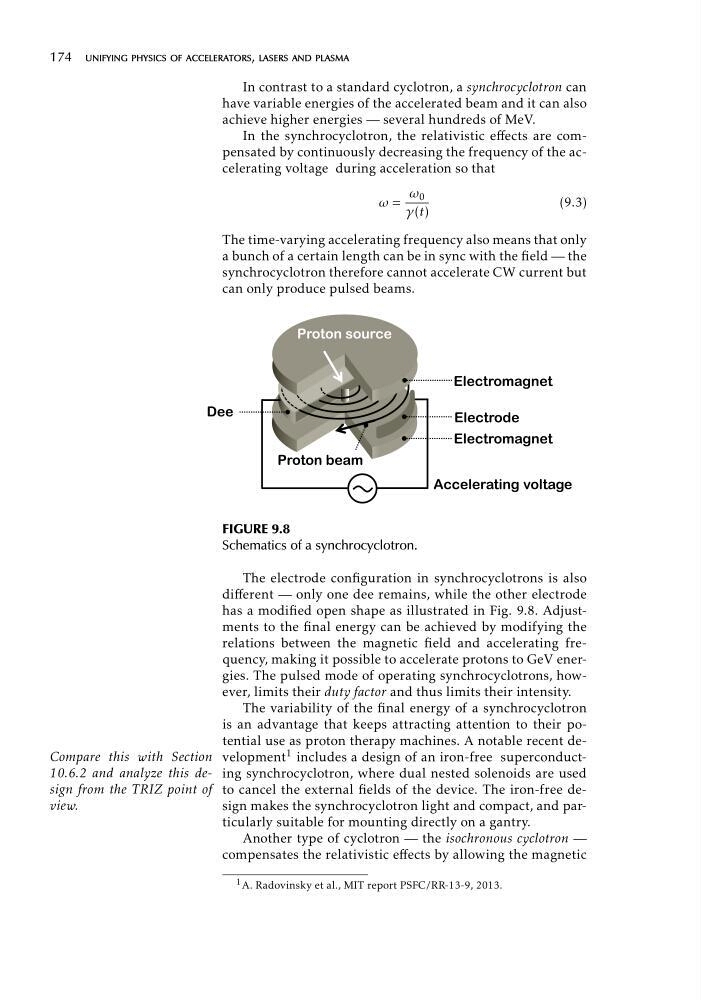
FIGURE 9.8
Schematics of a synchrocyclotron.
The electrode configuration in synchrocyclotrons is also
different — only one dee remains, while the other electrode
has a modified open shape as illustrated in Fig. 9.8. Adjustments to the final energy can be achieved by modifying the
relations between the magnetic field and accelerating frequency, making it possible to accelerate protons to GeV energies. The pulsed mode of operating synchrocyclotrons, however, limits their duty factor and thus limits their intensity.
The variability of the final energy of a synchrocyclotron
is an advantage that keeps attracting attention to their potential use as proton therapy machines. A notable recent deCompare this with Section velopment 1 includes a design of an iron-free superconduct10.6.2 and analyze this de ing synchrocyclotron, where dual nested solenoids are used
sign from the TRIZ point of to cancel the external fields of the device. The iron-free deview.
sign makes the synchrocyclotron light and compact, and particularly suitable for mounting directly on a gantry.
Another type of cyclotron — the isochronous cyclotron —
compensates the relativistic effects by allowing the magnetic
1 A. Radovinsky et al., MIT report PSFC/RR-13-9, 2013.
In contrast to a standard cyclotron, a synchrocyclotron can
have variable energies of the accelerated beam and it can also
achieve higher energies — several hundreds of MeV.
In the synchrocyclotron, the relativistic effects are compensated by continuously decreasing the frequency of the accelerating voltage during acceleration so that
ω 0
ω =
(9.3)
γ(t)
The time-varying accelerating frequency also means that only
a bunch of a certain length can be in sync with the field — the
synchrocyclotron therefore cannot accelerate CW current but
can only produce pulsed beams.
FIGURE 9.8
Schematics of a synchrocyclotron.
The electrode configuration in synchrocyclotrons is also
different — only one dee remains, while the other electrode
has a modified open shape as illustrated in Fig. 9.8. Adjustments to the final energy can be achieved by modifying the
relations between the magnetic field and accelerating frequency, making it possible to accelerate protons to GeV energies. The pulsed mode of operating synchrocyclotrons, however, limits their duty factor and thus limits their intensity.
The variability of the final energy of a synchrocyclotron
is an advantage that keeps attracting attention to their potential use as proton therapy machines. A notable recent deCompare this with Section velopment 1 includes a design of an iron-free superconduct10.6.2 and analyze this de ing synchrocyclotron, where dual nested solenoids are used
sign from the TRIZ point of to cancel the external fields of the device. The iron-free deview.
sign makes the synchrocyclotron light and compact, and particularly suitable for mounting directly on a gantry.
Another type of cyclotron — the isochronous cyclotron —
compensates the relativistic effects by allowing the magnetic
1 A. Radovinsky et al., MIT report PSFC/RR-13-9, 2013.