

proton and ion laser plasma acceleration 175
field to increase with the radius of the orbit as
B = γ(R) B 0
(9.4)
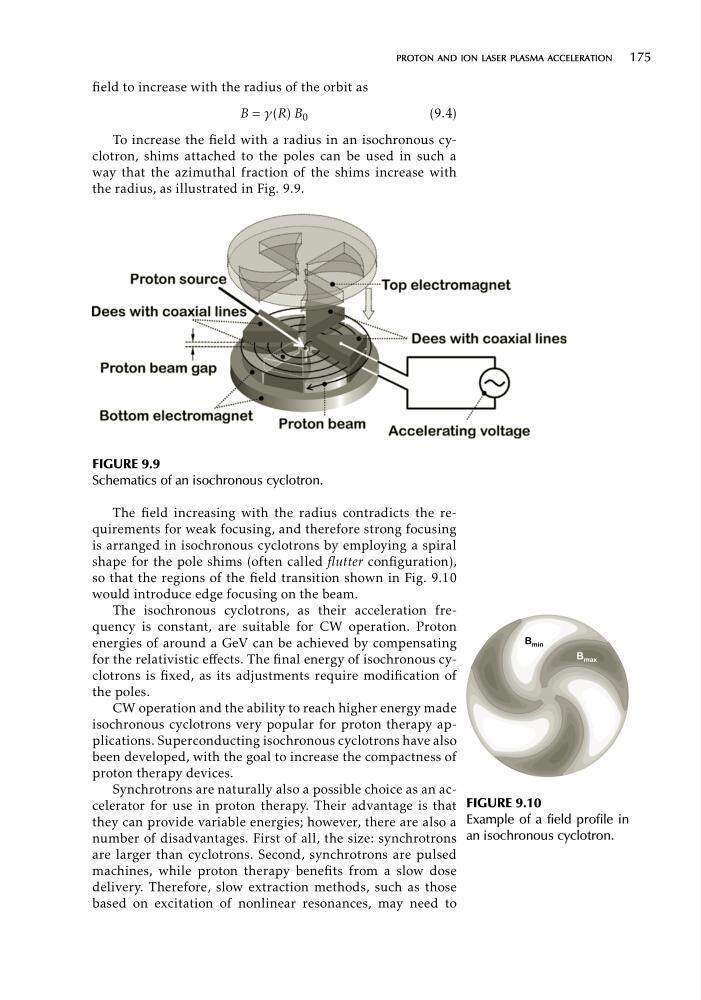
To increase the field with a radius in an isochronous cyclotron, shims attached to the poles can be used in such a
way that the azimuthal fraction of the shims increase with
the radius, as illustrated in Fig. 9.9.
FIGURE 9.9
Schematics of an isochronous cyclotron.
The field increasing with the radius contradicts the requirements for weak focusing, and therefore strong focusing
is arranged in isochronous cyclotrons by employing a spiral
shape for the pole shims (often called flutter configuration),
so that the regions of the field transition shown in Fig. 9.10
would introduce edge focusing on the beam.
The isochronous cyclotrons, as their acceleration frequency is constant, are suitable for CW operation. Proton
energies of around a GeV can be achieved by compensating
for the relativistic effects. The final energy of isochronous cyclotrons is fixed, as its adjustments require modification of
the poles.
CW operation and the ability to reach higher energy made
isochronous cyclotrons very popular for proton therapy applications. Superconducting isochronous cyclotrons have also
been developed, with the goal to increase the compactness of
proton therapy devices.
Synchrotrons are naturally also a possible choice as an accelerator for use in proton therapy. Their advantage is that
they can provide variable energies; however, there are also a
number of disadvantages. First of all, the size: synchrotrons
are larger than cyclotrons. Second, synchrotrons are pulsed
machines, while proton therapy benefits from a slow dose
delivery. Therefore, slow extraction methods, such as those
based on excitation of nonlinear resonances, may need to
FIGURE 9.10
Example of a field profile in
an isochronous cyclotron.
field to increase with the radius of the orbit as
B = γ(R) B 0
(9.4)
To increase the field with a radius in an isochronous cyclotron, shims attached to the poles can be used in such a
way that the azimuthal fraction of the shims increase with
the radius, as illustrated in Fig. 9.9.
FIGURE 9.9
Schematics of an isochronous cyclotron.
The field increasing with the radius contradicts the requirements for weak focusing, and therefore strong focusing
is arranged in isochronous cyclotrons by employing a spiral
shape for the pole shims (often called flutter configuration),
so that the regions of the field transition shown in Fig. 9.10
would introduce edge focusing on the beam.
The isochronous cyclotrons, as their acceleration frequency is constant, are suitable for CW operation. Proton
energies of around a GeV can be achieved by compensating
for the relativistic effects. The final energy of isochronous cyclotrons is fixed, as its adjustments require modification of
the poles.
CW operation and the ability to reach higher energy made
isochronous cyclotrons very popular for proton therapy applications. Superconducting isochronous cyclotrons have also
been developed, with the goal to increase the compactness of
proton therapy devices.
Synchrotrons are naturally also a possible choice as an accelerator for use in proton therapy. Their advantage is that
they can provide variable energies; however, there are also a
number of disadvantages. First of all, the size: synchrotrons
are larger than cyclotrons. Second, synchrotrons are pulsed
machines, while proton therapy benefits from a slow dose
delivery. Therefore, slow extraction methods, such as those
based on excitation of nonlinear resonances, may need to
FIGURE 9.10
Example of a field profile in
an isochronous cyclotron.