

172 unifying physics of accelerators, lasers and plasma
cost of the components and the size of the necessary building
are the prevailing limiting factors — there are presently several tens of facilities operating worldwide, while the generally accepted estimation states that there should be one proton treatment facility for every 10 million people.
9.3.1 Beam generation and handling at proton facilities
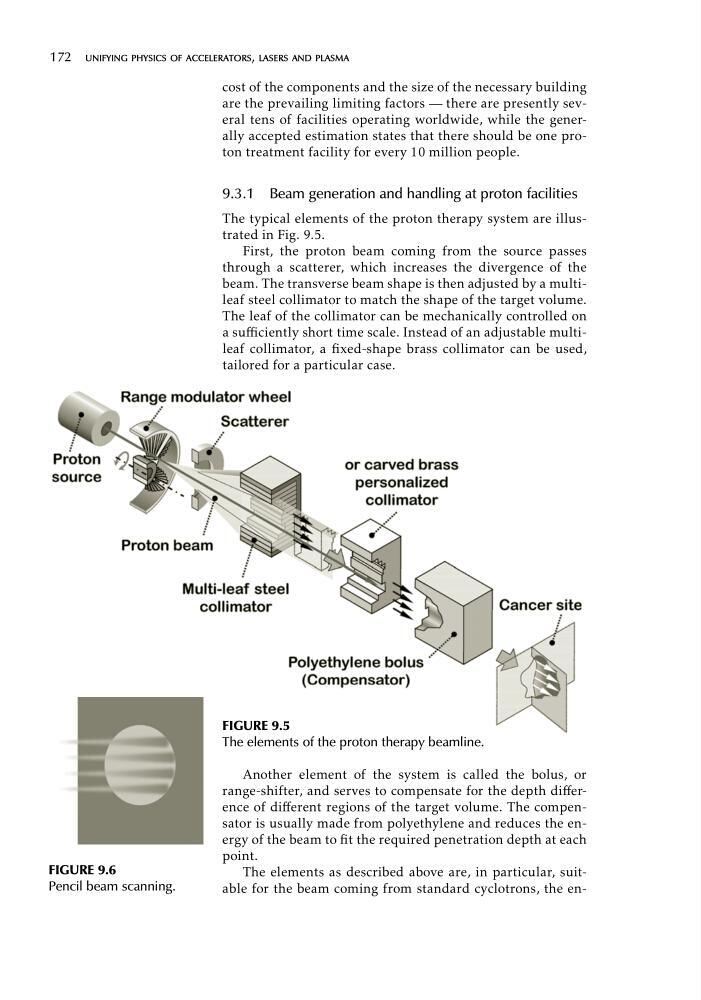
The typical elements of the proton therapy system are illustrated in Fig. 9.5.
First, the proton beam coming from the source passes
through a scatterer, which increases the divergence of the
beam. The transverse beam shape is then adjusted by a multileaf steel collimator to match the shape of the target volume.
The leaf of the collimator can be mechanically controlled on
a sufficiently short time scale. Instead of an adjustable multileaf collimator, a fixed-shape brass collimator can be used,
tailored for a particular case.
FIGURE 9.5
FIGURE 9.6
Pencil beam scanning.
The elements of the proton therapy beamline.
Another element of the system is called the bolus, or
range-shifter, and serves to compensate for the depth difference of different regions of the target volume. The compensator is usually made from polyethylene and reduces the energy of the beam to fit the required penetration depth at each
point.
The elements as described above are, in particular, suitable for the beam coming from standard cyclotrons, the en
cost of the components and the size of the necessary building
are the prevailing limiting factors — there are presently several tens of facilities operating worldwide, while the generally accepted estimation states that there should be one proton treatment facility for every 10 million people.
9.3.1 Beam generation and handling at proton facilities
The typical elements of the proton therapy system are illustrated in Fig. 9.5.
First, the proton beam coming from the source passes
through a scatterer, which increases the divergence of the
beam. The transverse beam shape is then adjusted by a multileaf steel collimator to match the shape of the target volume.
The leaf of the collimator can be mechanically controlled on
a sufficiently short time scale. Instead of an adjustable multileaf collimator, a fixed-shape brass collimator can be used,
tailored for a particular case.
FIGURE 9.5
FIGURE 9.6
Pencil beam scanning.
The elements of the proton therapy beamline.
Another element of the system is called the bolus, or
range-shifter, and serves to compensate for the depth difference of different regions of the target volume. The compensator is usually made from polyethylene and reduces the energy of the beam to fit the required penetration depth at each
point.
The elements as described above are, in particular, suitable for the beam coming from standard cyclotrons, the en