

proton and ion laser plasma acceleration 171
9.3 Conventional proton therapy facilities
The design of conventional proton therapy facilities is dictated by several factors, such as the size of the proton source,
the number of treatment beamlines and the size of the gantry.
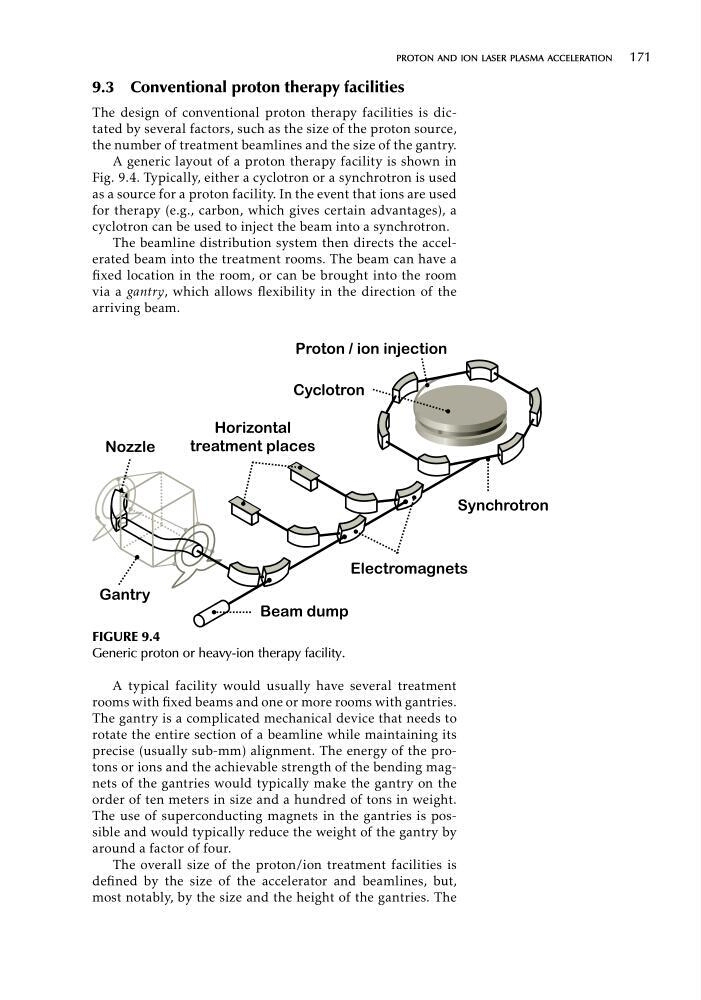
A generic layout of a proton therapy facility is shown in
Fig. 9.4. Typically, either a cyclotron or a synchrotron is used
as a source for a proton facility. In the event that ions are used
for therapy (e.g., carbon, which gives certain advantages), a
cyclotron can be used to inject the beam into a synchrotron.
The beamline distribution system then directs the accelerated beam into the treatment rooms. The beam can have a
fixed location in the room, or can be brought into the room
via a gantry, which allows flexibility in the direction of the
arriving beam.
FIGURE 9.4
Generic proton or heavy-ion therapy facility.
A typical facility would usually have several treatment
rooms with fixed beams and one or more rooms with gantries.
The gantry is a complicated mechanical device that needs to
rotate the entire section of a beamline while maintaining its
precise (usually sub-mm) alignment. The energy of the protons or ions and the achievable strength of the bending magnets of the gantries would typically make the gantry on the
order of ten meters in size and a hundred of tons in weight.
The use of superconducting magnets in the gantries is possible and would typically reduce the weight of the gantry by
around a factor of four.
The overall size of the proton/ion treatment facilities is
defined by the size of the accelerator and beamlines, but,
most notably, by the size and the height of the gantries. The
9.3 Conventional proton therapy facilities
The design of conventional proton therapy facilities is dictated by several factors, such as the size of the proton source,
the number of treatment beamlines and the size of the gantry.
A generic layout of a proton therapy facility is shown in
Fig. 9.4. Typically, either a cyclotron or a synchrotron is used
as a source for a proton facility. In the event that ions are used
for therapy (e.g., carbon, which gives certain advantages), a
cyclotron can be used to inject the beam into a synchrotron.
The beamline distribution system then directs the accelerated beam into the treatment rooms. The beam can have a
fixed location in the room, or can be brought into the room
via a gantry, which allows flexibility in the direction of the
arriving beam.
FIGURE 9.4
Generic proton or heavy-ion therapy facility.
A typical facility would usually have several treatment
rooms with fixed beams and one or more rooms with gantries.
The gantry is a complicated mechanical device that needs to
rotate the entire section of a beamline while maintaining its
precise (usually sub-mm) alignment. The energy of the protons or ions and the achievable strength of the bending magnets of the gantries would typically make the gantry on the
order of ten meters in size and a hundred of tons in weight.
The use of superconducting magnets in the gantries is possible and would typically reduce the weight of the gantry by
around a factor of four.
The overall size of the proton/ion treatment facilities is
defined by the size of the accelerator and beamlines, but,
most notably, by the size and the height of the gantries. The