

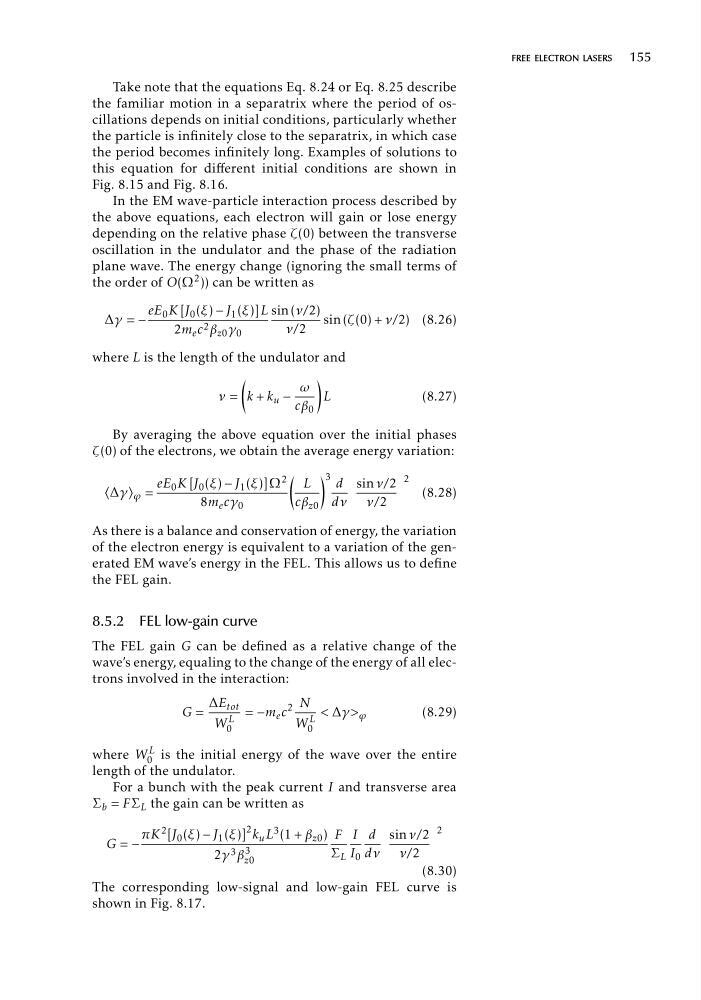
Take note that the equations Eq. 8.24 or Eq. 8.25 describe
the familiar motion in a separatrix where the period of oscillations depends on initial conditions, particularly whether
the particle is infinitely close to the separatrix, in which case
the period becomes infinitely long. Examples of solutions to
this equation for different initial conditions are shown in
Fig. 8.15 and Fig. 8.16.
In the EM wave-particle interaction process described by
the above equations, each electron will gain or lose energy
depending on the relative phase ζ(0) between the transverse
oscillation in the undulator and the phase of the radiation
plane wave. The energy change (ignoring the small terms of
the order of O(Ω 2 )) can be written as
eE 0 K [J 0 (ξ) − J 1 (ξ)] L sin (ν/2)
Δγ = −
sin (ζ(0) + ν/2) (8.26)
2m e c 2 β z0 γ 0
ν/2
where L is the length of the undulator and
(
)
ω
ν = k + k u −
L
(8.27)
cβ 0
By averaging the above equation over the initial phases
ζ(0) of the electrons, we obtain the average energy variation:
(
) 3
2
eE 0 K [J 0 (ξ) − J 1 (ξ)] Ω 2 L
d sin ν/2
(Δγ) ϕ =
(8.28)
8m e cγ 0
cβ z0 dν ν/2
As there is a balance and conservation of energy, the variation
of the electron energy is equivalent to a variation of the generated EM wave’s energy in the FEL. This allows us to define
the FEL gain.
8.5.2 FEL low-gain curve
The FEL gain G can be defined as a relative change of the
wave’s energy, equaling to the change of the energy of all electrons involved in the interaction:
ΔE tot
N
G =
= −m e c
2
< Δγ> ϕ
(8.29)
W
L
W
L
0
0
where W
L is the initial energy of the
0
wave over the entire
length of the undulator.
For a bunch with the peak current I and transverse area
Σ b = FΣ L the gain can be written as
πK 2 [
2
J 0 (ξ) − J 1 (ξ)] k u L 3 (1 + β z0 )
2
F I d sin ν/2
G = −
2 3 3
γ β
Σ L I 0 dν ν/2
z0
(8.30)
The corresponding low-signal and low-gain FEL curve is
shown in Fig. 8.17.
free electron lasers 155
the familiar motion in a separatrix where the period of oscillations depends on initial conditions, particularly whether
the particle is infinitely close to the separatrix, in which case
the period becomes infinitely long. Examples of solutions to
this equation for different initial conditions are shown in
Fig. 8.15 and Fig. 8.16.
In the EM wave-particle interaction process described by
the above equations, each electron will gain or lose energy
depending on the relative phase ζ(0) between the transverse
oscillation in the undulator and the phase of the radiation
plane wave. The energy change (ignoring the small terms of
the order of O(Ω 2 )) can be written as
eE 0 K [J 0 (ξ) − J 1 (ξ)] L sin (ν/2)
Δγ = −
sin (ζ(0) + ν/2) (8.26)
2m e c 2 β z0 γ 0
ν/2
where L is the length of the undulator and
(
)
ω
ν = k + k u −
L
(8.27)
cβ 0
By averaging the above equation over the initial phases
ζ(0) of the electrons, we obtain the average energy variation:
(
) 3
2
eE 0 K [J 0 (ξ) − J 1 (ξ)] Ω 2 L
d sin ν/2
(Δγ) ϕ =
(8.28)
8m e cγ 0
cβ z0 dν ν/2
As there is a balance and conservation of energy, the variation
of the electron energy is equivalent to a variation of the generated EM wave’s energy in the FEL. This allows us to define
the FEL gain.
8.5.2 FEL low-gain curve
The FEL gain G can be defined as a relative change of the
wave’s energy, equaling to the change of the energy of all electrons involved in the interaction:
ΔE tot
N
G =
= −m e c
2
< Δγ> ϕ
(8.29)
W
L
W
L
0
0
where W
L is the initial energy of the
0
wave over the entire
length of the undulator.
For a bunch with the peak current I and transverse area
Σ b = FΣ L the gain can be written as
πK 2 [
2
J 0 (ξ) − J 1 (ξ)] k u L 3 (1 + β z0 )
2
F I d sin ν/2
G = −
2 3 3
γ β
Σ L I 0 dν ν/2
z0
(8.30)
The corresponding low-signal and low-gain FEL curve is
shown in Fig. 8.17.
free electron lasers 155