

156 unifying physics of accelerators, lasers and plasma
*DLQ
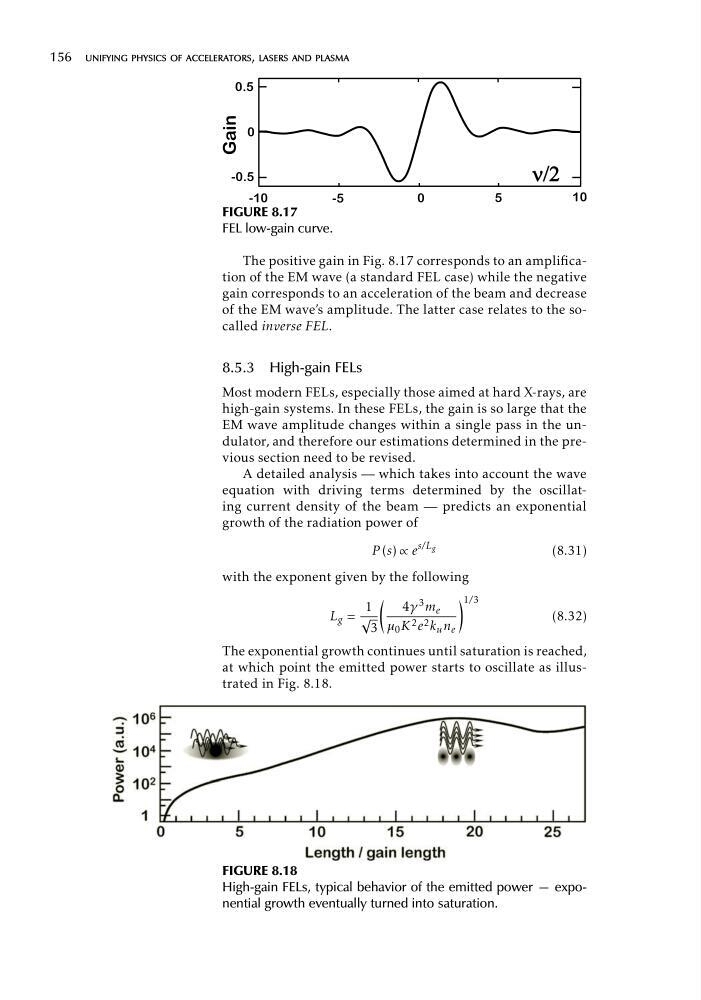
FIGURE 8.17
FEL low-gain curve.
The positive gain in Fig. 8.17 corresponds to an amplification of the EM wave (a standard FEL case) while the negative
gain corresponds to an acceleration of the beam and decrease
of the EM wave’s amplitude. The latter case relates to the socalled inverse FEL.
8.5.3 High-gain FELs
Most modern FELs, especially those aimed at hard X-rays, are
high-gain systems. In these FELs, the gain is so large that the
EM wave amplitude changes within a single pass in the undulator, and therefore our estimations determined in the previous section need to be revised.
A detailed analysis — which takes into account the wave
equation with driving terms determined by the oscillating current density of the beam — predicts an exponential
growth of the radiation power of
s/L g
P (s) ∝ e
(8.31)
with the exponent given by the following
(
) 1/3
1
4γ 3 m e
L g = √
(8.32)
3 μ 0 K 2 e 2 k u n e
The exponential growth continues until saturation is reached,
at which point the emitted power starts to oscillate as illustrated in Fig. 8.18.
FIGURE 8.18
High-gain FELs, typical behavior of the emitted power — exponential growth eventually turned into saturation.
*DLQ
FIGURE 8.17
FEL low-gain curve.
The positive gain in Fig. 8.17 corresponds to an amplification of the EM wave (a standard FEL case) while the negative
gain corresponds to an acceleration of the beam and decrease
of the EM wave’s amplitude. The latter case relates to the socalled inverse FEL.
8.5.3 High-gain FELs
Most modern FELs, especially those aimed at hard X-rays, are
high-gain systems. In these FELs, the gain is so large that the
EM wave amplitude changes within a single pass in the undulator, and therefore our estimations determined in the previous section need to be revised.
A detailed analysis — which takes into account the wave
equation with driving terms determined by the oscillating current density of the beam — predicts an exponential
growth of the radiation power of
s/L g
P (s) ∝ e
(8.31)
with the exponent given by the following
(
) 1/3
1
4γ 3 m e
L g = √
(8.32)
3 μ 0 K 2 e 2 k u n e
The exponential growth continues until saturation is reached,
at which point the emitted power starts to oscillate as illustrated in Fig. 8.18.
FIGURE 8.18
High-gain FELs, typical behavior of the emitted power — exponential growth eventually turned into saturation.