

154 unifying physics of accelerators, lasers and plasma
all quantities over one undulator period in order to remove
fast oscillations.
We begin by introducing the following variable:
ζ = k u z + α = (k + k u )z − ωt + ϕ
(8.23)
The above-defined system of the first-order differential equations can be transformed into a single differential equation of
second order:
eE (k + k)[J (ξ) J (ξ)](1 + K 2 /2)K
ζ ¨ = −
0 u
0
− 1
sin ζ
(8.24)
2m 4
e γ
where ξ = K 2 /(4 + 2K 2 ) and J 0 and J 1 are Bessel functions.
Eq. 8.24 (above) can be expressed as
¨
ζ +
2
Ω sin ζ = 0
(8.25)
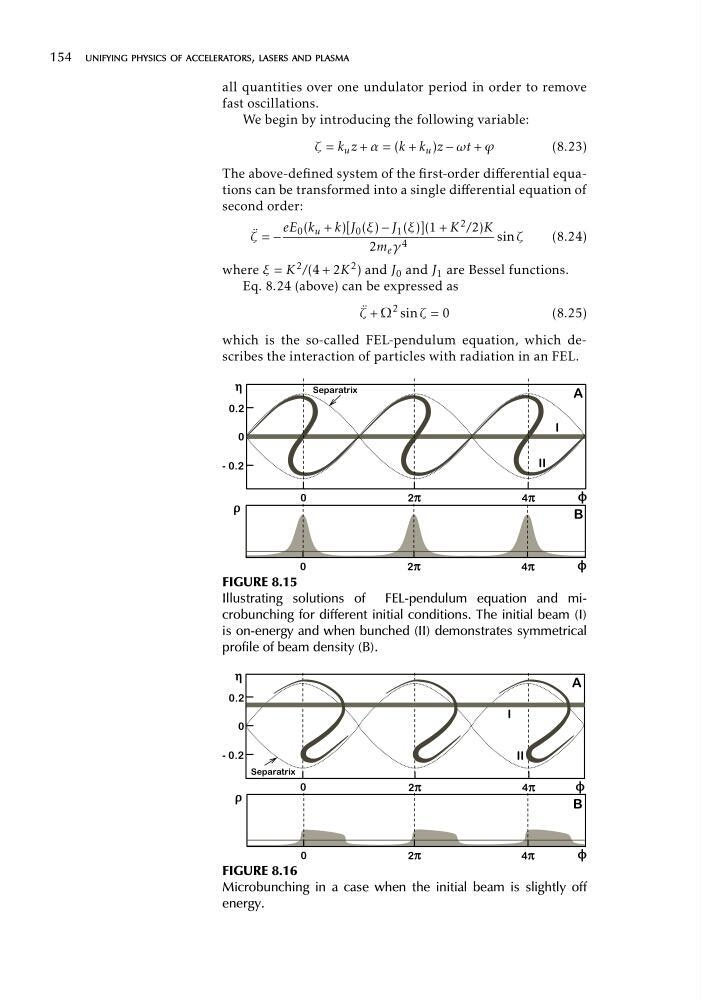
which is the so-called FEL-pendulum equation, which describes the interaction of particles with radiation in an FEL.
6HSDUDWUL[
$
,
,,
%
FIGURE 8.15
Illustrating solutions of FEL-pendulum equation and microbunching for different initial conditions. The initial beam (I)
is on-energy and when bunched (II) demonstrates symmetrical
profile of beam density (B).
$
,
,,
6HSDUDWUL[
%
FIGURE 8.16
Microbunching in a case when the initial beam is slightly off
energy.
all quantities over one undulator period in order to remove
fast oscillations.
We begin by introducing the following variable:
ζ = k u z + α = (k + k u )z − ωt + ϕ
(8.23)
The above-defined system of the first-order differential equations can be transformed into a single differential equation of
second order:
eE (k + k)[J (ξ) J (ξ)](1 + K 2 /2)K
ζ ¨ = −
0 u
0
− 1
sin ζ
(8.24)
2m 4
e γ
where ξ = K 2 /(4 + 2K 2 ) and J 0 and J 1 are Bessel functions.
Eq. 8.24 (above) can be expressed as
¨
ζ +
2
Ω sin ζ = 0
(8.25)
which is the so-called FEL-pendulum equation, which describes the interaction of particles with radiation in an FEL.
6HSDUDWUL[
$
,
,,
%
FIGURE 8.15
Illustrating solutions of FEL-pendulum equation and microbunching for different initial conditions. The initial beam (I)
is on-energy and when bunched (II) demonstrates symmetrical
profile of beam density (B).
$
,
,,
6HSDUDWUL[
%
FIGURE 8.16
Microbunching in a case when the initial beam is slightly off
energy.