

free electron lasers 153
crobunching in detail. The relevant equations of motion are
dp
e
dE
= eE + v × B and
= eE · v
(8.16)
dt
c
dt
where momentum and energy are
p = m e γv and E = m e c
2 γ
(8.17)
and where B and E are the magnetic field of the undulator
and of the undulator radiation.
We will define the undulator magnetic field as
B = B 0 0 , cos (k u z) , 0
(8.18)
where B 0 is the amplitude of the undulator fields. And we
will define the undulator harmonic radiation as
E = E 0 cos α , 0, 0
B = E 0 0 , cos α, 0
(8.19)
where E 0 is the amplitude of the radiation harmonic and
α = kz − ωt + ϕ and ω = kc
(8.20)
As you can see, we have simplified the undulator radiation by
representing it as a plane wave.
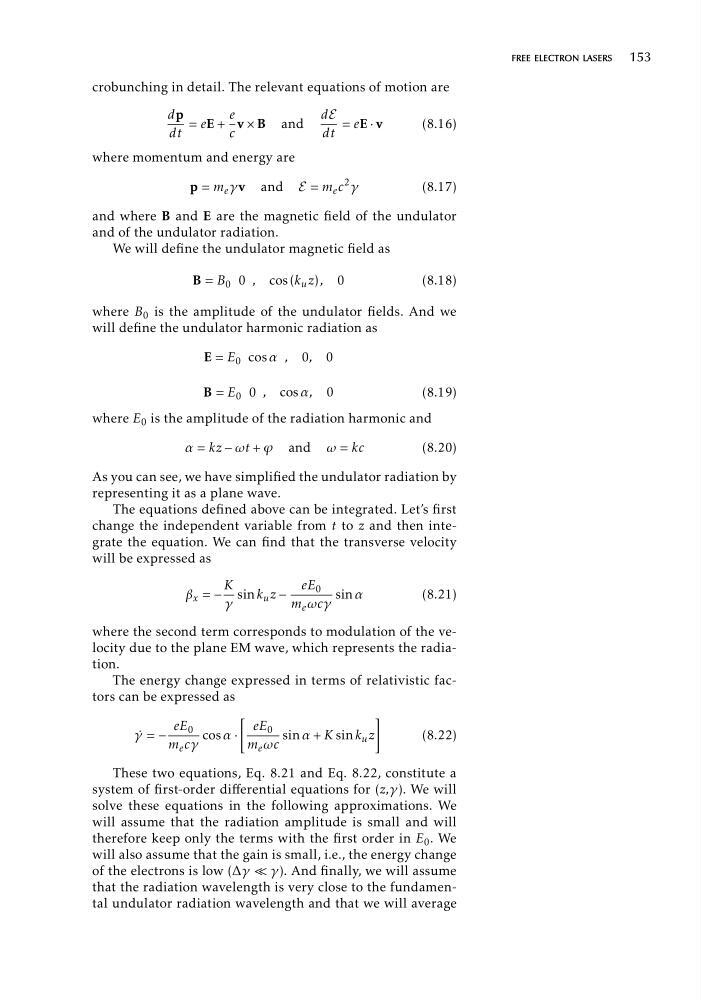
The equations defined above can be integrated. Let’s first
change the independent variable from t to z and then integrate the equation. We can find that the transverse velocity
will be expressed as
K
eE 0
β x = − sin k u z
sin α
(8.21)
γ
− m e ωcγ
where the second term corresponds to modulation of the velocity due to the plane EM wave, which represents the radiation.
The energy change expressed in terms of relativistic factors can be expressed as
eE
γ˙ = −
0
eE
cos
0
α
sin
m
·
e cγ
r
α + K sin k u z
(8.22)
m e ωc
1
These two equations, Eq. 8.21 and Eq. 8.22, constitute a
system of first-order differential equations for (z,γ). We will
solve these equations in the following approximations. We
will assume that the radiation amplitude is small and will
therefore keep only the terms with the first order in E 0 . We
will also assume that the gain is small, i.e., the energy change
of the electrons is low (Δγ
γ). And finally, we will assume
that the radiation wavelength
«
is very close to the fundamental undulator radiation wavelength and that we will average
crobunching in detail. The relevant equations of motion are
dp
e
dE
= eE + v × B and
= eE · v
(8.16)
dt
c
dt
where momentum and energy are
p = m e γv and E = m e c
2 γ
(8.17)
and where B and E are the magnetic field of the undulator
and of the undulator radiation.
We will define the undulator magnetic field as
B = B 0 0 , cos (k u z) , 0
(8.18)
where B 0 is the amplitude of the undulator fields. And we
will define the undulator harmonic radiation as
E = E 0 cos α , 0, 0
B = E 0 0 , cos α, 0
(8.19)
where E 0 is the amplitude of the radiation harmonic and
α = kz − ωt + ϕ and ω = kc
(8.20)
As you can see, we have simplified the undulator radiation by
representing it as a plane wave.
The equations defined above can be integrated. Let’s first
change the independent variable from t to z and then integrate the equation. We can find that the transverse velocity
will be expressed as
K
eE 0
β x = − sin k u z
sin α
(8.21)
γ
− m e ωcγ
where the second term corresponds to modulation of the velocity due to the plane EM wave, which represents the radiation.
The energy change expressed in terms of relativistic factors can be expressed as
eE
γ˙ = −
0
eE
cos
0
α
sin
m
·
e cγ
r
α + K sin k u z
(8.22)
m e ωc
1
These two equations, Eq. 8.21 and Eq. 8.22, constitute a
system of first-order differential equations for (z,γ). We will
solve these equations in the following approximations. We
will assume that the radiation amplitude is small and will
therefore keep only the terms with the first order in E 0 . We
will also assume that the gain is small, i.e., the energy change
of the electrons is low (Δγ
γ). And finally, we will assume
that the radiation wavelength
«
is very close to the fundamental undulator radiation wavelength and that we will average