

152 unifying physics of accelerators, lasers and plasma
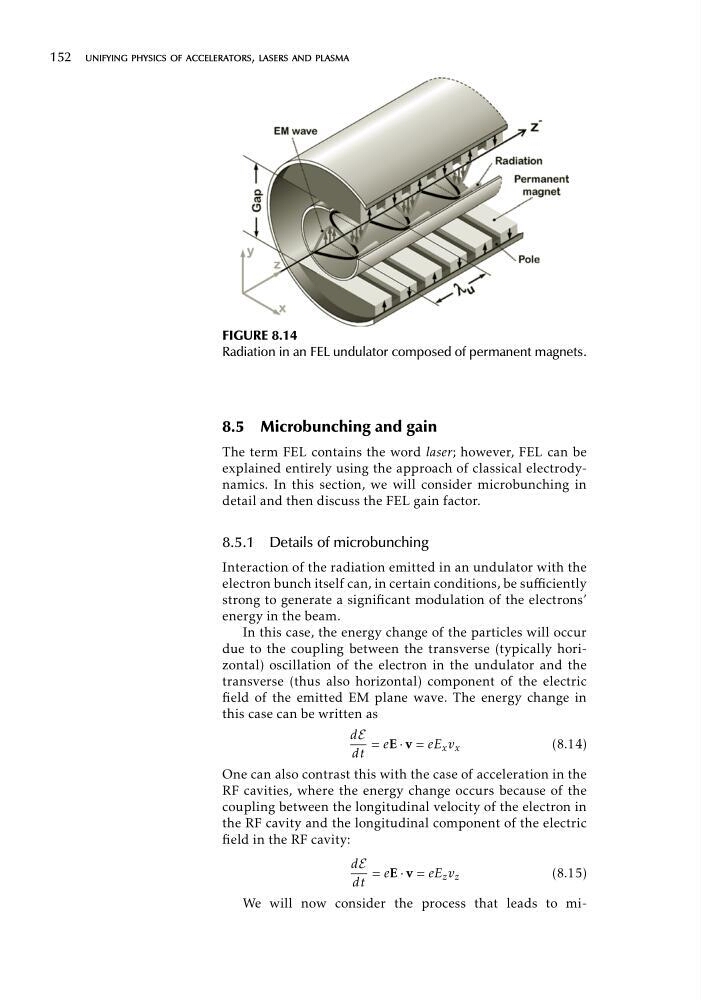
FIGURE 8.14
Radiation in an FEL undulator composed of permanent magnets.
8.5 Microbunching and gain
The term FEL contains the word laser; however, FEL can be
explained entirely using the approach of classical electrodynamics. In this section, we will consider microbunching in
detail and then discuss the FEL gain factor.
8.5.1 Details of microbunching
Interaction of the radiation emitted in an undulator with the
electron bunch itself can, in certain conditions, be sufficiently
strong to generate a significant modulation of the electrons’
energy in the beam.
In this case, the energy change of the particles will occur
due to the coupling between the transverse (typically horizontal) oscillation of the electron in the undulator and the
transverse (thus also horizontal) component of the electric
field of the emitted EM plane wave. The energy change in
this case can be written as
dE = eE · v = eE x v x
(8.14)
dt
One can also contrast this with the case of acceleration in the
RF cavities, where the energy change occurs because of the
coupling between the longitudinal velocity of the electron in
the RF cavity and the longitudinal component of the electric
field in the RF cavity:
dE = eE · v = eE z v z
(8.15)
dt
We will now consider the process that leads to mi
FIGURE 8.14
Radiation in an FEL undulator composed of permanent magnets.
8.5 Microbunching and gain
The term FEL contains the word laser; however, FEL can be
explained entirely using the approach of classical electrodynamics. In this section, we will consider microbunching in
detail and then discuss the FEL gain factor.
8.5.1 Details of microbunching
Interaction of the radiation emitted in an undulator with the
electron bunch itself can, in certain conditions, be sufficiently
strong to generate a significant modulation of the electrons’
energy in the beam.
In this case, the energy change of the particles will occur
due to the coupling between the transverse (typically horizontal) oscillation of the electron in the undulator and the
transverse (thus also horizontal) component of the electric
field of the emitted EM plane wave. The energy change in
this case can be written as
dE = eE · v = eE x v x
(8.14)
dt
One can also contrast this with the case of acceleration in the
RF cavities, where the energy change occurs because of the
coupling between the longitudinal velocity of the electron in
the RF cavity and the longitudinal component of the electric
field in the RF cavity:
dE = eE · v = eE z v z
(8.15)
dt
We will now consider the process that leads to mi