

free electron lasers 149
because v ⊥ 0. Therefore, if electrons have a transverse velocity, energy can be transferred between electrons and EM
wave — which is the principle FEL relies upon.
8.3.3 Resonance condition
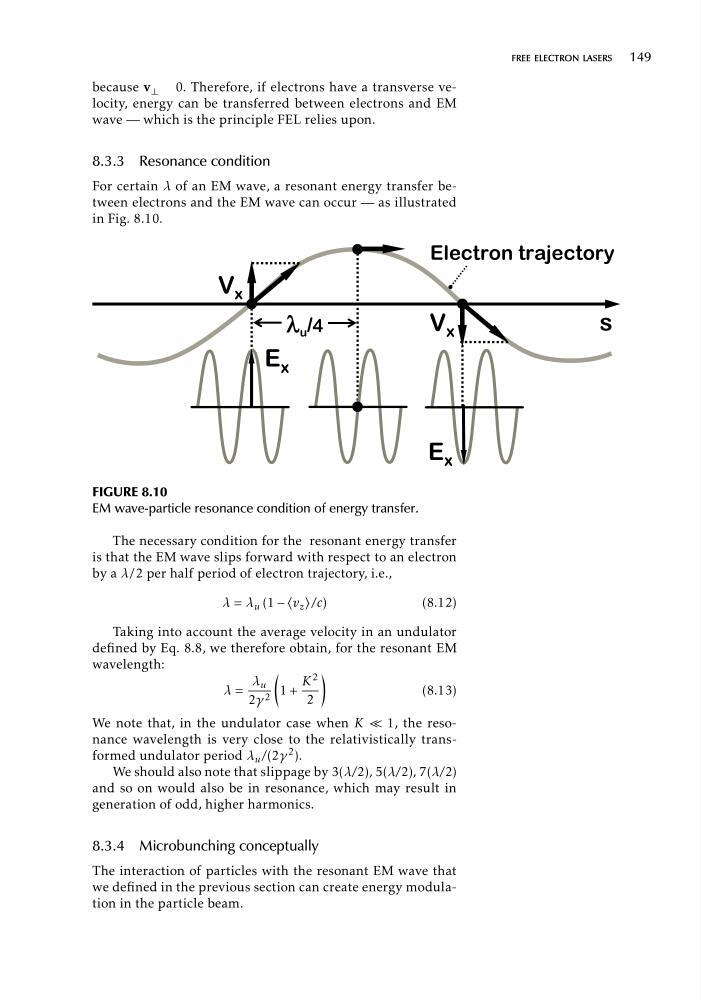
For certain λ of an EM wave, a resonant energy transfer between electrons and the EM wave can occur — as illustrated
in Fig. 8.10.
(OHFWURQWUDMHFWRU\
V
9 [
9 [
( [
( [
X
FIGURE 8.10
EM wave-particle resonance condition of energy transfer.
The necessary condition for the resonant energy transfer
is that the EM wave slips forward with respect to an electron
by a λ/2 per half period of electron trajectory, i.e.,
λ = λ u (1 − (v z ) /c)
(8.12)
Taking into account the average velocity in an undulator
defined by Eq. 8.8, we therefore obtain, for the resonant EM
wavelength:
(
)
K 2
λ u
λ =
1 +
(8.13)
2γ 2
2
We note that, in the undulator case when K « 1, the resonance wavelength is very close to the relativistically transformed undulator period λ u /(2γ 2 ).
We should also note that slippage by 3(λ/2), 5(λ/2), 7(λ/2)
and so on would also be in resonance, which may result in
generation of odd, higher harmonics.
8.3.4 Microbunching conceptually
The interaction of particles with the resonant EM wave that
we defined in the previous section can create energy modulation in the particle beam.
because v ⊥ 0. Therefore, if electrons have a transverse velocity, energy can be transferred between electrons and EM
wave — which is the principle FEL relies upon.
8.3.3 Resonance condition
For certain λ of an EM wave, a resonant energy transfer between electrons and the EM wave can occur — as illustrated
in Fig. 8.10.
(OHFWURQWUDMHFWRU\
V
9 [
9 [
( [
( [
X
FIGURE 8.10
EM wave-particle resonance condition of energy transfer.
The necessary condition for the resonant energy transfer
is that the EM wave slips forward with respect to an electron
by a λ/2 per half period of electron trajectory, i.e.,
λ = λ u (1 − (v z ) /c)
(8.12)
Taking into account the average velocity in an undulator
defined by Eq. 8.8, we therefore obtain, for the resonant EM
wavelength:
(
)
K 2
λ u
λ =
1 +
(8.13)
2γ 2
2
We note that, in the undulator case when K « 1, the resonance wavelength is very close to the relativistically transformed undulator period λ u /(2γ 2 ).
We should also note that slippage by 3(λ/2), 5(λ/2), 7(λ/2)
and so on would also be in resonance, which may result in
generation of odd, higher harmonics.
8.3.4 Microbunching conceptually
The interaction of particles with the resonant EM wave that
we defined in the previous section can create energy modulation in the particle beam.