

150 unifying physics of accelerators, lasers and plasma
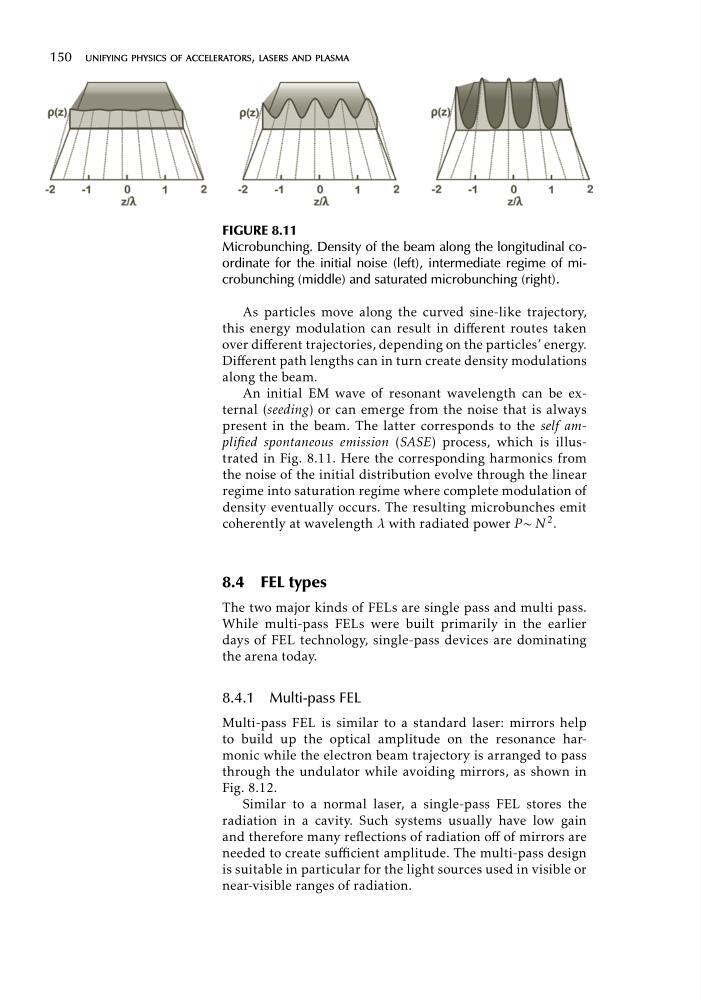
FIGURE 8.11
Microbunching. Density of the beam along the longitudinal coordinate for the initial noise (left), intermediate regime of microbunching (middle) and saturated microbunching (right).
As particles move along the curved sine-like trajectory,
this energy modulation can result in different routes taken
over different trajectories, depending on the particles’ energy.
Different path lengths can in turn create density modulations
along the beam.
An initial EM wave of resonant wavelength can be external (seeding) or can emerge from the noise that is always
present in the beam. The latter corresponds to the self amplified spontaneous emission (SASE) process, which is illustrated in Fig. 8.11. Here the corresponding harmonics from
the noise of the initial distribution evolve through the linear
regime into saturation regime where complete modulation of
density eventually occurs. The resulting microbunches emit
coherently at wavelength λ with radiated power P∼ N 2 .
8.4 FEL types
The two major kinds of FELs are single pass and multi pass.
While multi-pass FELs were built primarily in the earlier
days of FEL technology, single-pass devices are dominating
the arena today.
8.4.1 Multi-pass FEL
Multi-pass FEL is similar to a standard laser: mirrors help
to build up the optical amplitude on the resonance harmonic while the electron beam trajectory is arranged to pass
through the undulator while avoiding mirrors, as shown in
Fig. 8.12.
Similar to a normal laser, a single-pass FEL stores the
radiation in a cavity. Such systems usually have low gain
and therefore many reflections of radiation off of mirrors are
needed to create sufficient amplitude. The multi-pass design
is suitable in particular for the light sources used in visible or
near-visible ranges of radiation.
FIGURE 8.11
Microbunching. Density of the beam along the longitudinal coordinate for the initial noise (left), intermediate regime of microbunching (middle) and saturated microbunching (right).
As particles move along the curved sine-like trajectory,
this energy modulation can result in different routes taken
over different trajectories, depending on the particles’ energy.
Different path lengths can in turn create density modulations
along the beam.
An initial EM wave of resonant wavelength can be external (seeding) or can emerge from the noise that is always
present in the beam. The latter corresponds to the self amplified spontaneous emission (SASE) process, which is illustrated in Fig. 8.11. Here the corresponding harmonics from
the noise of the initial distribution evolve through the linear
regime into saturation regime where complete modulation of
density eventually occurs. The resulting microbunches emit
coherently at wavelength λ with radiated power P∼ N 2 .
8.4 FEL types
The two major kinds of FELs are single pass and multi pass.
While multi-pass FELs were built primarily in the earlier
days of FEL technology, single-pass devices are dominating
the arena today.
8.4.1 Multi-pass FEL
Multi-pass FEL is similar to a standard laser: mirrors help
to build up the optical amplitude on the resonance harmonic while the electron beam trajectory is arranged to pass
through the undulator while avoiding mirrors, as shown in
Fig. 8.12.
Similar to a normal laser, a single-pass FEL stores the
radiation in a cavity. Such systems usually have low gain
and therefore many reflections of radiation off of mirrors are
needed to create sufficient amplitude. The multi-pass design
is suitable in particular for the light sources used in visible or
near-visible ranges of radiation.