

148 unifying physics of accelerators, lasers and plasma
For the sine-like trajectory that we parametrized above, the
transverse velocity is given by
(
)
K
2π z
v x = β c sin
(8.6)
γ
λ u
In the second-order approximation, the longitudinal velocity
can be written as follows
(
)
2
1 v x
v z ≈ β c 1−
(8.7)
β 2 c 2
2
and therefore the average longitudinal velocity can be expressed as
(
(
))
1
K 2
(v z ) ≈ c 1−
1 +
(8.8)
2γ 2
2
We can see that, in comparison with free space, there is an
additional longitudinal retardation, which is due to the transverse velocity in an undulator. This retardation is equal to
K 2
c
(8.9)
4 γ 2
and is determined by the undulator parameter.
8.3.2 Particle and field energy exchange
Energy exchange between an EM wave and electron depends
on the electric field and velocity:
dW = e E · v
(8.10)
dt
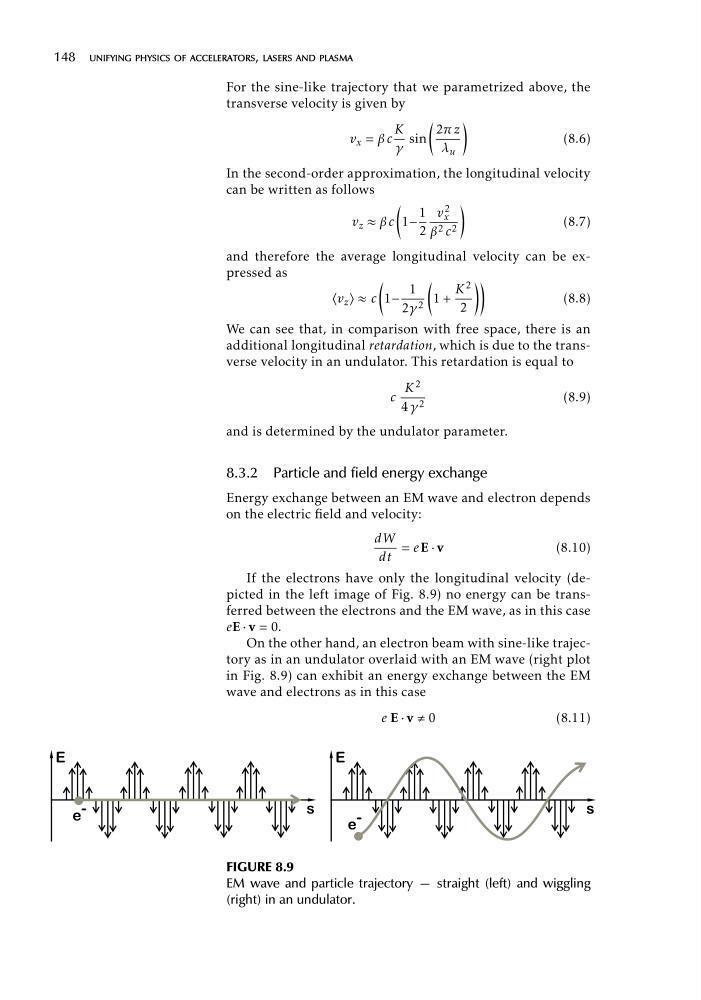
If the electrons have only the longitudinal velocity (depicted in the left image of Fig. 8.9) no energy can be transferred between the electrons and the EM wave, as in this case
eE · v = 0.
On the other hand, an electron beam with sine-like trajectory as in an undulator overlaid with an EM wave (right plot
in Fig. 8.9) can exhibit an energy exchange between the EM
wave and electrons as in this case
e E · v 0
(8.11)
FIGURE 8.9
EM wave and particle trajectory — straight (left) and wiggling
(right) in an undulator.
For the sine-like trajectory that we parametrized above, the
transverse velocity is given by
(
)
K
2π z
v x = β c sin
(8.6)
γ
λ u
In the second-order approximation, the longitudinal velocity
can be written as follows
(
)
2
1 v x
v z ≈ β c 1−
(8.7)
β 2 c 2
2
and therefore the average longitudinal velocity can be expressed as
(
(
))
1
K 2
(v z ) ≈ c 1−
1 +
(8.8)
2γ 2
2
We can see that, in comparison with free space, there is an
additional longitudinal retardation, which is due to the transverse velocity in an undulator. This retardation is equal to
K 2
c
(8.9)
4 γ 2
and is determined by the undulator parameter.
8.3.2 Particle and field energy exchange
Energy exchange between an EM wave and electron depends
on the electric field and velocity:
dW = e E · v
(8.10)
dt
If the electrons have only the longitudinal velocity (depicted in the left image of Fig. 8.9) no energy can be transferred between the electrons and the EM wave, as in this case
eE · v = 0.
On the other hand, an electron beam with sine-like trajectory as in an undulator overlaid with an EM wave (right plot
in Fig. 8.9) can exhibit an energy exchange between the EM
wave and electrons as in this case
e E · v 0
(8.11)
FIGURE 8.9
EM wave and particle trajectory — straight (left) and wiggling
(right) in an undulator.