

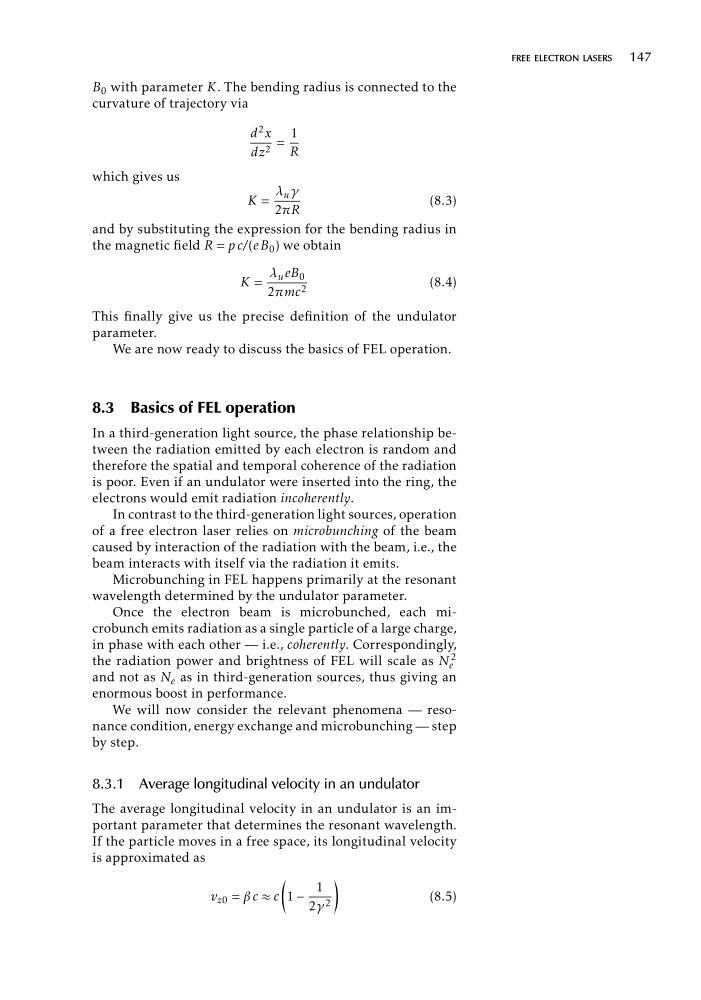
B 0 with parameter K. The bending radius is connected to the
curvature of trajectory via
d x 1
=
dz 2 R
which gives us
λ u γ
K =
(8.3)
2πR
and by substituting the expression for the bending radius in
the magnetic field R = p c/(e B 0 ) we obtain
λ u eB 0
K =
(8.4)
2πmc 2
2
This finally give us the precise definition of the undulator
parameter.
We are now ready to discuss the basics of FEL operation.
8.3 Basics of FEL operation
In a third-generation light source, the phase relationship between the radiation emitted by each electron is random and
therefore the spatial and temporal coherence of the radiation
is poor. Even if an undulator were inserted into the ring, the
electrons would emit radiation incoherently.
In contrast to the third-generation light sources, operation
of a free electron laser relies on microbunching of the beam
caused by interaction of the radiation with the beam, i.e., the
beam interacts with itself via the radiation it emits.
Microbunching in FEL happens primarily at the resonant
wavelength determined by the undulator parameter.
Once the electron beam is microbunched, each microbunch emits radiation as a single particle of a large charge,
in phase with each other — i.e., coherently. Correspondingly,
the radiation power and brightness of FEL will scale as N 2
e
and not as N e as in third-generation sources, thus giving an
enormous boost in performance.
We will now consider the relevant phenomena — resonance condition, energy exchange and microbunching — step
by step.
8.3.1 Average longitudinal velocity in an undulator
The average longitudinal velocity in an undulator is an important parameter that determines the resonant wavelength.
If the particle moves in a free space, its longitudinal velocity
is approximated as
(
)
1
v z0 = β c ≈ c 1 −
(8.5)
2γ 2
free electron lasers 147
curvature of trajectory via
d x 1
=
dz 2 R
which gives us
λ u γ
K =
(8.3)
2πR
and by substituting the expression for the bending radius in
the magnetic field R = p c/(e B 0 ) we obtain
λ u eB 0
K =
(8.4)
2πmc 2
2
This finally give us the precise definition of the undulator
parameter.
We are now ready to discuss the basics of FEL operation.
8.3 Basics of FEL operation
In a third-generation light source, the phase relationship between the radiation emitted by each electron is random and
therefore the spatial and temporal coherence of the radiation
is poor. Even if an undulator were inserted into the ring, the
electrons would emit radiation incoherently.
In contrast to the third-generation light sources, operation
of a free electron laser relies on microbunching of the beam
caused by interaction of the radiation with the beam, i.e., the
beam interacts with itself via the radiation it emits.
Microbunching in FEL happens primarily at the resonant
wavelength determined by the undulator parameter.
Once the electron beam is microbunched, each microbunch emits radiation as a single particle of a large charge,
in phase with each other — i.e., coherently. Correspondingly,
the radiation power and brightness of FEL will scale as N 2
e
and not as N e as in third-generation sources, thus giving an
enormous boost in performance.
We will now consider the relevant phenomena — resonance condition, energy exchange and microbunching — step
by step.
8.3.1 Average longitudinal velocity in an undulator
The average longitudinal velocity in an undulator is an important parameter that determines the resonant wavelength.
If the particle moves in a free space, its longitudinal velocity
is approximated as
(
)
1
v z0 = β c ≈ c 1 −
(8.5)
2γ 2
free electron lasers 147