

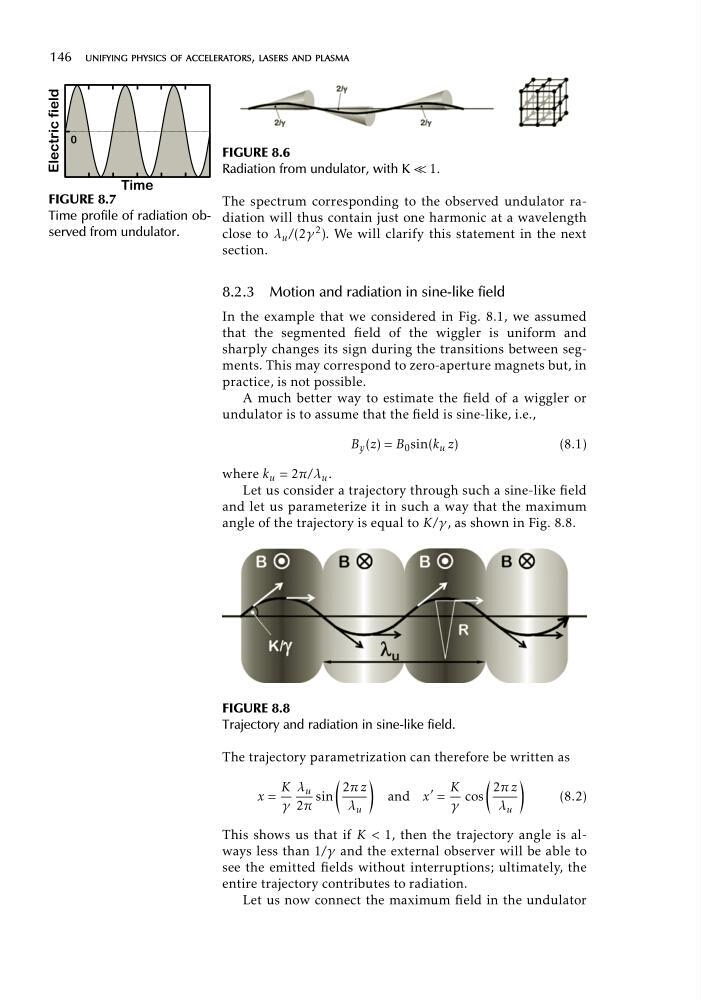
GURE 8.6
adiation from undulator, with K 1.
FI
R
«
FIGURE 8.7
Time profile of radiation ob-
served from undulator.
The spectrum corresponding to the observed undulator radiation will thus contain just one harmonic at a wavelength
close to λ u /(2γ 2 ). We will clarify this statement in the next
section.
8.2.3 Motion and radiation in sine-like field
In the example that we considered in Fig. 8.1, we assumed
that the segmented field of the wiggler is uniform and
sharply changes its sign during the transitions between segments. This may correspond to zero-aperture magnets but, in
practice, is not possible.
A much better way to estimate the field of a wiggler or
undulator is to assume that the field is sine-like, i.e.,
B y (z) = B 0 sin(k u z)
(8.1)
where k u = 2π/λ u .
Let us consider a trajectory through such a sine-like field
and let us parameterize it in such a way that the maximum
angle of the trajectory is equal to K/γ, as shown in Fig. 8.8.
FIGURE 8.8
Trajectory and radiation in sine-like field.
The trajectory parametrization can therefore be written as
K λ
2π z
K
2π z
x =
u sin
(
)
and x
' = cos
(
)
(8.2)
γ 2π
λ u
γ
λ u
This shows us that if K < 1, then the trajectory angle is always less than 1/γ and the external observer will be able to
see the emitted fields without interruptions; ultimately, the
entire trajectory contributes to radiation.
Let us now connect the maximum field in the undulator
146 unifying physics of accelerators, lasers and plasma
adiation from undulator, with K 1.
FI
R
«
FIGURE 8.7
Time profile of radiation ob-
served from undulator.
The spectrum corresponding to the observed undulator radiation will thus contain just one harmonic at a wavelength
close to λ u /(2γ 2 ). We will clarify this statement in the next
section.
8.2.3 Motion and radiation in sine-like field
In the example that we considered in Fig. 8.1, we assumed
that the segmented field of the wiggler is uniform and
sharply changes its sign during the transitions between segments. This may correspond to zero-aperture magnets but, in
practice, is not possible.
A much better way to estimate the field of a wiggler or
undulator is to assume that the field is sine-like, i.e.,
B y (z) = B 0 sin(k u z)
(8.1)
where k u = 2π/λ u .
Let us consider a trajectory through such a sine-like field
and let us parameterize it in such a way that the maximum
angle of the trajectory is equal to K/γ, as shown in Fig. 8.8.
FIGURE 8.8
Trajectory and radiation in sine-like field.
The trajectory parametrization can therefore be written as
K λ
2π z
K
2π z
x =
u sin
(
)
and x
' = cos
(
)
(8.2)
γ 2π
λ u
γ
λ u
This shows us that if K < 1, then the trajectory angle is always less than 1/γ and the external observer will be able to
see the emitted fields without interruptions; ultimately, the
entire trajectory contributes to radiation.
Let us now connect the maximum field in the undulator
146 unifying physics of accelerators, lasers and plasma