

DX
:
DX
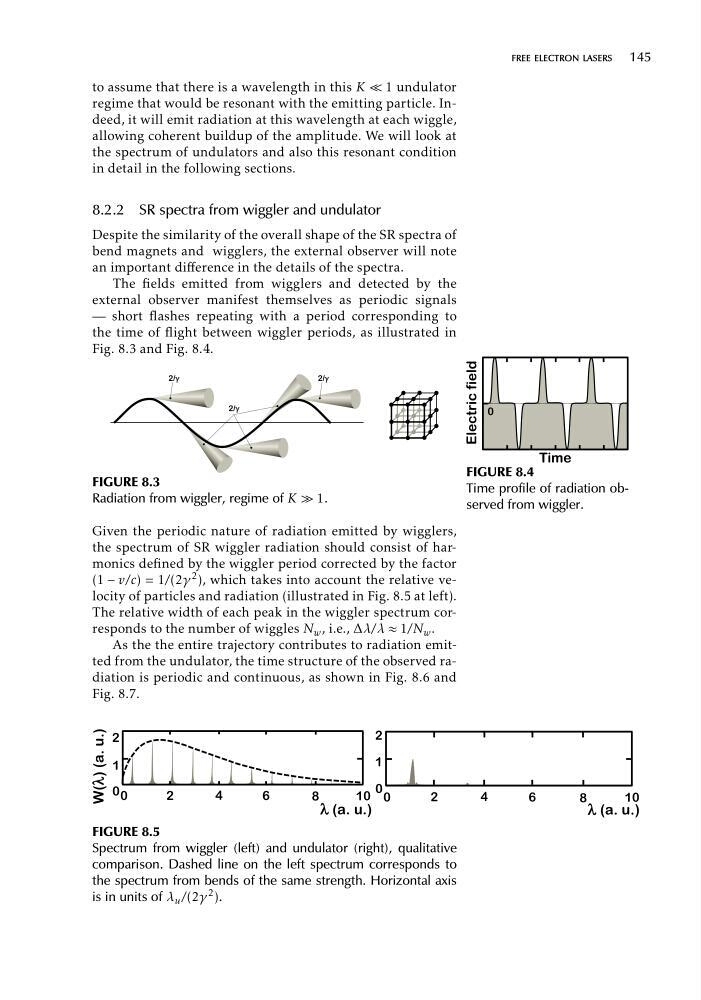
FIGURE 8.5
Spectrum from wiggler (left) and undulator (right), qualitative
comparison. Dashed line on the left spectrum corresponds to
the spectrum from bends of the same strength. Horizontal axis
is in units of λ u /(2γ 2 ).
DX
free electron lasers 145
to assume that there is a wavelength in this K « 1 undulator
regime that would be resonant with the emitting particle. Indeed, it will emit radiation at this wavelength at each wiggle,
allowing coherent buildup of the amplitude. We will look at
the spectrum of undulators and also this resonant condition
in detail in the following sections.
8.2.2
Despite the similarity of the overall shape of the SR spectra of
bend magnets and wigglers, the external observer will note
an important difference in the details of the spectra.
The fields emitted from wigglers and detected by the
external observer manifest themselves as periodic signals
— short flashes repeating with a period corresponding to
the time of flight between wiggler periods, as illustrated in
Fig. 8.3 and Fig. 8.4.
FIGURE 8.3
Radiation from wiggler, regime of K » 1.
Given the periodic nature of radiation emitted by wigglers,
the spectrum of SR wiggler radiation should consist of harmonics defined by the wiggler period corrected by the factor
(1 − v/c) = 1/(2γ 2 ), which takes into account the relative velocity of particles and radiation (illustrated in Fig. 8.5 at left).
The relative width of each peak in the wiggler spectrum corresponds to the number of wiggles N w , i.e., Δλ/λ 1/N w .
As the the entire trajectory contributes to radia
≈
tion emitted from the undulator, the time structure of the observed radiation is periodic and continuous, as shown in Fig. 8.6 and
Fig. 8.7.
SR spectra from wiggler and undulator
FIGURE 8.4
Time profile of radiation observed from wiggler.
:
DX
FIGURE 8.5
Spectrum from wiggler (left) and undulator (right), qualitative
comparison. Dashed line on the left spectrum corresponds to
the spectrum from bends of the same strength. Horizontal axis
is in units of λ u /(2γ 2 ).
DX
free electron lasers 145
to assume that there is a wavelength in this K « 1 undulator
regime that would be resonant with the emitting particle. Indeed, it will emit radiation at this wavelength at each wiggle,
allowing coherent buildup of the amplitude. We will look at
the spectrum of undulators and also this resonant condition
in detail in the following sections.
8.2.2
Despite the similarity of the overall shape of the SR spectra of
bend magnets and wigglers, the external observer will note
an important difference in the details of the spectra.
The fields emitted from wigglers and detected by the
external observer manifest themselves as periodic signals
— short flashes repeating with a period corresponding to
the time of flight between wiggler periods, as illustrated in
Fig. 8.3 and Fig. 8.4.
FIGURE 8.3
Radiation from wiggler, regime of K » 1.
Given the periodic nature of radiation emitted by wigglers,
the spectrum of SR wiggler radiation should consist of harmonics defined by the wiggler period corrected by the factor
(1 − v/c) = 1/(2γ 2 ), which takes into account the relative velocity of particles and radiation (illustrated in Fig. 8.5 at left).
The relative width of each peak in the wiggler spectrum corresponds to the number of wiggles N w , i.e., Δλ/λ 1/N w .
As the the entire trajectory contributes to radia
≈
tion emitted from the undulator, the time structure of the observed radiation is periodic and continuous, as shown in Fig. 8.6 and
Fig. 8.7.
SR spectra from wiggler and undulator
FIGURE 8.4
Time profile of radiation observed from wiggler.