

144 unifying physics of accelerators, lasers and plasma
8.2 SR from bends, wigglers and undulators
We started our discussion of FELs in Chapter 3, where we approached radiation from wigglers and undulators and compared them to radiation from bending magnets. We recall
that, for relativistic electrons with γ » 1, the emitted phoRecall that γ 3 dependence of tons go into 1/γ cone and, if the radius of the curvature of
ω c is due to the length of the trajectory in the magnetic field is R, then the external obthe emitting arc (∝ 1/γ) and server will see the photons emitted during the particle travel
photon and particle velocity along the arc 2R/γ. This allowed us to estimate the characterdifference (v − c ∝ 1/γ 2 ).
istic frequency of SR as ω c = 1.5c γ 3 /R.
We also recall that the extra factor of γ 2 appears in this
formula for ω c due to the difference between the speed of
photons c and the speed of particles v, estimated as (1−v/c) =
1/(2 γ 2 ). Knowledge of the characteristic frequency allows
us to determine the spectral characteristic of the SR emitted
from the bending magnets.
8.2.1 Radiation from sequence of bends
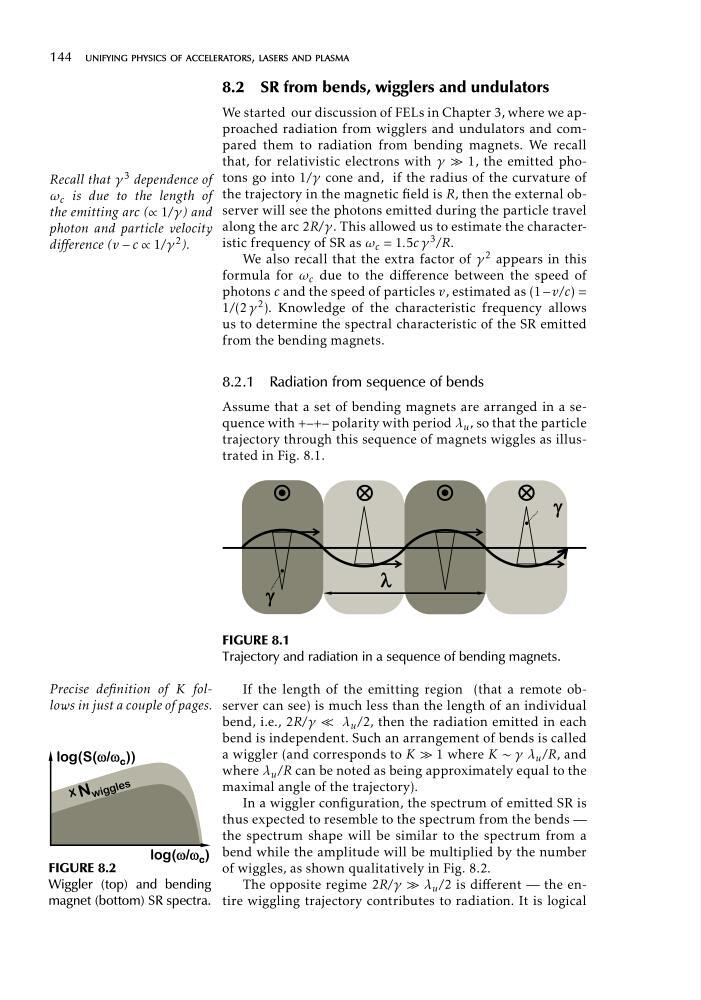
Assume that a set of bending magnets are arranged in a sequence with +–+– polarity with period λ u , so that the particle
trajectory through this sequence of magnets wiggles as illustrated in Fig. 8.1.
%
%
%
%
5
5
5
5
X
FIGURE 8.1
Trajectory and radiation in a sequence of bending magnets.
Precise definition of K follows in just a couple of pages.
ORJ6
ORJ
FIGURE 8.2
Wiggler (top) and bending
magnet (bottom) SR spectra.
If the length of the emitting region (that a remote observer can see) is much less than the length of an individual
bend, i.e., 2R/γ « λ u /2, then the radiation emitted in each
bend is independent. Such an arrangement of bends is called
a wiggler (and corresponds to K
1 where K γ λ u /R, and
where
»
∼
λ u /R can be noted as being approximately equal to the
maximal angle of the trajectory).
In a wiggler configuration, the spectrum of emitted SR is
thus expected to resemble to the spectrum from the bends —
the spectrum shape will be similar to the spectrum from a
bend while the amplitude will be multiplied by the number
of wiggles, as shown qualitatively in Fig. 8.2.
The opposite regime 2R/γ » λ u /2 is different — the entire wiggling trajectory contributes to radiation. It is logical
8.2 SR from bends, wigglers and undulators
We started our discussion of FELs in Chapter 3, where we approached radiation from wigglers and undulators and compared them to radiation from bending magnets. We recall
that, for relativistic electrons with γ » 1, the emitted phoRecall that γ 3 dependence of tons go into 1/γ cone and, if the radius of the curvature of
ω c is due to the length of the trajectory in the magnetic field is R, then the external obthe emitting arc (∝ 1/γ) and server will see the photons emitted during the particle travel
photon and particle velocity along the arc 2R/γ. This allowed us to estimate the characterdifference (v − c ∝ 1/γ 2 ).
istic frequency of SR as ω c = 1.5c γ 3 /R.
We also recall that the extra factor of γ 2 appears in this
formula for ω c due to the difference between the speed of
photons c and the speed of particles v, estimated as (1−v/c) =
1/(2 γ 2 ). Knowledge of the characteristic frequency allows
us to determine the spectral characteristic of the SR emitted
from the bending magnets.
8.2.1 Radiation from sequence of bends
Assume that a set of bending magnets are arranged in a sequence with +–+– polarity with period λ u , so that the particle
trajectory through this sequence of magnets wiggles as illustrated in Fig. 8.1.
%
%
%
%
5
5
5
5
X
FIGURE 8.1
Trajectory and radiation in a sequence of bending magnets.
Precise definition of K follows in just a couple of pages.
ORJ6
ORJ
FIGURE 8.2
Wiggler (top) and bending
magnet (bottom) SR spectra.
If the length of the emitting region (that a remote observer can see) is much less than the length of an individual
bend, i.e., 2R/γ « λ u /2, then the radiation emitted in each
bend is independent. Such an arrangement of bends is called
a wiggler (and corresponds to K
1 where K γ λ u /R, and
where
»
∼
λ u /R can be noted as being approximately equal to the
maximal angle of the trajectory).
In a wiggler configuration, the spectrum of emitted SR is
thus expected to resemble to the spectrum from the bends —
the spectrum shape will be similar to the spectrum from a
bend while the amplitude will be multiplied by the number
of wiggles, as shown qualitatively in Fig. 8.2.
The opposite regime 2R/γ » λ u /2 is different — the entire wiggling trajectory contributes to radiation. It is logical