

light sources 139
In the above, N e and N γ are the numbers of electrons and
photons in the colliding bunches and f is the repetition frequency of collisions. The beam sizes in Eq. 7.10 are the convolution of electron and photon beam sizes:
)
σ = σ e
2 + σ γ
2
(7.11)
The above equations help us to estimate the rate of X-ray production as
dN γ = σ tot L
(7.12)
dt
In relativistic approximation γ » 1, the expression for the
final frequency of Compton scattered photons is given by the
following equation
2γ 2 ω i (1 − cosφ 1 )
ω f ≈
(7.13)
1 + (γφ 2 )
2 + 2γ
ω i (1 − cosφ 1 )
m e
which identifies the following characteristics of Compton
scattering. There is a clear dependence between scattered
photon energy and its angle — this can be useful for the
selection of monochromatic beam with help of collimation.
The majority of the X-ray flux is emitted into a cone with
an opening angle of 4/γ. The photons of maximum energy
ω c = 4 ω i γ 2 come from a head-on collision (ϕ 1 = π), while
the photons of half-maximum energy come from a ϕ 1 = π/2
collision.
The equations and dependencies defined above aid us in
estimating basic parameters of Compton-based light sources.
Let us now consider the design of such light sources and their
typical characteristics.
7.5 Compton light sources
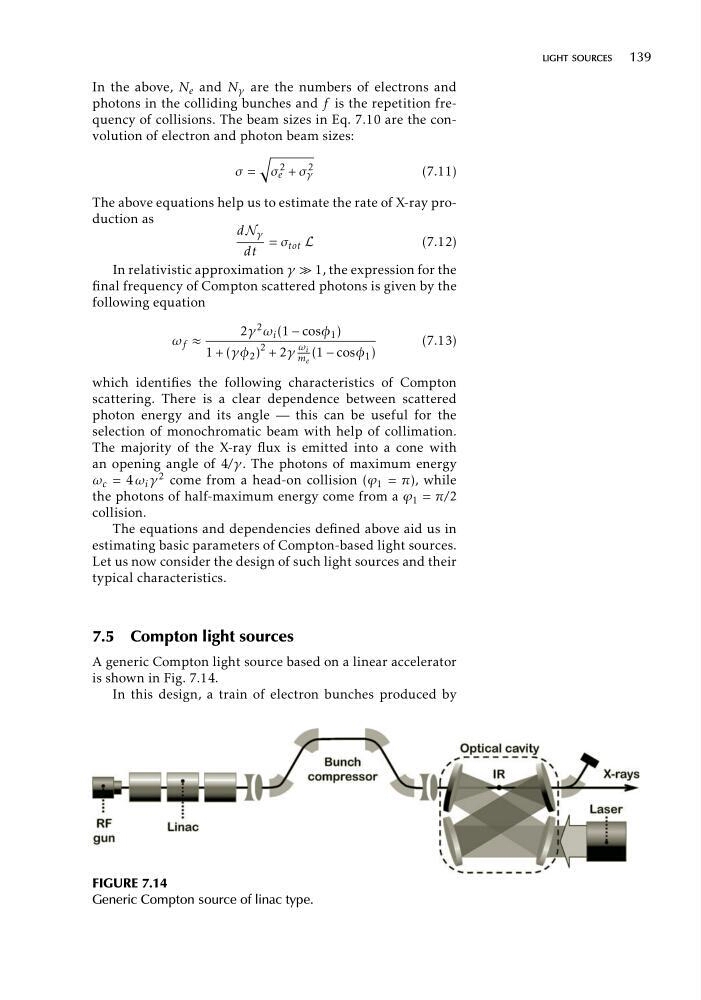
A generic Compton light source based on a linear accelerator
is shown in Fig. 7.14.
In this design, a train of electron bunches produced by
FIGURE 7.14
Generic Compton source of linac type.
In the above, N e and N γ are the numbers of electrons and
photons in the colliding bunches and f is the repetition frequency of collisions. The beam sizes in Eq. 7.10 are the convolution of electron and photon beam sizes:
)
σ = σ e
2 + σ γ
2
(7.11)
The above equations help us to estimate the rate of X-ray production as
dN γ = σ tot L
(7.12)
dt
In relativistic approximation γ » 1, the expression for the
final frequency of Compton scattered photons is given by the
following equation
2γ 2 ω i (1 − cosφ 1 )
ω f ≈
(7.13)
1 + (γφ 2 )
2 + 2γ
ω i (1 − cosφ 1 )
m e
which identifies the following characteristics of Compton
scattering. There is a clear dependence between scattered
photon energy and its angle — this can be useful for the
selection of monochromatic beam with help of collimation.
The majority of the X-ray flux is emitted into a cone with
an opening angle of 4/γ. The photons of maximum energy
ω c = 4 ω i γ 2 come from a head-on collision (ϕ 1 = π), while
the photons of half-maximum energy come from a ϕ 1 = π/2
collision.
The equations and dependencies defined above aid us in
estimating basic parameters of Compton-based light sources.
Let us now consider the design of such light sources and their
typical characteristics.
7.5 Compton light sources
A generic Compton light source based on a linear accelerator
is shown in Fig. 7.14.
In this design, a train of electron bunches produced by
FIGURE 7.14
Generic Compton source of linac type.