

138 unifying physics of accelerators, lasers and plasma
where the parameters are defined as follows:
ω i
ω f
1 1
x 1 =2γ
(1−β cos φ 1 ) ; x 2 = −2γ
(1−β cos φ 2 ) ; y = +
m
m
x x
e
e
1
2
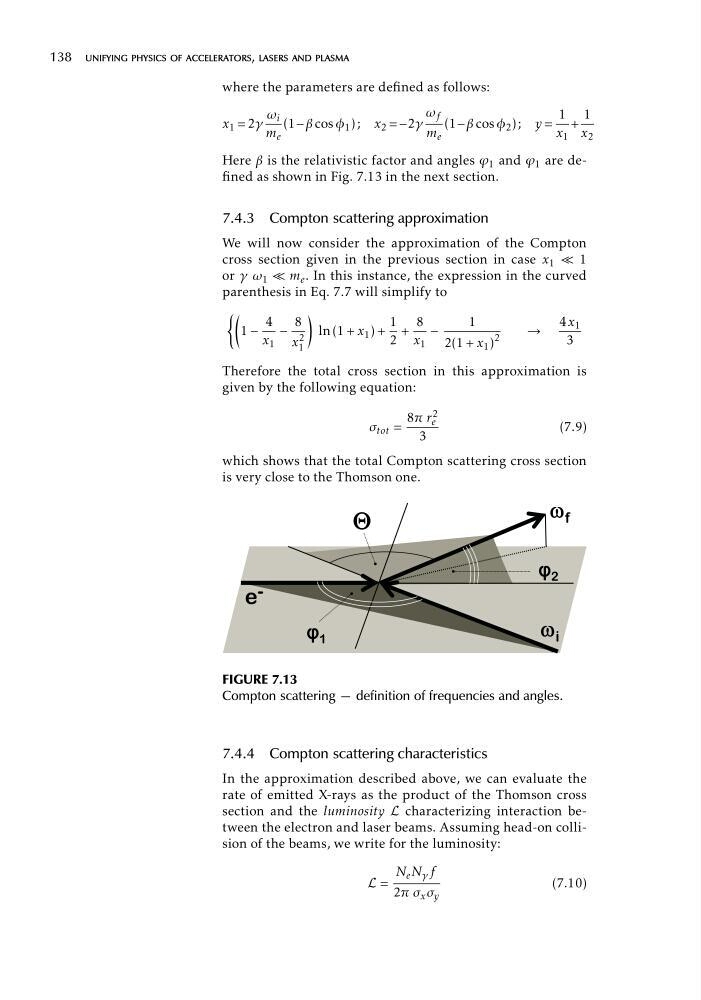
Here β is the relativistic factor and angles ϕ 1 and ϕ 1 are defined as shown in Fig. 7.13 in the next section.
7.4.3 Compton scattering approximation
We will now consider the approximation of the Compton
cross section given in the previous section in case x 1 « 1
or γ ω 1 « m . In this instance, the expression in the curved
e
parenthesis in Eq. 7.7 will simplify to
(
)
4
8
1 8
1
4 x 1
1 −
− 2 ln (1 + x 1 ) + +
−
→
x 1 x
2 x 1 2(1 + x 1 )
2
3
1
Therefore the total cross section in this approximation is
given by the following equation:
8π r 2
e
σ tot =
(7.9)
3
which shows that the total Compton scattering cross section
is very close to the Thomson one.
H
I
L
FIGURE 7.13
Compton scattering — definition of frequencies and angles.
7.4.4 Compton scattering characteristics
In the approximation described above, we can evaluate the
rate of emitted X-rays as the product of the Thomson cross
section and the luminosity L characterizing interaction between the electron and laser beams. Assuming head-on collision of the beams, we write for the luminosity:
N e N γ f
L =
(7.10)
2π σ σ
x y
where the parameters are defined as follows:
ω i
ω f
1 1
x 1 =2γ
(1−β cos φ 1 ) ; x 2 = −2γ
(1−β cos φ 2 ) ; y = +
m
m
x x
e
e
1
2
Here β is the relativistic factor and angles ϕ 1 and ϕ 1 are defined as shown in Fig. 7.13 in the next section.
7.4.3 Compton scattering approximation
We will now consider the approximation of the Compton
cross section given in the previous section in case x 1 « 1
or γ ω 1 « m . In this instance, the expression in the curved
e
parenthesis in Eq. 7.7 will simplify to
(
)
4
8
1 8
1
4 x 1
1 −
− 2 ln (1 + x 1 ) + +
−
→
x 1 x
2 x 1 2(1 + x 1 )
2
3
1
Therefore the total cross section in this approximation is
given by the following equation:
8π r 2
e
σ tot =
(7.9)
3
which shows that the total Compton scattering cross section
is very close to the Thomson one.
H
I
L
FIGURE 7.13
Compton scattering — definition of frequencies and angles.
7.4.4 Compton scattering characteristics
In the approximation described above, we can evaluate the
rate of emitted X-rays as the product of the Thomson cross
section and the luminosity L characterizing interaction between the electron and laser beams. Assuming head-on collision of the beams, we write for the luminosity:
N e N γ f
L =
(7.10)
2π σ σ
x y