

light sources 137
In the approximation of small angles and relativistic electrons (see Fig. 7.11), the wavelength of the photon after
Compton backscattering is described by the following equation:
λ 2 = λ 1 1 + θ
2 2
γ / 4
2
γ
(7.4)
As we can see from Eq. 7.4, in the case of relativistic
electrons, the photon gains considerable energy after interaction: its wavelength is shortened by the factor of 4γ 2 . Let’s
consider two examples in the case of green light with λ 1 = Green laser (532 nm) scat532 nm (corresponding photon energy is 2.33 eV). If the to- tered from an 18.6 MeV electal electron energy is 5.11 MeV (γ = 10) then λ 2 = 1.33 nm tron beam turns into X-rays
(equivalent to 0.93 keV energy of the photons). For a slightly with 0.1 nm wavelength.
larger energy of electrons of 18.6 MeV (γ = 36.5) the scattered wavelength would reach an angstrom: λ 2 = 0.1 nm (or
12.4 keV).
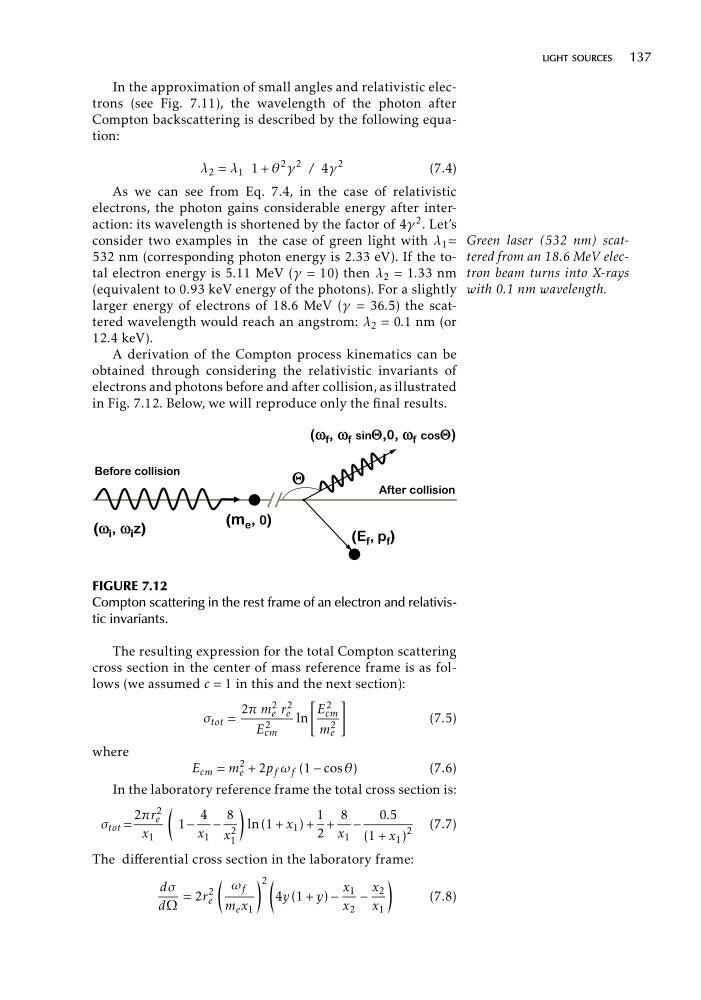
A derivation of the Compton process kinematics can be
obtained through considering the relativistic invariants of
electrons and photons before and after collision, as illustrated
in Fig. 7.12. Below, we will reproduce only the final results.
VLQ
I I
FRV
I
%HIRUHFROOLVLRQ
$IWHUFROOLVLRQ
P H
]
( I S I
FIGURE 7.12
Compton scattering in the rest frame of an electron and relativistic invariants.
The resulting expression for the total Compton scattering
cross section in the center of mass reference frame is as follows (we assumed c = 1 in this and the next section):
2π m 2 r 2 r
E 2
e e
σ
cm
tot =
ln
1
(7.5)
2
2
E cm
m e
where
2
E cm = m e + 2p f ω f (1 − cos θ)
(7.6)
In the laboratory reference frame the total cross section is:
2πr 2
e
(
4 8
)
1 8
0.5
σ tot =
1− −
ln (1 + x 1 ) + +
(7.7)
x
x
2
1
1 x
2 x 1
−
(1 + x
2
1
1 )
The differential cross section in the laboratory frame:
(
) 2
dσ
ω
2
f
r
(
x
x
= 2 e
4y (1 +
1
y) −
−
2
)
(7.8)
dΩ
m e x 1
x 2 x 1
In the approximation of small angles and relativistic electrons (see Fig. 7.11), the wavelength of the photon after
Compton backscattering is described by the following equation:
λ 2 = λ 1 1 + θ
2 2
γ / 4
2
γ
(7.4)
As we can see from Eq. 7.4, in the case of relativistic
electrons, the photon gains considerable energy after interaction: its wavelength is shortened by the factor of 4γ 2 . Let’s
consider two examples in the case of green light with λ 1 = Green laser (532 nm) scat532 nm (corresponding photon energy is 2.33 eV). If the to- tered from an 18.6 MeV electal electron energy is 5.11 MeV (γ = 10) then λ 2 = 1.33 nm tron beam turns into X-rays
(equivalent to 0.93 keV energy of the photons). For a slightly with 0.1 nm wavelength.
larger energy of electrons of 18.6 MeV (γ = 36.5) the scattered wavelength would reach an angstrom: λ 2 = 0.1 nm (or
12.4 keV).
A derivation of the Compton process kinematics can be
obtained through considering the relativistic invariants of
electrons and photons before and after collision, as illustrated
in Fig. 7.12. Below, we will reproduce only the final results.
VLQ
I I
FRV
I
%HIRUHFROOLVLRQ
$IWHUFROOLVLRQ
P H
]
( I S I
FIGURE 7.12
Compton scattering in the rest frame of an electron and relativistic invariants.
The resulting expression for the total Compton scattering
cross section in the center of mass reference frame is as follows (we assumed c = 1 in this and the next section):
2π m 2 r 2 r
E 2
e e
σ
cm
tot =
ln
1
(7.5)
2
2
E cm
m e
where
2
E cm = m e + 2p f ω f (1 − cos θ)
(7.6)
In the laboratory reference frame the total cross section is:
2πr 2
e
(
4 8
)
1 8
0.5
σ tot =
1− −
ln (1 + x 1 ) + +
(7.7)
x
x
2
1
1 x
2 x 1
−
(1 + x
2
1
1 )
The differential cross section in the laboratory frame:
(
) 2
dσ
ω
2
f
r
(
x
x
= 2 e
4y (1 +
1
y) −
−
2
)
(7.8)
dΩ
m e x 1
x 2 x 1