

( PF
H
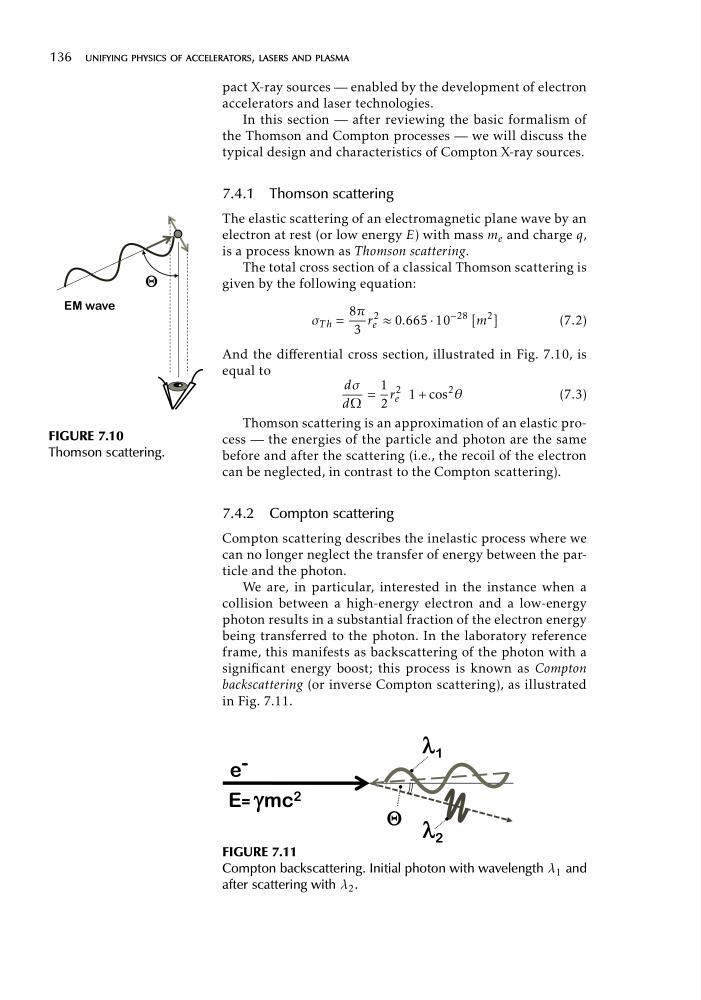
FIGURE 7.11
Compton backscattering. Initial photon with wavelength λ 1 and
after scattering with λ 2 .
(0ZDYH
FIGURE 7.10
Thomson scattering.
136 unifying physics of accelerators, lasers and plasma
pact X-ray sources — enabled by the development of electron
accelerators and laser technologies.
In this section — after reviewing the basic formalism of
the Thomson and Compton processes — we will discuss the
typical design and characteristics of Compton X-ray sources.
7.4.1 Thomson scattering
The elastic scattering of an electromagnetic plane wave by an
electron at rest (or low energy E) with mass m e and charge q,
is a process known as Thomson scattering.
The total cross section of a classical Thomson scattering is
given by the following equation:
2
σ T h =
8π r e ≈ 0.665 · 10
−28 [m
2 ]
(7.2)
3
And the differential cross section, illustrated in Fig. 7.10, is
equal to
2
dσ =
1 r 1 + cos
2 θ
(7.3)
e
dΩ 2
Thomson scattering is an approximation of an elastic process — the energies of the particle and photon are the same
before and after the scattering (i.e., the recoil of the electron
can be neglected, in contrast to the Compton scattering).
7.4.2 Compton scattering
Compton scattering describes the inelastic process where we
can no longer neglect the transfer of energy between the particle and the photon.
We are, in particular, interested in the instance when a
collision between a high-energy electron and a low-energy
photon results in a substantial fraction of the electron energy
being transferred to the photon. In the laboratory reference
frame, this manifests as backscattering of the photon with a
significant energy boost; this process is known as Compton
backscattering (or inverse Compton scattering), as illustrated
in Fig. 7.11.
H
FIGURE 7.11
Compton backscattering. Initial photon with wavelength λ 1 and
after scattering with λ 2 .
(0ZDYH
FIGURE 7.10
Thomson scattering.
136 unifying physics of accelerators, lasers and plasma
pact X-ray sources — enabled by the development of electron
accelerators and laser technologies.
In this section — after reviewing the basic formalism of
the Thomson and Compton processes — we will discuss the
typical design and characteristics of Compton X-ray sources.
7.4.1 Thomson scattering
The elastic scattering of an electromagnetic plane wave by an
electron at rest (or low energy E) with mass m e and charge q,
is a process known as Thomson scattering.
The total cross section of a classical Thomson scattering is
given by the following equation:
2
σ T h =
8π r e ≈ 0.665 · 10
−28 [m
2 ]
(7.2)
3
And the differential cross section, illustrated in Fig. 7.10, is
equal to
2
dσ =
1 r 1 + cos
2 θ
(7.3)
e
dΩ 2
Thomson scattering is an approximation of an elastic process — the energies of the particle and photon are the same
before and after the scattering (i.e., the recoil of the electron
can be neglected, in contrast to the Compton scattering).
7.4.2 Compton scattering
Compton scattering describes the inelastic process where we
can no longer neglect the transfer of energy between the particle and the photon.
We are, in particular, interested in the instance when a
collision between a high-energy electron and a low-energy
photon results in a substantial fraction of the electron energy
being transferred to the photon. In the laboratory reference
frame, this manifests as backscattering of the photon with a
significant energy boost; this process is known as Compton
backscattering (or inverse Compton scattering), as illustrated
in Fig. 7.11.