

light sources 135
ditionally enhanced by extremely short temporal durations
of X-ray flash.
To conclude this section, let us recapitulate the capabilities of the modern SR sources by referring to a well-known
example. In 1952, DNA structure was studied in R. Franklin
and R. Gosling’s experiments using an X-ray tube that had
a brilliance of around 10 8 ph/ sec /mm 2 /mrad 2 /0.1 BW . At
that time, the duration of exposure needed to acquire the
necessary statistics was typically as long as one day (around
10 5 sec). The modern third-generation light sources with a
brilliance of the order of 10 20 can provide the same exposure
in just 100 ns.
The much higher brightness is not the only advantage
of modern SR sources. Engaging lasers in combination with
SR sources creates a completely new type of experiment —
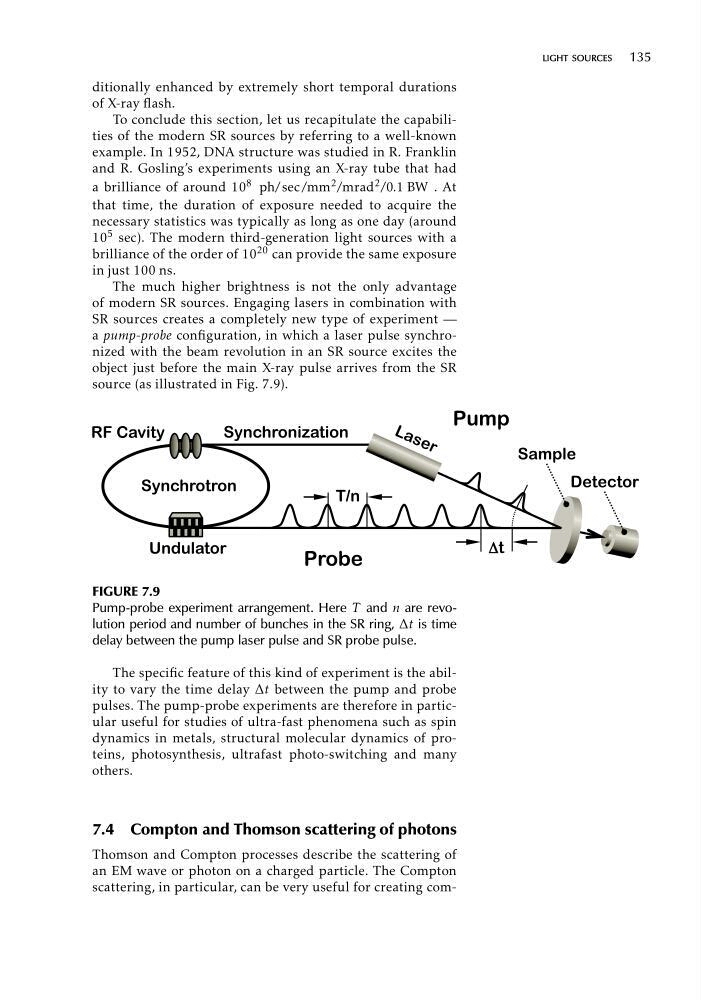
a pump-probe configuration, in which a laser pulse synchronized with the beam revolution in an SR source excites the
object just before the main X-ray pulse arrives from the SR
source (as illustrated in Fig. 7.9).
FIGURE 7.9
Pump-probe experiment arrangement. Here T and n are revolution period and number of bunches in the SR ring, Δt is time
delay between the pump laser pulse and SR probe pulse.
The specific feature of this kind of experiment is the ability to vary the time delay Δt between the pump and probe
pulses. The pump-probe experiments are therefore in particular useful for studies of ultra-fast phenomena such as spin
dynamics in metals, structural molecular dynamics of proteins, photosynthesis, ultrafast photo-switching and many
others.
7.4 Compton and Thomson scattering of photons
Thomson and Compton processes describe the scattering of
an EM wave or photon on a charged particle. The Compton
scattering, in particular, can be very useful for creating com
ditionally enhanced by extremely short temporal durations
of X-ray flash.
To conclude this section, let us recapitulate the capabilities of the modern SR sources by referring to a well-known
example. In 1952, DNA structure was studied in R. Franklin
and R. Gosling’s experiments using an X-ray tube that had
a brilliance of around 10 8 ph/ sec /mm 2 /mrad 2 /0.1 BW . At
that time, the duration of exposure needed to acquire the
necessary statistics was typically as long as one day (around
10 5 sec). The modern third-generation light sources with a
brilliance of the order of 10 20 can provide the same exposure
in just 100 ns.
The much higher brightness is not the only advantage
of modern SR sources. Engaging lasers in combination with
SR sources creates a completely new type of experiment —
a pump-probe configuration, in which a laser pulse synchronized with the beam revolution in an SR source excites the
object just before the main X-ray pulse arrives from the SR
source (as illustrated in Fig. 7.9).
FIGURE 7.9
Pump-probe experiment arrangement. Here T and n are revolution period and number of bunches in the SR ring, Δt is time
delay between the pump laser pulse and SR probe pulse.
The specific feature of this kind of experiment is the ability to vary the time delay Δt between the pump and probe
pulses. The pump-probe experiments are therefore in particular useful for studies of ultra-fast phenomena such as spin
dynamics in metals, structural molecular dynamics of proteins, photosynthesis, ultrafast photo-switching and many
others.
7.4 Compton and Thomson scattering of photons
Thomson and Compton processes describe the scattering of
an EM wave or photon on a charged particle. The Compton
scattering, in particular, can be very useful for creating com