

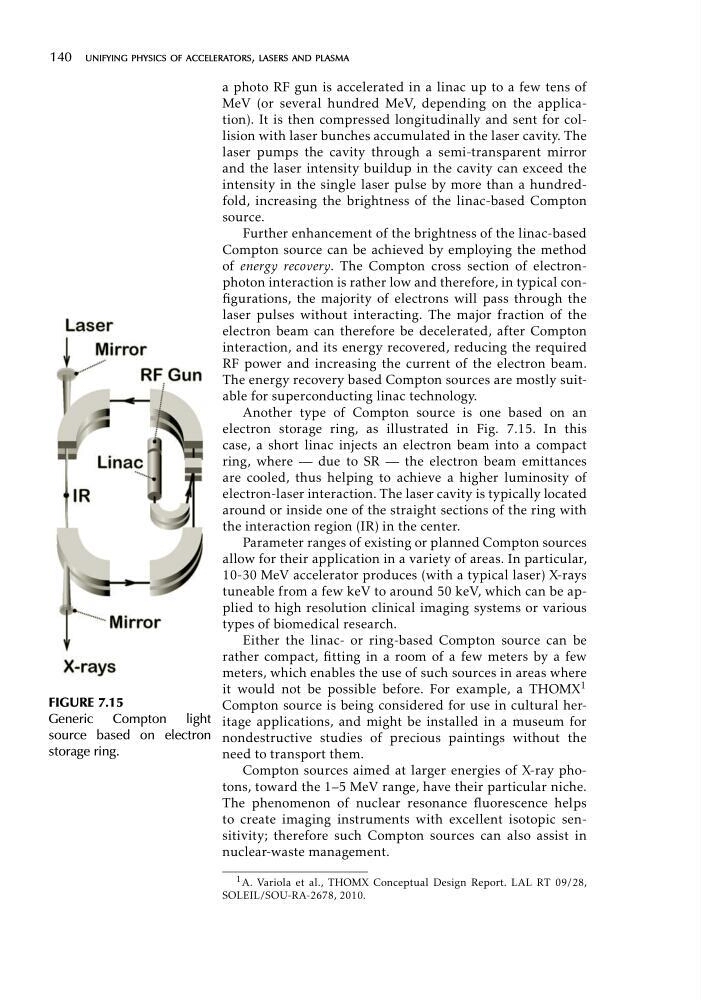
FIGURE 7.15
Generic Compton light
source based on electron
storage ring.
140 unifying physics of accelerators, lasers and plasma
a photo RF gun is accelerated in a linac up to a few tens of
MeV (or several hundred MeV, depending on the application). It is then compressed longitudinally and sent for collision with laser bunches accumulated in the laser cavity. The
laser pumps the cavity through a semi-transparent mirror
and the laser intensity buildup in the cavity can exceed the
intensity in the single laser pulse by more than a hundredfold, increasing the brightness of the linac-based Compton
source.
Further enhancement of the brightness of the linac-based
Compton source can be achieved by employing the method
of energy recovery. The Compton cross section of electronphoton interaction is rather low and therefore, in typical configurations, the majority of electrons will pass through the
laser pulses without interacting. The major fraction of the
electron beam can therefore be decelerated, after Compton
interaction, and its energy recovered, reducing the required
RF power and increasing the current of the electron beam.
The energy recovery based Compton sources are mostly suitable for superconducting linac technology.
Another type of Compton source is one based on an
electron storage ring, as illustrated in Fig. 7.15. In this
case, a short linac injects an electron beam into a compact
ring, where — due to SR — the electron beam emittances
are cooled, thus helping to achieve a higher luminosity of
electron-laser interaction. The laser cavity is typically located
around or inside one of the straight sections of the ring with
the interaction region (IR) in the center.
Parameter ranges of existing or planned Compton sources
allow for their application in a variety of areas. In particular,
10-30 MeV accelerator produces (with a typical laser) X-rays
tuneable from a few keV to around 50 keV, which can be applied to high resolution clinical imaging systems or various
types of biomedical research.
Either the linac- or ring-based Compton source can be
rather compact, fitting in a room of a few meters by a few
meters, which enables the use of such sources in areas where
it would not be possible before. For example, a THOMX 1
Compton source is being considered for use in cultural heritage applications, and might be installed in a museum for
nondestructive studies of precious paintings without the
need to transport them.
Compton sources aimed at larger energies of X-ray photons, toward the 1–5 MeV range, have their particular niche.
The phenomenon of nuclear resonance fluorescence helps
to create imaging instruments with excellent isotopic sensitivity; therefore such Compton sources can also assist in
nuclear-waste management.
1 A. Variola et al., THOMX Conceptual Design Report. LAL RT 09/28,
SOLEIL/SOU-RA-2678, 2010.
Generic Compton light
source based on electron
storage ring.
140 unifying physics of accelerators, lasers and plasma
a photo RF gun is accelerated in a linac up to a few tens of
MeV (or several hundred MeV, depending on the application). It is then compressed longitudinally and sent for collision with laser bunches accumulated in the laser cavity. The
laser pumps the cavity through a semi-transparent mirror
and the laser intensity buildup in the cavity can exceed the
intensity in the single laser pulse by more than a hundredfold, increasing the brightness of the linac-based Compton
source.
Further enhancement of the brightness of the linac-based
Compton source can be achieved by employing the method
of energy recovery. The Compton cross section of electronphoton interaction is rather low and therefore, in typical configurations, the majority of electrons will pass through the
laser pulses without interacting. The major fraction of the
electron beam can therefore be decelerated, after Compton
interaction, and its energy recovered, reducing the required
RF power and increasing the current of the electron beam.
The energy recovery based Compton sources are mostly suitable for superconducting linac technology.
Another type of Compton source is one based on an
electron storage ring, as illustrated in Fig. 7.15. In this
case, a short linac injects an electron beam into a compact
ring, where — due to SR — the electron beam emittances
are cooled, thus helping to achieve a higher luminosity of
electron-laser interaction. The laser cavity is typically located
around or inside one of the straight sections of the ring with
the interaction region (IR) in the center.
Parameter ranges of existing or planned Compton sources
allow for their application in a variety of areas. In particular,
10-30 MeV accelerator produces (with a typical laser) X-rays
tuneable from a few keV to around 50 keV, which can be applied to high resolution clinical imaging systems or various
types of biomedical research.
Either the linac- or ring-based Compton source can be
rather compact, fitting in a room of a few meters by a few
meters, which enables the use of such sources in areas where
it would not be possible before. For example, a THOMX 1
Compton source is being considered for use in cultural heritage applications, and might be installed in a museum for
nondestructive studies of precious paintings without the
need to transport them.
Compton sources aimed at larger energies of X-ray photons, toward the 1–5 MeV range, have their particular niche.
The phenomenon of nuclear resonance fluorescence helps
to create imaging instruments with excellent isotopic sensitivity; therefore such Compton sources can also assist in
nuclear-waste management.
1 A. Variola et al., THOMX Conceptual Design Report. LAL RT 09/28,
SOLEIL/SOU-RA-2678, 2010.