

light sources 133
field R defines two distinct regimes (see Section 3.3.5). If
2R/γ « λ u /2 (parameter K ∼ γ λ u /R
1), then the radiation emitted at each period of sin-like
»
field is independent;
this corresponds to a wiggler regime (similar to radiation
from a sequence of bends). The insertion devices working in
a wiggler regime are usually used to achieve high photon energies and flux.
In contrast, the undulator regime corresponds to the case
2R/γ » λ u /2 (or K « 1), which means that the entire wiggling trajectory will contribute to radiation. Undulators are
typically used to generate high brilliance radiation in a quasimonochromatic spectrum — the bandwidth of undulator radiation is inversely proportional to the number of undulator
&XUUHQWDUEXQLWV
7LPHKRXUV
D
E
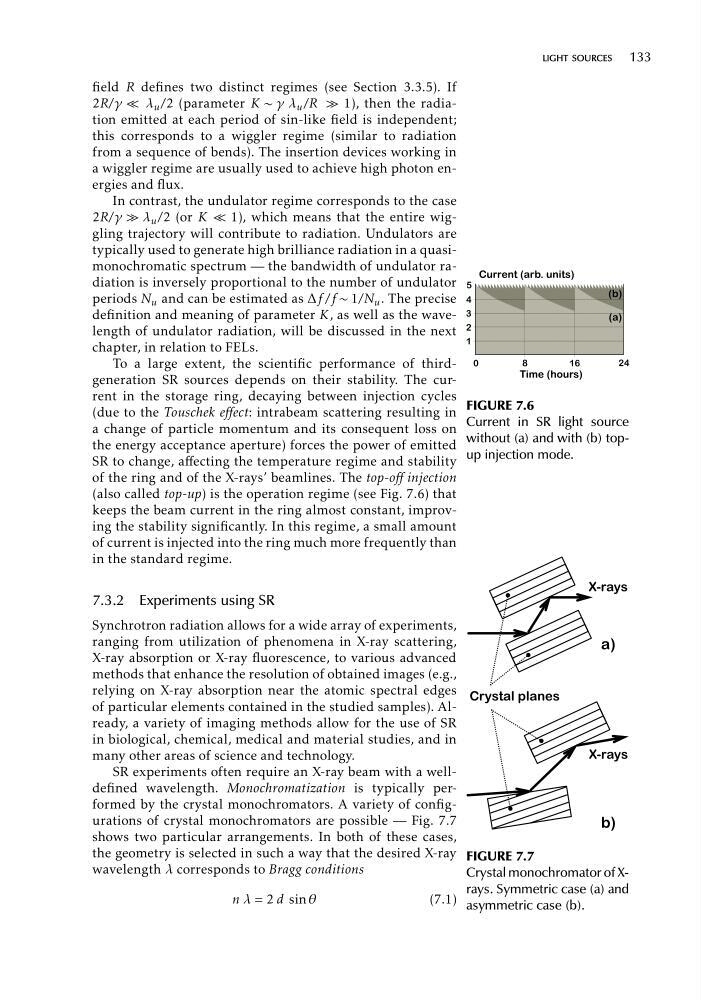
FIGURE 7.6
Current in SR light source
without (a) and with (b) topup injection mode.
periods N u and can be estimated as Δf /f 1/N u . The precise
definition and meaning of parameter
∼
K, as well as the wavelength of undulator radiation, will be discussed in the next
chapter, in relation to FELs.
To a large extent, the scientific performance of thirdgeneration SR sources depends on their stability. The current in the storage ring, decaying between injection cycles
(due to the Touschek effect: intrabeam scattering resulting in
a change of particle momentum and its consequent loss on
the energy acceptance aperture) forces the power of emitted
SR to change, affecting the temperature regime and stability
of the ring and of the X-rays’ beamlines. The top-off injection
(also called top-up) is the operation regime (see Fig. 7.6) that
keeps the beam current in the ring almost constant, improving the stability significantly. In this regime, a small amount
of current is injected into the ring much more frequently than
in the standard regime.
7.3.2 Experiments using SR
Synchrotron radiation allows for a wide array of experiments,
ranging from utilization of phenomena in X-ray scattering,
X-ray absorption or X-ray fluorescence, to various advanced
methods that enhance the resolution of obtained images (e.g.,
relying on X-ray absorption near the atomic spectral edges
of particular elements contained in the studied samples). Already, a variety of imaging methods allow for the use of SR
in biological, chemical, medical and material studies, and in
many other areas of science and technology.
SR experiments often require an X-ray beam with a welldefined wavelength. Monochromatization is typically performed by the crystal monochromators. A variety of configurations of crystal monochromators are possible — Fig. 7.7
shows two particular arrangements. In both of these cases,
the geometry is selected in such a way that the desired X-ray
wavelength λ corresponds to Bragg conditions
n λ = 2 d sin θ
(7.1)
r
&U\VWDOSODQHV
D
;UD\V
E
;UD\V
FIGURE 7.7
Crystal monochromator of Xays. Symmetric case (a) and
asymmetric case (b).
field R defines two distinct regimes (see Section 3.3.5). If
2R/γ « λ u /2 (parameter K ∼ γ λ u /R
1), then the radiation emitted at each period of sin-like
»
field is independent;
this corresponds to a wiggler regime (similar to radiation
from a sequence of bends). The insertion devices working in
a wiggler regime are usually used to achieve high photon energies and flux.
In contrast, the undulator regime corresponds to the case
2R/γ » λ u /2 (or K « 1), which means that the entire wiggling trajectory will contribute to radiation. Undulators are
typically used to generate high brilliance radiation in a quasimonochromatic spectrum — the bandwidth of undulator radiation is inversely proportional to the number of undulator
&XUUHQWDUEXQLWV
7LPHKRXUV
D
E
FIGURE 7.6
Current in SR light source
without (a) and with (b) topup injection mode.
periods N u and can be estimated as Δf /f 1/N u . The precise
definition and meaning of parameter
∼
K, as well as the wavelength of undulator radiation, will be discussed in the next
chapter, in relation to FELs.
To a large extent, the scientific performance of thirdgeneration SR sources depends on their stability. The current in the storage ring, decaying between injection cycles
(due to the Touschek effect: intrabeam scattering resulting in
a change of particle momentum and its consequent loss on
the energy acceptance aperture) forces the power of emitted
SR to change, affecting the temperature regime and stability
of the ring and of the X-rays’ beamlines. The top-off injection
(also called top-up) is the operation regime (see Fig. 7.6) that
keeps the beam current in the ring almost constant, improving the stability significantly. In this regime, a small amount
of current is injected into the ring much more frequently than
in the standard regime.
7.3.2 Experiments using SR
Synchrotron radiation allows for a wide array of experiments,
ranging from utilization of phenomena in X-ray scattering,
X-ray absorption or X-ray fluorescence, to various advanced
methods that enhance the resolution of obtained images (e.g.,
relying on X-ray absorption near the atomic spectral edges
of particular elements contained in the studied samples). Already, a variety of imaging methods allow for the use of SR
in biological, chemical, medical and material studies, and in
many other areas of science and technology.
SR experiments often require an X-ray beam with a welldefined wavelength. Monochromatization is typically performed by the crystal monochromators. A variety of configurations of crystal monochromators are possible — Fig. 7.7
shows two particular arrangements. In both of these cases,
the geometry is selected in such a way that the desired X-ray
wavelength λ corresponds to Bragg conditions
n λ = 2 d sin θ
(7.1)
r
&U\VWDOSODQHV
D
;UD\V
E
;UD\V
FIGURE 7.7
Crystal monochromator of Xays. Symmetric case (a) and
asymmetric case (b).