

light sources 129
parency of beryllium and aluminum foils near the K and L
edges.
The National Bureau of Standards (now National Institute
of Standards and Technology) was the next to use SR properties to their advantage, modifying a section of a vacuum
chamber of a 180 MeV electron synchrotron to enable access
to SR. Soon, it was apparent that the era of SR light sources
had begun.
7.2 Evolution and parameters of SR sources
A large demand for new scientific instruments stimulated
enormous advances in SR light source technology. In just a
few decades, several generations of SR sources technology
have been developed, each exhibiting an improvement with
every evolutionary step.
7.2.1 Generations of synchrotron radiation sources
It is now a tradition to distinguish the many generations of SR
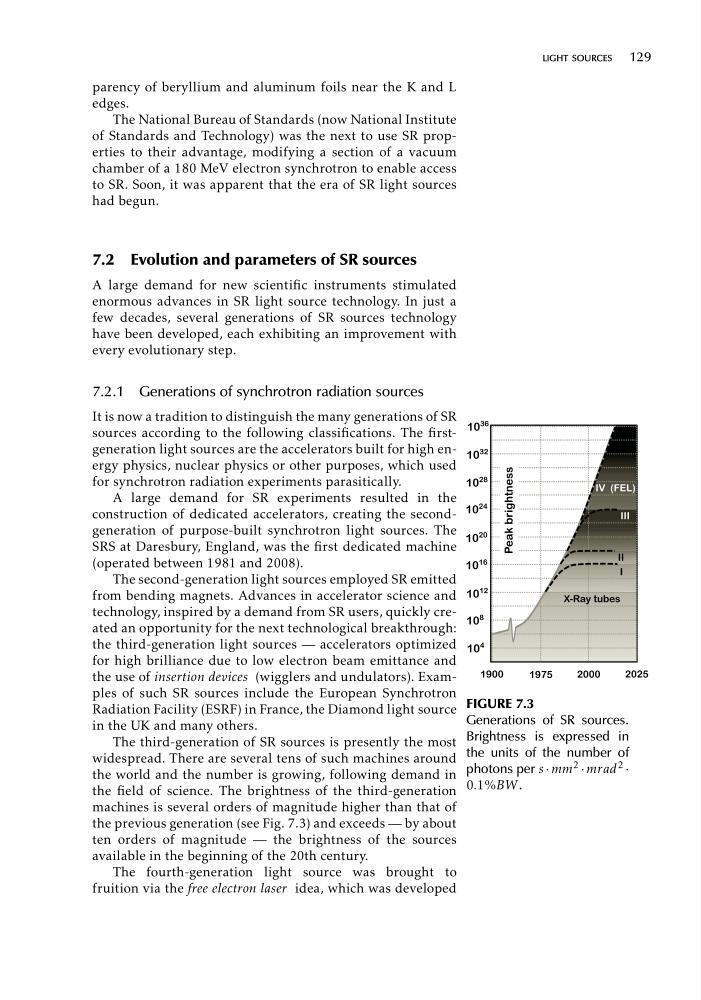
FIGURE 7.3
Generations of SR sources.
Brightness is expressed in
the units of the number
s mm 2
2
of
mrad
photons per
0.1%
·
·
·
BW .
sources according to the following classifications. The firstgeneration light sources are the accelerators built for high energy physics, nuclear physics or other purposes, which used
for synchrotron radiation experiments parasitically.
A large demand for SR experiments resulted in the
construction of dedicated accelerators, creating the secondgeneration of purpose-built synchrotron light sources. The
SRS at Daresbury, England, was the first dedicated machine
(operated between 1981 and 2008).
The second-generation light sources employed SR emitted
from bending magnets. Advances in accelerator science and
technology, inspired by a demand from SR users, quickly created an opportunity for the next technological breakthrough:
the third-generation light sources — accelerators optimized
for high brilliance due to low electron beam emittance and
the use of insertion devices (wigglers and undulators). Examples of such SR sources include the European Synchrotron
Radiation Facility (ESRF) in France, the Diamond light source
in the UK and many others.
The third-generation of SR sources is presently the most
widespread. There are several tens of such machines around
the world and the number is growing, following demand in
the field of science. The brightness of the third-generation
machines is several orders of magnitude higher than that of
the previous generation (see Fig. 7.3) and exceeds — by about
ten orders of magnitude — the brightness of the sources
available in the beginning of the 20th century.
The fourth-generation light source was brought to
fruition via the free electron laser idea, which was developed
parency of beryllium and aluminum foils near the K and L
edges.
The National Bureau of Standards (now National Institute
of Standards and Technology) was the next to use SR properties to their advantage, modifying a section of a vacuum
chamber of a 180 MeV electron synchrotron to enable access
to SR. Soon, it was apparent that the era of SR light sources
had begun.
7.2 Evolution and parameters of SR sources
A large demand for new scientific instruments stimulated
enormous advances in SR light source technology. In just a
few decades, several generations of SR sources technology
have been developed, each exhibiting an improvement with
every evolutionary step.
7.2.1 Generations of synchrotron radiation sources
It is now a tradition to distinguish the many generations of SR
FIGURE 7.3
Generations of SR sources.
Brightness is expressed in
the units of the number
s mm 2
2
of
mrad
photons per
0.1%
·
·
·
BW .
sources according to the following classifications. The firstgeneration light sources are the accelerators built for high energy physics, nuclear physics or other purposes, which used
for synchrotron radiation experiments parasitically.
A large demand for SR experiments resulted in the
construction of dedicated accelerators, creating the secondgeneration of purpose-built synchrotron light sources. The
SRS at Daresbury, England, was the first dedicated machine
(operated between 1981 and 2008).
The second-generation light sources employed SR emitted
from bending magnets. Advances in accelerator science and
technology, inspired by a demand from SR users, quickly created an opportunity for the next technological breakthrough:
the third-generation light sources — accelerators optimized
for high brilliance due to low electron beam emittance and
the use of insertion devices (wigglers and undulators). Examples of such SR sources include the European Synchrotron
Radiation Facility (ESRF) in France, the Diamond light source
in the UK and many others.
The third-generation of SR sources is presently the most
widespread. There are several tens of such machines around
the world and the number is growing, following demand in
the field of science. The brightness of the third-generation
machines is several orders of magnitude higher than that of
the previous generation (see Fig. 7.3) and exceeds — by about
ten orders of magnitude — the brightness of the sources
available in the beginning of the 20th century.
The fourth-generation light source was brought to
fruition via the free electron laser idea, which was developed