

130 unifying physics of accelerators, lasers and plasma
in the 1970s by John Madey. An essential part of the FEL,
the undulator (invented in 1947 by Ilya Ginzburg) provided
a significant cornerstone for the foundation of FEL technology development.
The fourth-generation light sources enjoy all the latest developments of accelerator science: they are linac-based with
low-emittance photo-injectors, assisted with several bunch
compressors that help to obtain the ultra-short bunches.
Examples of such FELs include: FLASH (Germany), LCLS
(USA), and SACLA (Japan).
The next generation of SR light sources will inevitably arrive, and very soon. The exact design and underlying technology are not yet determined, and in fact several ideas are
in competition, one being the ultimate storage rings discussed
in Chapter 3 and another being related to plasma acceleration light sources discussed in Chapter 6, among others.
7.2.2 Basic SR properties and parameters of SR sources
Without repeating the formulae, which can be found in
Chapter 3, let us briefly recall our approach for deriving important parameters of SR sources and of the synchrotron radiation itself.
Recall that a simple back-of-the-envelope treatment of SR
was possible when the amount of radiation left behind was
determined from simple geometrical consideration and the
volume integral over the field squared gave us the energy lost
per unit of length. This led us immediately to the estimation
of the cooling time and, after considering the quantum (statistical) character of radiation, we came up with an estimate
for the equilibrium horizontal emittance of the beam (with
vertical equilibrium emittance determined by the coupling
of the ring).
Knowledge of equilibrium emittances, as well as knowledge of the single photon emittance that we estimated on the
way, firstly led us to an estimation of the SR flux and then of
the brightness of SR sources.
High-intensity photon flux (defined as the number of photons per second and per spectral bandwidth) allows for either
rapid experiments or the use of weakly scattering objects or
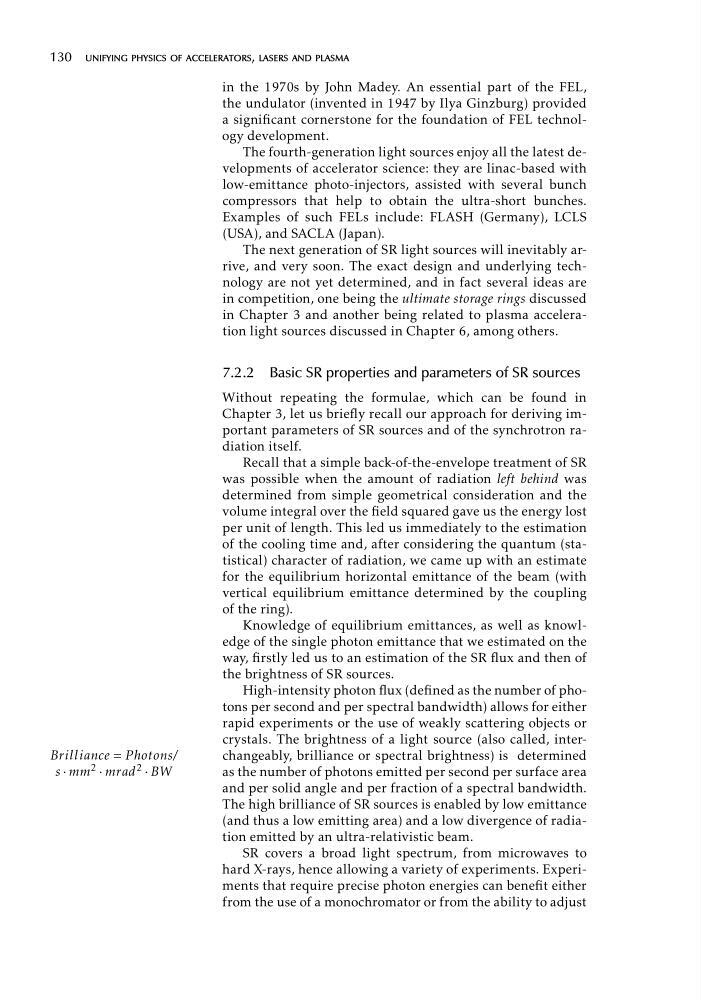
crystals. The brightness of a light source (also called, interBrilliance = Photons/
changeably, brilliance or spectral brightness) is determined
2
s · mm · mrad 2 · BW
as the number of photons emitted per second per surface area
and per solid angle and per fraction of a spectral bandwidth.
The high brilliance of SR sources is enabled by low emittance
(and thus a low emitting area) and a low divergence of radiation emitted by an ultra-relativistic beam.
SR covers a broad light spectrum, from microwaves to
hard X-rays, hence allowing a variety of experiments. Experiments that require precise photon energies can benefit either
from the use of a monochromator or from the ability to adjust
in the 1970s by John Madey. An essential part of the FEL,
the undulator (invented in 1947 by Ilya Ginzburg) provided
a significant cornerstone for the foundation of FEL technology development.
The fourth-generation light sources enjoy all the latest developments of accelerator science: they are linac-based with
low-emittance photo-injectors, assisted with several bunch
compressors that help to obtain the ultra-short bunches.
Examples of such FELs include: FLASH (Germany), LCLS
(USA), and SACLA (Japan).
The next generation of SR light sources will inevitably arrive, and very soon. The exact design and underlying technology are not yet determined, and in fact several ideas are
in competition, one being the ultimate storage rings discussed
in Chapter 3 and another being related to plasma acceleration light sources discussed in Chapter 6, among others.
7.2.2 Basic SR properties and parameters of SR sources
Without repeating the formulae, which can be found in
Chapter 3, let us briefly recall our approach for deriving important parameters of SR sources and of the synchrotron radiation itself.
Recall that a simple back-of-the-envelope treatment of SR
was possible when the amount of radiation left behind was
determined from simple geometrical consideration and the
volume integral over the field squared gave us the energy lost
per unit of length. This led us immediately to the estimation
of the cooling time and, after considering the quantum (statistical) character of radiation, we came up with an estimate
for the equilibrium horizontal emittance of the beam (with
vertical equilibrium emittance determined by the coupling
of the ring).
Knowledge of equilibrium emittances, as well as knowledge of the single photon emittance that we estimated on the
way, firstly led us to an estimation of the SR flux and then of
the brightness of SR sources.
High-intensity photon flux (defined as the number of photons per second and per spectral bandwidth) allows for either
rapid experiments or the use of weakly scattering objects or
crystals. The brightness of a light source (also called, interBrilliance = Photons/
changeably, brilliance or spectral brightness) is determined
2
s · mm · mrad 2 · BW
as the number of photons emitted per second per surface area
and per solid angle and per fraction of a spectral bandwidth.
The high brilliance of SR sources is enabled by low emittance
(and thus a low emitting area) and a low divergence of radiation emitted by an ultra-relativistic beam.
SR covers a broad light spectrum, from microwaves to
hard X-rays, hence allowing a variety of experiments. Experiments that require precise photon energies can benefit either
from the use of a monochromator or from the ability to adjust