

128 unifying physics of accelerators, lasers and plasma
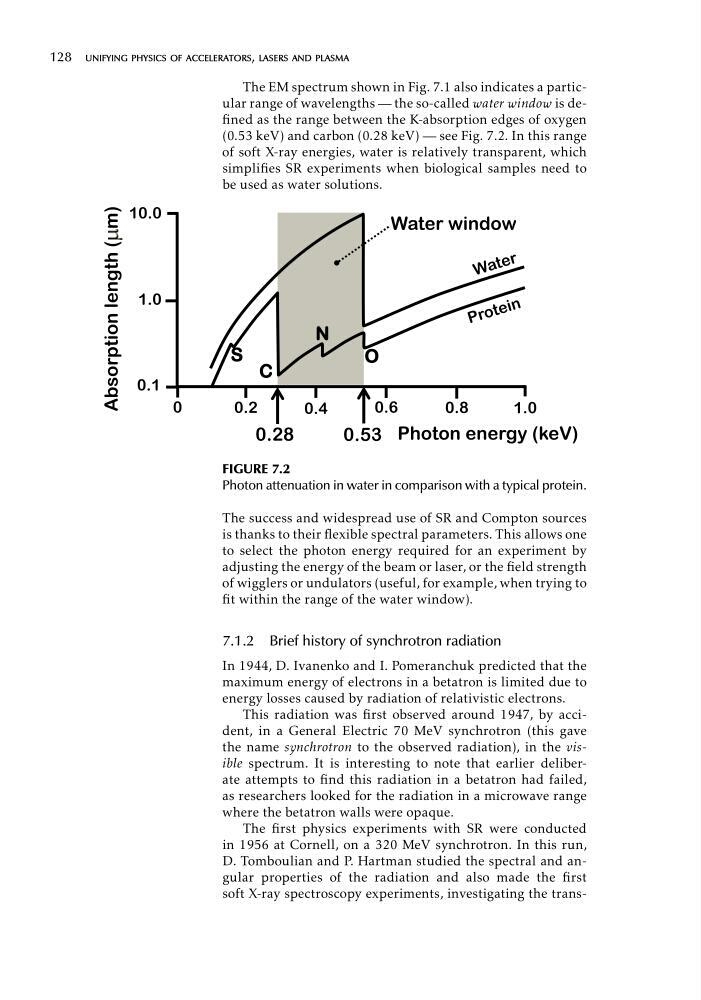
The EM spectrum shown in Fig. 7.1 also indicates a particular range of wavelengths — the so-called water window is defined as the range between the K-absorption edges of oxygen
(0.53 keV) and carbon (0.28 keV) — see Fig. 7.2. In this range
of soft X-ray energies, water is relatively transparent, which
simplifies SR experiments when biological samples need to
be used as water solutions.
FIGURE 7.2
Photon attenuation in water in comparison with a typical protein.
The success and widespread use of SR and Compton sources
is thanks to their flexible spectral parameters. This allows one
to select the photon energy required for an experiment by
adjusting the energy of the beam or laser, or the field strength
of wigglers or undulators (useful, for example, when trying to
fit within the range of the water window).
7.1.2 Brief history of synchrotron radiation
In 1944, D. Ivanenko and I. Pomeranchuk predicted that the
maximum energy of electrons in a betatron is limited due to
energy losses caused by radiation of relativistic electrons.
This radiation was first observed around 1947, by accident, in a General Electric 70 MeV synchrotron (this gave
the name synchrotron to the observed radiation), in the visible spectrum. It is interesting to note that earlier deliberate attempts to find this radiation in a betatron had failed,
as researchers looked for the radiation in a microwave range
where the betatron walls were opaque.
The first physics experiments with SR were conducted
in 1956 at Cornell, on a 320 MeV synchrotron. In this run,
D. Tomboulian and P. Hartman studied the spectral and angular properties of the radiation and also made the first
soft X-ray spectroscopy experiments, investigating the trans
The EM spectrum shown in Fig. 7.1 also indicates a particular range of wavelengths — the so-called water window is defined as the range between the K-absorption edges of oxygen
(0.53 keV) and carbon (0.28 keV) — see Fig. 7.2. In this range
of soft X-ray energies, water is relatively transparent, which
simplifies SR experiments when biological samples need to
be used as water solutions.
FIGURE 7.2
Photon attenuation in water in comparison with a typical protein.
The success and widespread use of SR and Compton sources
is thanks to their flexible spectral parameters. This allows one
to select the photon energy required for an experiment by
adjusting the energy of the beam or laser, or the field strength
of wigglers or undulators (useful, for example, when trying to
fit within the range of the water window).
7.1.2 Brief history of synchrotron radiation
In 1944, D. Ivanenko and I. Pomeranchuk predicted that the
maximum energy of electrons in a betatron is limited due to
energy losses caused by radiation of relativistic electrons.
This radiation was first observed around 1947, by accident, in a General Electric 70 MeV synchrotron (this gave
the name synchrotron to the observed radiation), in the visible spectrum. It is interesting to note that earlier deliberate attempts to find this radiation in a betatron had failed,
as researchers looked for the radiation in a microwave range
where the betatron walls were opaque.
The first physics experiments with SR were conducted
in 1956 at Cornell, on a 320 MeV synchrotron. In this run,
D. Tomboulian and P. Hartman studied the spectral and angular properties of the radiation and also made the first
soft X-ray spectroscopy experiments, investigating the trans