

7
Light Sources
7.1 SR properties and
In this chapter, we will focus on light sources — first synhistory
127 chrotron radiation light sources and then Compton light
7.2 Evolution and
sources. For the former, we will base our observations on reparameters of SR
sults derived in Chapter 3, and will then introduce the necsources
129 essary formalism for the latter.
7.3 SR source layouts
and experiments
131
7.4
Compton and
7.1 SR properties and history
Thomson scattering We know from courses on electrodynamics that electromagof photons
135 netic radiation is emitted by charged particles when they are
7.5
Compton light
accelerated. In the particular case when the relativistic parsources
139 ticles move on a curved trajectory — i.e., when they are accelerated radially (when the velocity is perpendicular to the
acceleration vector) — the emitted electromagnetic radiation
is called synchrotron radiation.
This SR was at first considered a nuisance, as it causes energy losses in the accelerated particles. Its unique properties,
however, were eventually shown to have the potential to pave
the path to a new and important type of scientific instrument:
the SR sources.
7.1.1
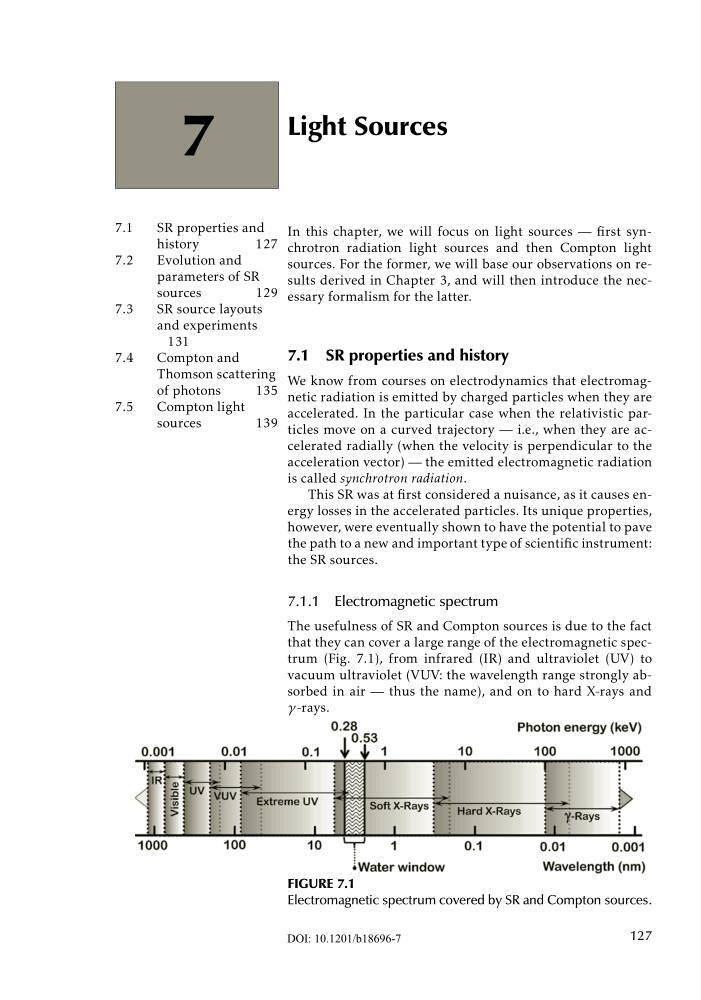
The usefulness of SR and Compton sources is due to the fact
that they can cover a large range of the electromagnetic spectrum (Fig. 7.1), from infrared (IR) and ultraviolet (UV) to
vacuum ultraviolet (VUV: the wavelength range strongly absorbed in air — thus the name), and on to hard X-rays and
γ-rays.
Electromagnetic spectrum
FIGURE 7.1
Electromagnetic spectrum covered by SR and Compton sources.
127
DOI: 10.1201/b18696-7
Light Sources
7.1 SR properties and
In this chapter, we will focus on light sources — first synhistory
127 chrotron radiation light sources and then Compton light
7.2 Evolution and
sources. For the former, we will base our observations on reparameters of SR
sults derived in Chapter 3, and will then introduce the necsources
129 essary formalism for the latter.
7.3 SR source layouts
and experiments
131
7.4
Compton and
7.1 SR properties and history
Thomson scattering We know from courses on electrodynamics that electromagof photons
135 netic radiation is emitted by charged particles when they are
7.5
Compton light
accelerated. In the particular case when the relativistic parsources
139 ticles move on a curved trajectory — i.e., when they are accelerated radially (when the velocity is perpendicular to the
acceleration vector) — the emitted electromagnetic radiation
is called synchrotron radiation.
This SR was at first considered a nuisance, as it causes energy losses in the accelerated particles. Its unique properties,
however, were eventually shown to have the potential to pave
the path to a new and important type of scientific instrument:
the SR sources.
7.1.1
The usefulness of SR and Compton sources is due to the fact
that they can cover a large range of the electromagnetic spectrum (Fig. 7.1), from infrared (IR) and ultraviolet (UV) to
vacuum ultraviolet (VUV: the wavelength range strongly absorbed in air — thus the name), and on to hard X-rays and
γ-rays.
Electromagnetic spectrum
FIGURE 7.1
Electromagnetic spectrum covered by SR and Compton sources.
127
DOI: 10.1201/b18696-7