

plasma acceleration 123
phasing time t d is thus given by
(c−v g ) t d = λ p /2
(6.47)
We then substitute the expression for the group velocity and
get the estimate for the dephasing length:
L d ≈
2
2
λ p ω /ω p
(6.48)
For example, for a laser with a wavelength of 1 μm and
λ p = 30 μm, the dephasing length is L d
accelera
≈ 30 mm. With an
ting gradient (at the corresponding plasma density)
of 1 GeV/cm, a single stage could yield around 3 GeV. Acceleration to a TeV would thus require several hundred stages.
Preservation of beam qualities during multi-stage acceleration is the research area that promises significant advances in
the near future.
6.7.2 Beam-driven plasma acceleration
Plasma can be excited not with a laser pulse, but with a short
intense bunch of charged particles (e.g., electrons). In this
case, the bubble will be formed due to the bunch’s field, and
will have a very similar shape and properties to the laser example.
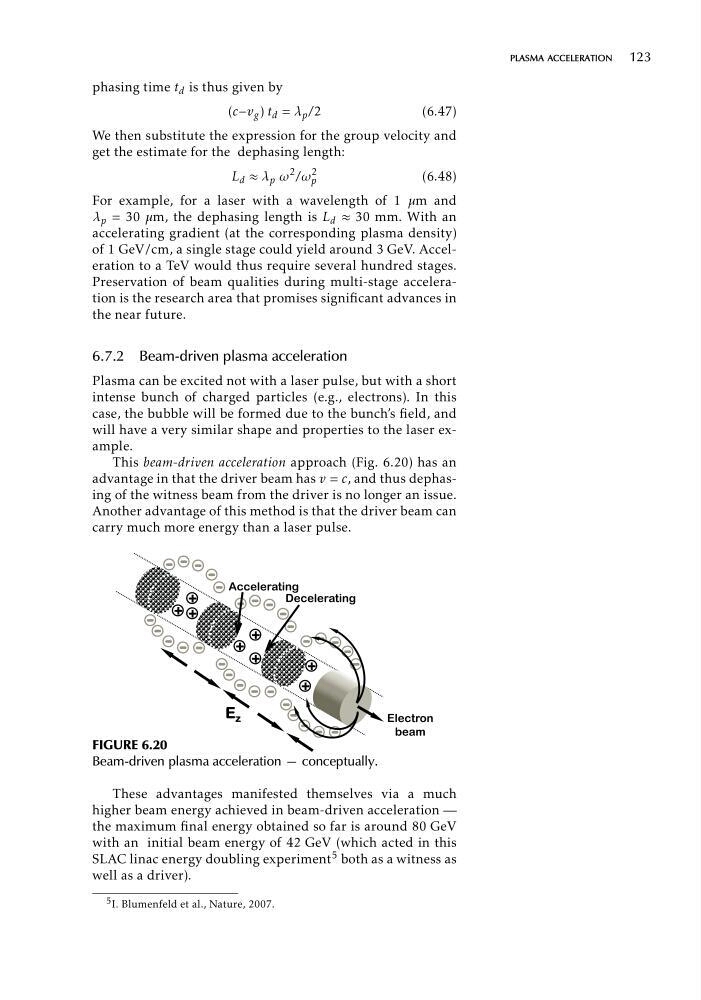
This beam-driven acceleration approach (Fig. 6.20) has an
advantage in that the driver beam has v = c, and thus dephasing of the witness beam from the driver is no longer an issue.
Another advantage of this method is that the driver beam can
carry much more energy than a laser pulse.
FIGURE 6.20
Beam-driven plasma acceleration — conceptually.
These advantages manifested themselves via a much
higher beam energy achieved in beam-driven acceleration —
the maximum final energy obtained so far is around 80 GeV
with an initial beam energy of 42 GeV (which acted in this
SLAC linac energy doubling experiment 5 both as a witness as
well as a driver).
5 I. Blumenfeld et al., Nature, 2007.
phasing time t d is thus given by
(c−v g ) t d = λ p /2
(6.47)
We then substitute the expression for the group velocity and
get the estimate for the dephasing length:
L d ≈
2
2
λ p ω /ω p
(6.48)
For example, for a laser with a wavelength of 1 μm and
λ p = 30 μm, the dephasing length is L d
accelera
≈ 30 mm. With an
ting gradient (at the corresponding plasma density)
of 1 GeV/cm, a single stage could yield around 3 GeV. Acceleration to a TeV would thus require several hundred stages.
Preservation of beam qualities during multi-stage acceleration is the research area that promises significant advances in
the near future.
6.7.2 Beam-driven plasma acceleration
Plasma can be excited not with a laser pulse, but with a short
intense bunch of charged particles (e.g., electrons). In this
case, the bubble will be formed due to the bunch’s field, and
will have a very similar shape and properties to the laser example.
This beam-driven acceleration approach (Fig. 6.20) has an
advantage in that the driver beam has v = c, and thus dephasing of the witness beam from the driver is no longer an issue.
Another advantage of this method is that the driver beam can
carry much more energy than a laser pulse.
FIGURE 6.20
Beam-driven plasma acceleration — conceptually.
These advantages manifested themselves via a much
higher beam energy achieved in beam-driven acceleration —
the maximum final energy obtained so far is around 80 GeV
with an initial beam energy of 42 GeV (which acted in this
SLAC linac energy doubling experiment 5 both as a witness as
well as a driver).
5 I. Blumenfeld et al., Nature, 2007.