

124 unifying physics of accelerators, lasers and plasma
6.8 Laser-plasma and protons
So far, we have only discussed acceleration of electrons. However, plasma acceleration of protons and ions is possible and
is being actively developed. We will touch here on this subject
only briefly, and leave the details for Chapter 9.
The major reason why laser plasma acceleration of protons should be developed is its potential value to proton
therapy. Conventional proton therapy systems — which require around 250 MeV protons and include beam sources (cyclotron or synchrotron), beamlines and especially the beam
delivery gantries — are large and expensive. A desire to create compact laser plasma acceleration proton therapy systems is one of the main motivations for development of
plasma acceleration of protons.
Proton and ion laser plasma acceleration is a rapidly developing area, but it is not quite yet ready for the textbooks.
Different models, with different assumptions and simplifications, are created to explain and predict beam properties in
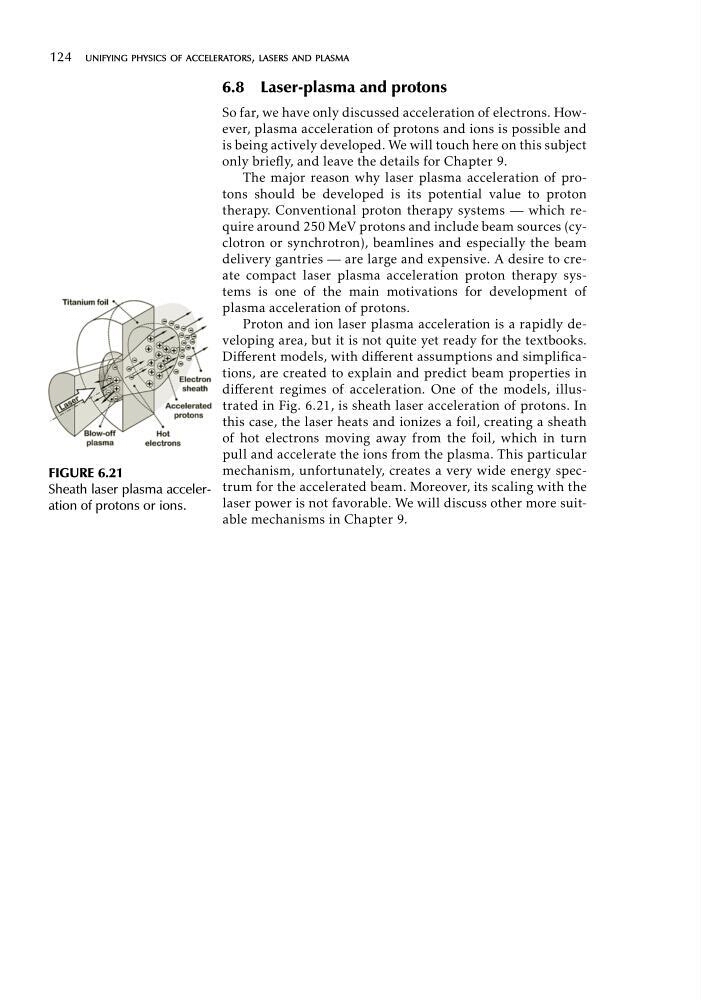
different regimes of acceleration. One of the models, illustrated in Fig. 6.21, is sheath laser acceleration of protons. In
this case, the laser heats and ionizes a foil, creating a sheath
of hot electrons moving away from the foil, which in turn
pull and accelerate the ions from the plasma. This particular
mechanism, unfortunately, creates a very wide energy spectrum for the accelerated beam. Moreover, its scaling with the
laser power is not favorable. We will discuss other more suitable mechanisms in Chapter 9.
FIGURE 6.21
Sheath laser plasma acceleration of protons or ions.
6.8 Laser-plasma and protons
So far, we have only discussed acceleration of electrons. However, plasma acceleration of protons and ions is possible and
is being actively developed. We will touch here on this subject
only briefly, and leave the details for Chapter 9.
The major reason why laser plasma acceleration of protons should be developed is its potential value to proton
therapy. Conventional proton therapy systems — which require around 250 MeV protons and include beam sources (cyclotron or synchrotron), beamlines and especially the beam
delivery gantries — are large and expensive. A desire to create compact laser plasma acceleration proton therapy systems is one of the main motivations for development of
plasma acceleration of protons.
Proton and ion laser plasma acceleration is a rapidly developing area, but it is not quite yet ready for the textbooks.
Different models, with different assumptions and simplifications, are created to explain and predict beam properties in
different regimes of acceleration. One of the models, illustrated in Fig. 6.21, is sheath laser acceleration of protons. In
this case, the laser heats and ionizes a foil, creating a sheath
of hot electrons moving away from the foil, which in turn
pull and accelerate the ions from the plasma. This particular
mechanism, unfortunately, creates a very wide energy spectrum for the accelerated beam. Moreover, its scaling with the
laser power is not favorable. We will discuss other more suitable mechanisms in Chapter 9.
FIGURE 6.21
Sheath laser plasma acceleration of protons or ions.