

122 unifying physics of accelerators, lasers and plasma
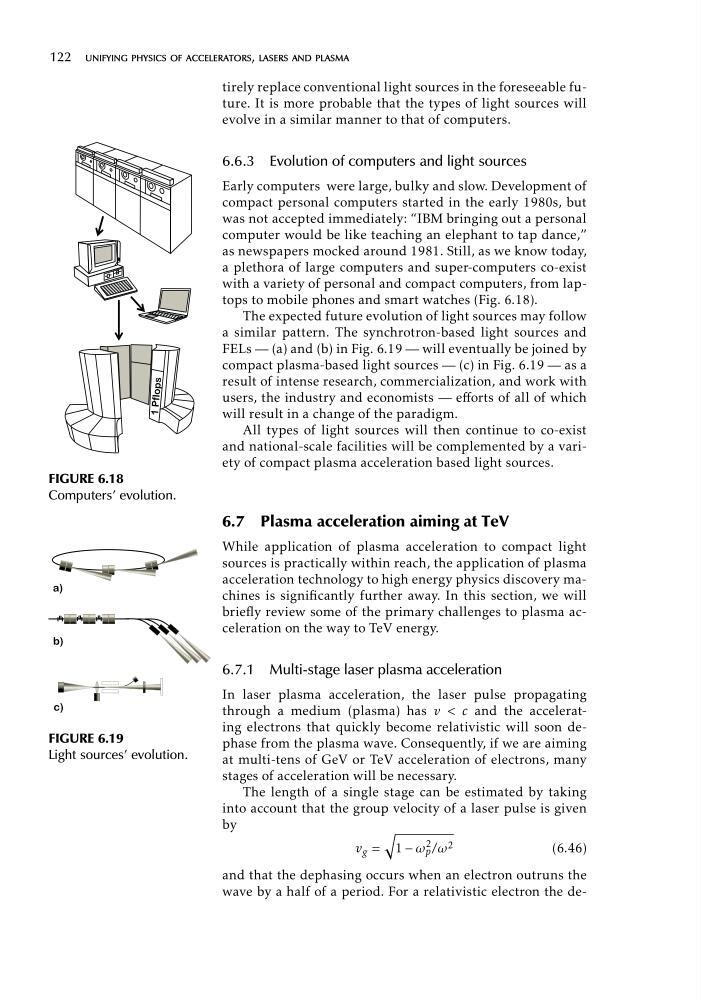
FIGURE 6.18
Computers’ evolution.
FIGURE 6.19
Light sources’ evolution.
tirely replace conventional light sources in the foreseeable future. It is more probable that the types of light sources will
evolve in a similar manner to that of computers.
6.6.3 Evolution of computers and light sources
Early computers were large, bulky and slow. Development of
compact personal computers started in the early 1980s, but
was not accepted immediately: “IBM bringing out a personal
computer would be like teaching an elephant to tap dance,”
as newspapers mocked around 1981. Still, as we know today,
a plethora of large computers and super-computers co-exist
with a variety of personal and compact computers, from laptops to mobile phones and smart watches (Fig. 6.18).
The expected future evolution of light sources may follow
a similar pattern. The synchrotron-based light sources and
FELs — (a) and (b) in Fig. 6.19 — will eventually be joined by
compact plasma-based light sources — (c) in Fig. 6.19 — as a
result of intense research, commercialization, and work with
users, the industry and economists — efforts of all of which
will result in a change of the paradigm.
All types of light sources will then continue to co-exist
and national-scale facilities will be complemented by a variety of compact plasma acceleration based light sources.
6.7 Plasma acceleration aiming at TeV
While application of plasma acceleration to compact light
sources is practically within reach, the application of plasma
acceleration technology to high energy physics discovery machines is significantly further away. In this section, we will
briefly review some of the primary challenges to plasma acceleration on the way to TeV energy.
6.7.1 Multi-stage laser plasma acceleration
In laser plasma acceleration, the laser pulse propagating
through a medium (plasma) has v < c and the accelerating electrons that quickly become relativistic will soon dephase from the plasma wave. Consequently, if we are aiming
at multi-tens of GeV or TeV acceleration of electrons, many
stages of acceleration will be necessary.
The length of a single stage can be estimated by taking
into account that the group velocity of a laser pulse is given
by
)
v g = 1 − ω p
2 /ω 2
(6.46)
and that the dephasing occurs when an electron outruns the
wave by a half of a period. For a relativistic electron the de
FIGURE 6.18
Computers’ evolution.
FIGURE 6.19
Light sources’ evolution.
tirely replace conventional light sources in the foreseeable future. It is more probable that the types of light sources will
evolve in a similar manner to that of computers.
6.6.3 Evolution of computers and light sources
Early computers were large, bulky and slow. Development of
compact personal computers started in the early 1980s, but
was not accepted immediately: “IBM bringing out a personal
computer would be like teaching an elephant to tap dance,”
as newspapers mocked around 1981. Still, as we know today,
a plethora of large computers and super-computers co-exist
with a variety of personal and compact computers, from laptops to mobile phones and smart watches (Fig. 6.18).
The expected future evolution of light sources may follow
a similar pattern. The synchrotron-based light sources and
FELs — (a) and (b) in Fig. 6.19 — will eventually be joined by
compact plasma-based light sources — (c) in Fig. 6.19 — as a
result of intense research, commercialization, and work with
users, the industry and economists — efforts of all of which
will result in a change of the paradigm.
All types of light sources will then continue to co-exist
and national-scale facilities will be complemented by a variety of compact plasma acceleration based light sources.
6.7 Plasma acceleration aiming at TeV
While application of plasma acceleration to compact light
sources is practically within reach, the application of plasma
acceleration technology to high energy physics discovery machines is significantly further away. In this section, we will
briefly review some of the primary challenges to plasma acceleration on the way to TeV energy.
6.7.1 Multi-stage laser plasma acceleration
In laser plasma acceleration, the laser pulse propagating
through a medium (plasma) has v < c and the accelerating electrons that quickly become relativistic will soon dephase from the plasma wave. Consequently, if we are aiming
at multi-tens of GeV or TeV acceleration of electrons, many
stages of acceleration will be necessary.
The length of a single stage can be estimated by taking
into account that the group velocity of a laser pulse is given
by
)
v g = 1 − ω p
2 /ω 2
(6.46)
and that the dephasing occurs when an electron outruns the
wave by a half of a period. For a relativistic electron the de