

plasma acceleration 121
6.6.2 Compact radiation sources
Laser-driven plasma accelerators can already generate electron beams with several GeV of energy, ∼10 fs bunch duration and ∼10-100 pC of charge per bunch.
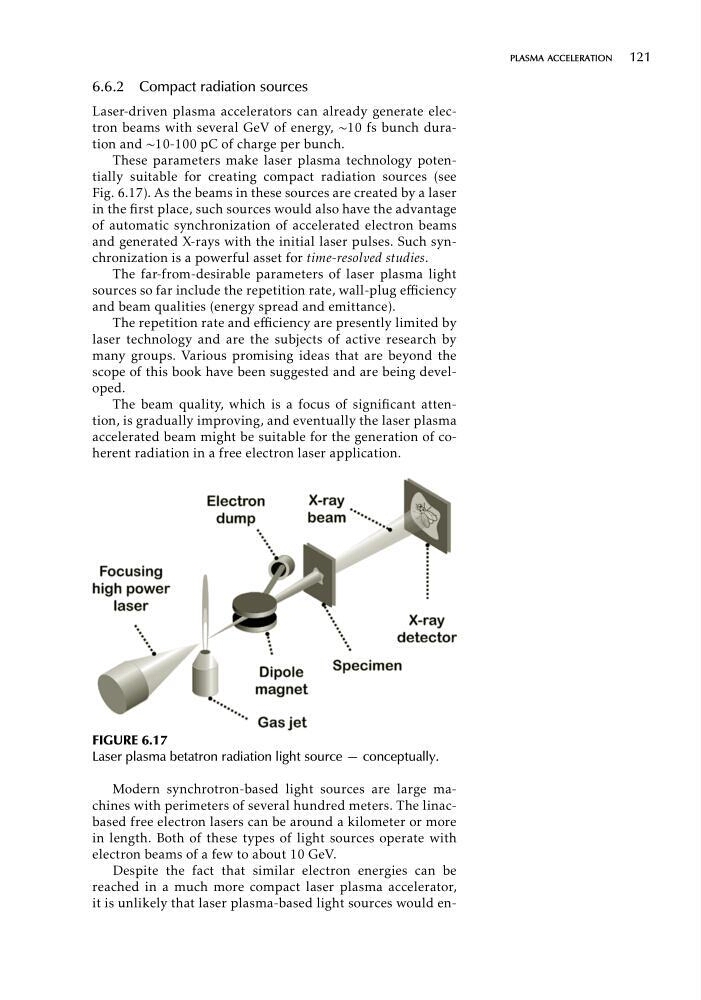
These parameters make laser plasma technology potentially suitable for creating compact radiation sources (see
Fig. 6.17). As the beams in these sources are created by a laser
in the first place, such sources would also have the advantage
of automatic synchronization of accelerated electron beams
and generated X-rays with the initial laser pulses. Such synchronization is a powerful asset for time-resolved studies.
The far-from-desirable parameters of laser plasma light
sources so far include the repetition rate, wall-plug efficiency
and beam qualities (energy spread and emittance).
The repetition rate and efficiency are presently limited by
laser technology and are the subjects of active research by
many groups. Various promising ideas that are beyond the
scope of this book have been suggested and are being developed.
The beam quality, which is a focus of significant attention, is gradually improving, and eventually the laser plasma
accelerated beam might be suitable for the generation of coherent radiation in a free electron laser application.
FIGURE 6.17
Laser plasma betatron radiation light source — conceptually.
Modern synchrotron-based light sources are large machines with perimeters of several hundred meters. The linacbased free electron lasers can be around a kilometer or more
in length. Both of these types of light sources operate with
electron beams of a few to about 10 GeV.
Despite the fact that similar electron energies can be
reached in a much more compact laser plasma accelerator,
it is unlikely that laser plasma-based light sources would en
6.6.2 Compact radiation sources
Laser-driven plasma accelerators can already generate electron beams with several GeV of energy, ∼10 fs bunch duration and ∼10-100 pC of charge per bunch.
These parameters make laser plasma technology potentially suitable for creating compact radiation sources (see
Fig. 6.17). As the beams in these sources are created by a laser
in the first place, such sources would also have the advantage
of automatic synchronization of accelerated electron beams
and generated X-rays with the initial laser pulses. Such synchronization is a powerful asset for time-resolved studies.
The far-from-desirable parameters of laser plasma light
sources so far include the repetition rate, wall-plug efficiency
and beam qualities (energy spread and emittance).
The repetition rate and efficiency are presently limited by
laser technology and are the subjects of active research by
many groups. Various promising ideas that are beyond the
scope of this book have been suggested and are being developed.
The beam quality, which is a focus of significant attention, is gradually improving, and eventually the laser plasma
accelerated beam might be suitable for the generation of coherent radiation in a free electron laser application.
FIGURE 6.17
Laser plasma betatron radiation light source — conceptually.
Modern synchrotron-based light sources are large machines with perimeters of several hundred meters. The linacbased free electron lasers can be around a kilometer or more
in length. Both of these types of light sources operate with
electron beams of a few to about 10 GeV.
Despite the fact that similar electron energies can be
reached in a much more compact laser plasma accelerator,
it is unlikely that laser plasma-based light sources would en