

E · dS = 4π ρdV (Gaussian units)
(6.35)
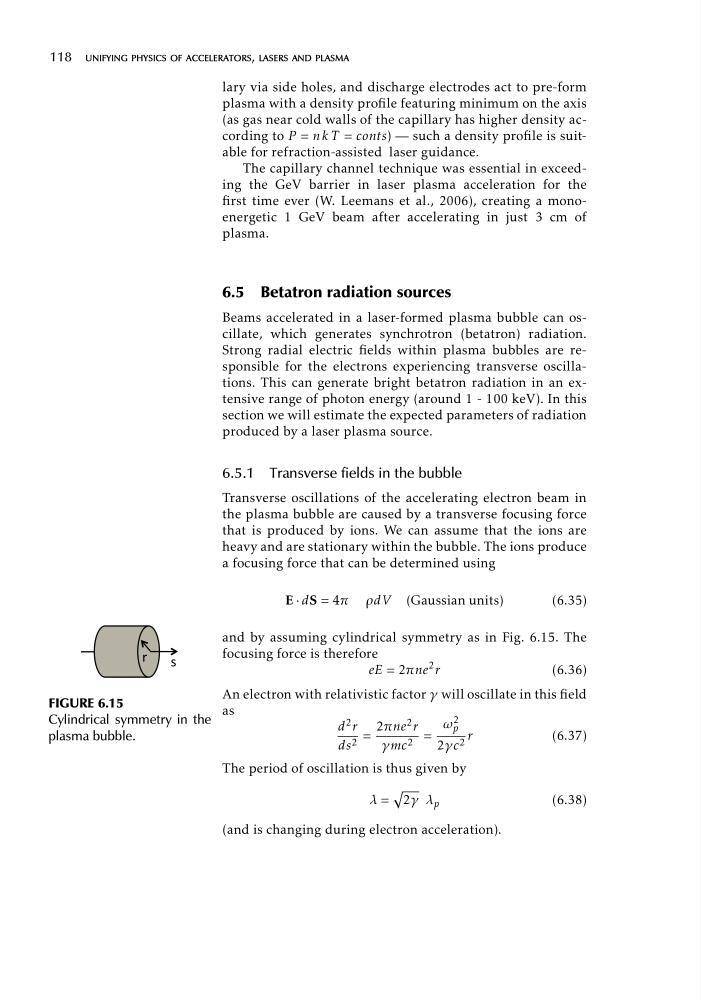
and by assuming cylindrical symmetry as in Fig. 6.15. The
focusing force is therefore
eE = 2
2
πne r
(6.36)
FIGURE 6.15
Cylindrical symmetry in the
plasma bubble.
An electron with relativistic factor γ will oscillate in this field
as
2
d 2 r 2πne 2 r
ω p
=
=
r
(6.37)
ds 2
γmc 2
2γc 2
The period of oscillation is thus given by
λ =
(and
.
2γ λ p
(6.38)
is changing during electron acceleration).
118 unifying physics of accelerators, lasers and plasma
lary via side holes, and discharge electrodes act to pre-form
plasma with a density profile featuring minimum on the axis
(as gas near cold walls of the capillary has higher density according to P = n k T = conts) — such a density profile is suitable for refraction-assisted laser guidance.
The capillary channel technique was essential in exceeding the GeV barrier in laser plasma acceleration for the
first time ever (W. Leemans et al., 2006), creating a monoenergetic 1 GeV beam after accelerating in just 3 cm of
plasma.
6.5 Betatron radiation sources
Beams accelerated in a laser-formed plasma bubble can oscillate, which generates synchrotron (betatron) radiation.
Strong radial electric fields within plasma bubbles are responsible for the electrons experiencing transverse oscillations. This can generate bright betatron radiation in an extensive range of photon energy (around 1 - 100 keV). In this
section we will estimate the expected parameters of radiation
produced by a laser plasma source.
6.5.1 Transverse fields in the bubble
Transverse oscillations of the accelerating electron beam in
the plasma bubble are caused by a transverse focusing force
that is produced by ions. We can assume that the ions are
heavy and are stationary within the bubble. The ions produce
a focusing force that can be determined using
(6.35)
and by assuming cylindrical symmetry as in Fig. 6.15. The
focusing force is therefore
eE = 2
2
πne r
(6.36)
FIGURE 6.15
Cylindrical symmetry in the
plasma bubble.
An electron with relativistic factor γ will oscillate in this field
as
2
d 2 r 2πne 2 r
ω p
=
=
r
(6.37)
ds 2
γmc 2
2γc 2
The period of oscillation is thus given by
λ =
(and
.
2γ λ p
(6.38)
is changing during electron acceleration).
118 unifying physics of accelerators, lasers and plasma
lary via side holes, and discharge electrodes act to pre-form
plasma with a density profile featuring minimum on the axis
(as gas near cold walls of the capillary has higher density according to P = n k T = conts) — such a density profile is suitable for refraction-assisted laser guidance.
The capillary channel technique was essential in exceeding the GeV barrier in laser plasma acceleration for the
first time ever (W. Leemans et al., 2006), creating a monoenergetic 1 GeV beam after accelerating in just 3 cm of
plasma.
6.5 Betatron radiation sources
Beams accelerated in a laser-formed plasma bubble can oscillate, which generates synchrotron (betatron) radiation.
Strong radial electric fields within plasma bubbles are responsible for the electrons experiencing transverse oscillations. This can generate bright betatron radiation in an extensive range of photon energy (around 1 - 100 keV). In this
section we will estimate the expected parameters of radiation
produced by a laser plasma source.
6.5.1 Transverse fields in the bubble
Transverse oscillations of the accelerating electron beam in
the plasma bubble are caused by a transverse focusing force
that is produced by ions. We can assume that the ions are
heavy and are stationary within the bubble. The ions produce
a focusing force that can be determined using