

6.5.2 Estimations of betatron radiation parameters
In Chapter 3 we estimated the characteristics of synchrotron
radiation, in particular the energy loss per unit length:
2
dW 2 e γ 4
=
(6.39)
ds
3 R 2
the characteristic frequency of photons:
3 c γ 3
ω c =
(6.40)
2 R
and the number of photons emitted per unit length:
dN α γ
=
(6.41)
ds
R
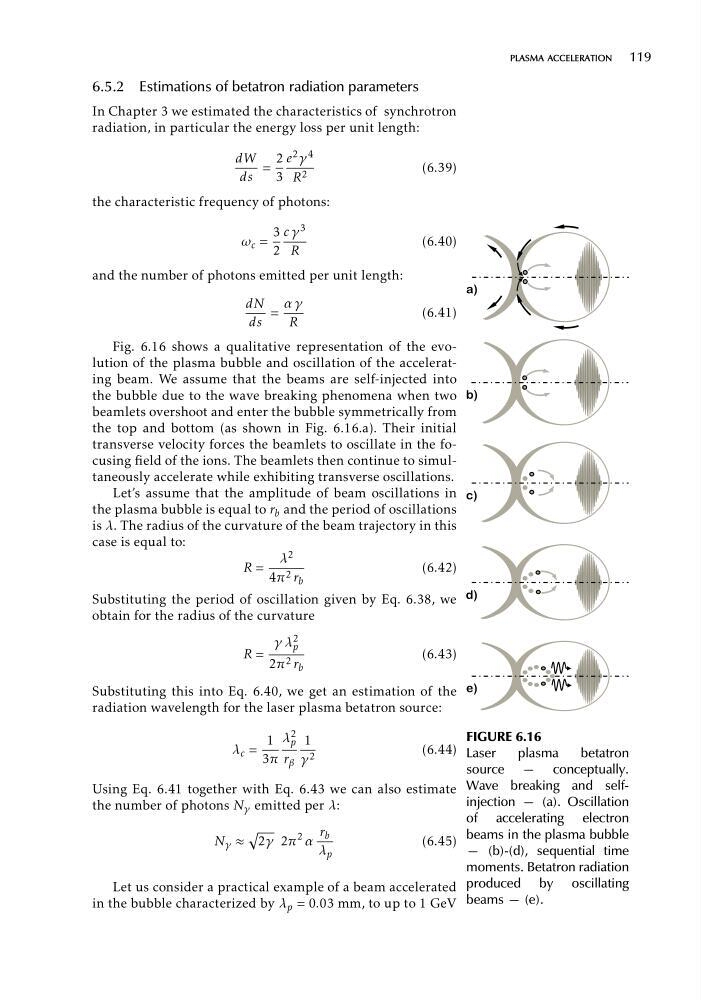
Fig. 6.16 shows a qualitative representation of the evolution of the plasma bubble and oscillation of the accelerating beam. We assume that the beams are self-injected into
the bubble due to the wave breaking phenomena when two
beamlets overshoot and enter the bubble symmetrically from
the top and bottom (as shown in Fig. 6.16.a). Their initial
transverse velocity forces the beamlets to oscillate in the focusing field of the ions. The beamlets then continue to simultaneously accelerate while exhibiting transverse oscillations.
Let’s assume that the amplitude of beam oscillations in
the plasma bubble is equal to r b and the period of oscillations
is λ. The radius of the curvature of the beam trajectory in this
case is equal to:
λ 2
R =
(6.42)
4π 2 r b
Substituting the period of oscillation given by Eq. 6.38, we
obtain for the radius of the curvature
γ λ 2
p
R =
(6.43)
2π 2 r b
Substituting this into Eq. 6.40, we get an estimation of the
radiation wavelength for the laser plasma betatron source:
λ 2
1 p 1
λ c =
(6.44)
3π r β γ 2
Using Eq. 6.41 together with Eq. 6.43 we can also estimate
the number of photons N γ emitted per λ:
.
N γ ≈ 2γ 2π
2 α
r b
(6.45)
λ p
Let us consider a practical example of a beam accelerated
in the bubble characterized by λ p = 0.03 mm, to up to 1 GeV
plasma acceleration 119
FIGURE 6.16
Laser
plasma
betatron
source — conceptually.
Wave breaking and selfinjection — (a). Oscillation
of accelerating electron
beams in the plasma bubble
— (b)-(d), sequential time
moments. Betatron radiation
produced by oscillating
beams — (e).
In Chapter 3 we estimated the characteristics of synchrotron
radiation, in particular the energy loss per unit length:
2
dW 2 e γ 4
=
(6.39)
ds
3 R 2
the characteristic frequency of photons:
3 c γ 3
ω c =
(6.40)
2 R
and the number of photons emitted per unit length:
dN α γ
=
(6.41)
ds
R
Fig. 6.16 shows a qualitative representation of the evolution of the plasma bubble and oscillation of the accelerating beam. We assume that the beams are self-injected into
the bubble due to the wave breaking phenomena when two
beamlets overshoot and enter the bubble symmetrically from
the top and bottom (as shown in Fig. 6.16.a). Their initial
transverse velocity forces the beamlets to oscillate in the focusing field of the ions. The beamlets then continue to simultaneously accelerate while exhibiting transverse oscillations.
Let’s assume that the amplitude of beam oscillations in
the plasma bubble is equal to r b and the period of oscillations
is λ. The radius of the curvature of the beam trajectory in this
case is equal to:
λ 2
R =
(6.42)
4π 2 r b
Substituting the period of oscillation given by Eq. 6.38, we
obtain for the radius of the curvature
γ λ 2
p
R =
(6.43)
2π 2 r b
Substituting this into Eq. 6.40, we get an estimation of the
radiation wavelength for the laser plasma betatron source:
λ 2
1 p 1
λ c =
(6.44)
3π r β γ 2
Using Eq. 6.41 together with Eq. 6.43 we can also estimate
the number of photons N γ emitted per λ:
.
N γ ≈ 2γ 2π
2 α
r b
(6.45)
λ p
Let us consider a practical example of a beam accelerated
in the bubble characterized by λ p = 0.03 mm, to up to 1 GeV
plasma acceleration 119
FIGURE 6.16
Laser
plasma
betatron
source — conceptually.
Wave breaking and selfinjection — (a). Oscillation
of accelerating electron
beams in the plasma bubble
— (b)-(d), sequential time
moments. Betatron radiation
produced by oscillating
beams — (e).