

plasma acceleration 117
6.4.4 Importance of laser guidance
As a laser pulse travels through the gas or plasma, several
competing effects are taking place.
The most notable is diffraction; indeed, a laser beam focused to a size of several tens of μm will diffract very fast.
Other effects include dephasing — the gradual separation of
the accelerating beam (which quickly become relativistic)
from the laser (which propagates in gas or plasma slower
than the speed of light) — and also depletion — the gradual
decrease of the laser intensity.
Additional peculiar effects include longitudinal compression of the laser pulse by plasma waves; self-focusing, in particular due to the relativistic effect (the electrons of plasma
at the axis become relativistic and have higher masses, affecting the plasma refraction coefficient); and ionization-caused
diffraction (gas on the axis where intensity is higher will be
ionized first, affecting diffraction).
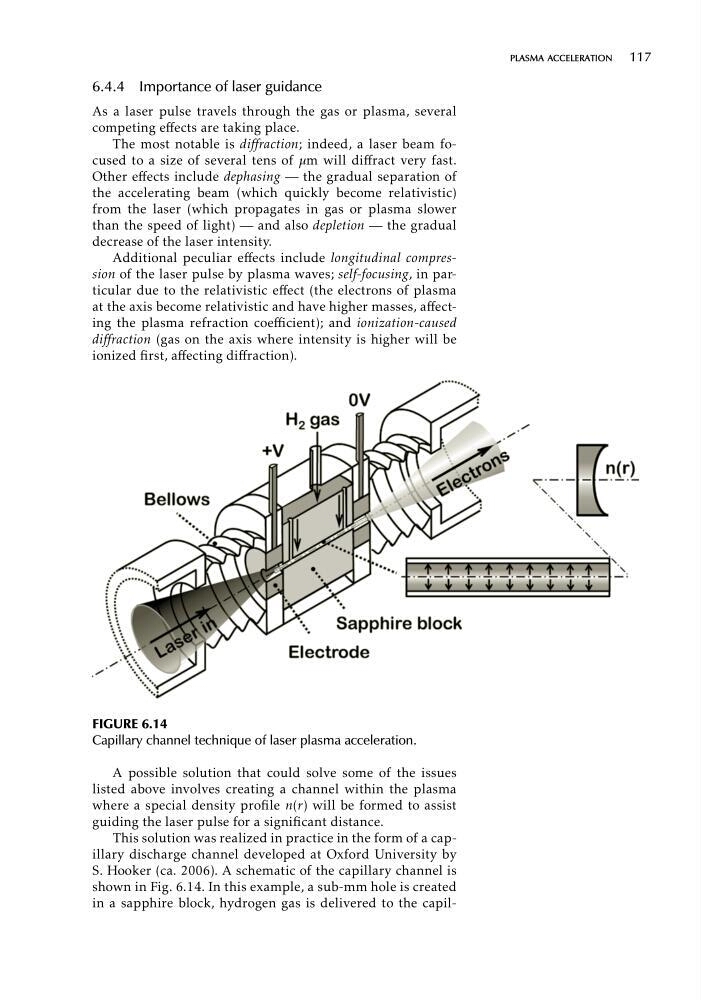
FIGURE 6.14
Capillary channel technique of laser plasma acceleration.
A possible solution that could solve some of the issues
listed above involves creating a channel within the plasma
where a special density profile n(r) will be formed to assist
guiding the laser pulse for a significant distance.
This solution was realized in practice in the form of a capillary discharge channel developed at Oxford University by
S. Hooker (ca. 2006). A schematic of the capillary channel is
shown in Fig. 6.14. In this example, a sub-mm hole is created
in a sapphire block, hydrogen gas is delivered to the capil
6.4.4 Importance of laser guidance
As a laser pulse travels through the gas or plasma, several
competing effects are taking place.
The most notable is diffraction; indeed, a laser beam focused to a size of several tens of μm will diffract very fast.
Other effects include dephasing — the gradual separation of
the accelerating beam (which quickly become relativistic)
from the laser (which propagates in gas or plasma slower
than the speed of light) — and also depletion — the gradual
decrease of the laser intensity.
Additional peculiar effects include longitudinal compression of the laser pulse by plasma waves; self-focusing, in particular due to the relativistic effect (the electrons of plasma
at the axis become relativistic and have higher masses, affecting the plasma refraction coefficient); and ionization-caused
diffraction (gas on the axis where intensity is higher will be
ionized first, affecting diffraction).
FIGURE 6.14
Capillary channel technique of laser plasma acceleration.
A possible solution that could solve some of the issues
listed above involves creating a channel within the plasma
where a special density profile n(r) will be formed to assist
guiding the laser pulse for a significant distance.
This solution was realized in practice in the form of a capillary discharge channel developed at Oxford University by
S. Hooker (ca. 2006). A schematic of the capillary channel is
shown in Fig. 6.14. In this example, a sub-mm hole is created
in a sapphire block, hydrogen gas is delivered to the capil