

116 unifying physics of accelerators, lasers and plasma
6.4.2 Laser plasma acceleration in nonlinear regime
Ponderomotive force plays a key role in the formation of
the accelerating bubble in the nonlinear (also called blow-out)
regime of laser plasma acceleration.
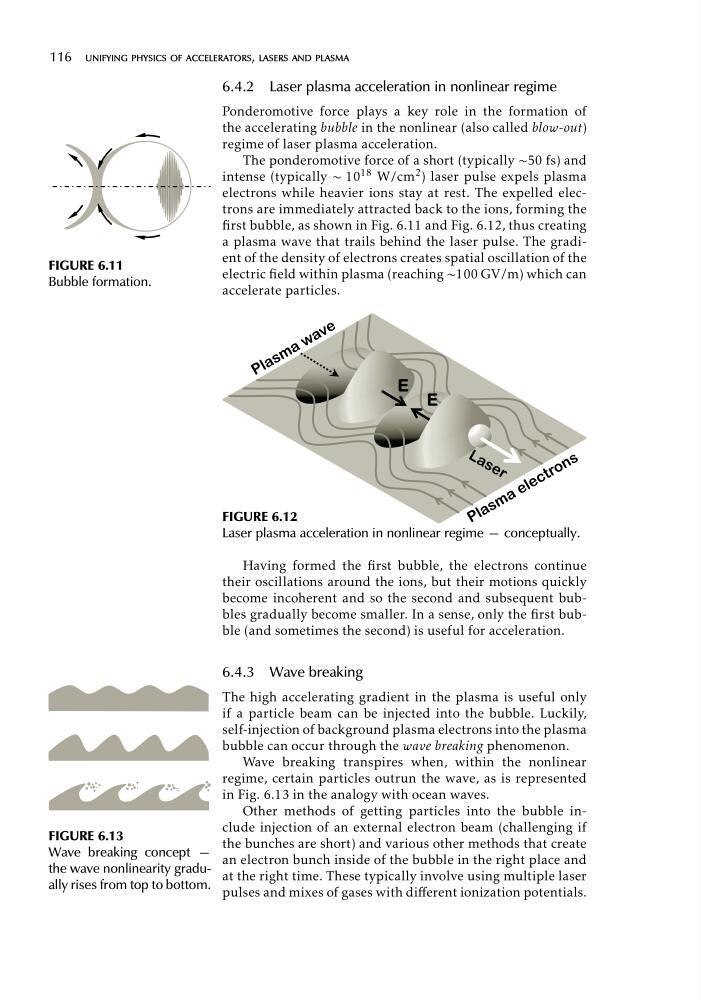
FIGURE 6.11
Bubble formation.
The ponderomotive force of a short (typically ∼50 fs) and
intense (typically ∼ 10 18 W/cm 2 ) laser pulse expels plasma
electrons while heavier ions stay at rest. The expelled electrons are immediately attracted back to the ions, forming the
first bubble, as shown in Fig. 6.11 and Fig. 6.12, thus creating
a plasma wave that trails behind the laser pulse. The gradient of the density of electrons creates spatial oscillation of the
electric field within plasma (reaching ∼100 GV/m) which can
accelerate particles.
FIGURE 6.12
FIGURE 6.13
Wave breaking concept —
the wave nonlinearity gradually rises from top to bottom.
Laser plasma acceleration in nonlinear regime — conceptually.
Having formed the first bubble, the electrons continue
their oscillations around the ions, but their motions quickly
become incoherent and so the second and subsequent bubbles gradually become smaller. In a sense, only the first bubble (and sometimes the second) is useful for acceleration.
6.4.3 Wave breaking
The high accelerating gradient in the plasma is useful only
if a particle beam can be injected into the bubble. Luckily,
self-injection of background plasma electrons into the plasma
bubble can occur through the wave breaking phenomenon.
Wave breaking transpires when, within the nonlinear
regime, certain particles outrun the wave, as is represented
in Fig. 6.13 in the analogy with ocean waves.
Other methods of getting particles into the bubble include injection of an external electron beam (challenging if
the bunches are short) and various other methods that create
an electron bunch inside of the bubble in the right place and
at the right time. These typically involve using multiple laser
pulses and mixes of gases with different ionization potentials.
6.4.2 Laser plasma acceleration in nonlinear regime
Ponderomotive force plays a key role in the formation of
the accelerating bubble in the nonlinear (also called blow-out)
regime of laser plasma acceleration.
FIGURE 6.11
Bubble formation.
The ponderomotive force of a short (typically ∼50 fs) and
intense (typically ∼ 10 18 W/cm 2 ) laser pulse expels plasma
electrons while heavier ions stay at rest. The expelled electrons are immediately attracted back to the ions, forming the
first bubble, as shown in Fig. 6.11 and Fig. 6.12, thus creating
a plasma wave that trails behind the laser pulse. The gradient of the density of electrons creates spatial oscillation of the
electric field within plasma (reaching ∼100 GV/m) which can
accelerate particles.
FIGURE 6.12
FIGURE 6.13
Wave breaking concept —
the wave nonlinearity gradually rises from top to bottom.
Laser plasma acceleration in nonlinear regime — conceptually.
Having formed the first bubble, the electrons continue
their oscillations around the ions, but their motions quickly
become incoherent and so the second and subsequent bubbles gradually become smaller. In a sense, only the first bubble (and sometimes the second) is useful for acceleration.
6.4.3 Wave breaking
The high accelerating gradient in the plasma is useful only
if a particle beam can be injected into the bubble. Luckily,
self-injection of background plasma electrons into the plasma
bubble can occur through the wave breaking phenomenon.
Wave breaking transpires when, within the nonlinear
regime, certain particles outrun the wave, as is represented
in Fig. 6.13 in the analogy with ocean waves.
Other methods of getting particles into the bubble include injection of an external electron beam (challenging if
the bunches are short) and various other methods that create
an electron bunch inside of the bubble in the right place and
at the right time. These typically involve using multiple laser
pulses and mixes of gases with different ionization potentials.