

114 unifying physics of accelerators, lasers and plasma
6.4 The concept of laser acceleration
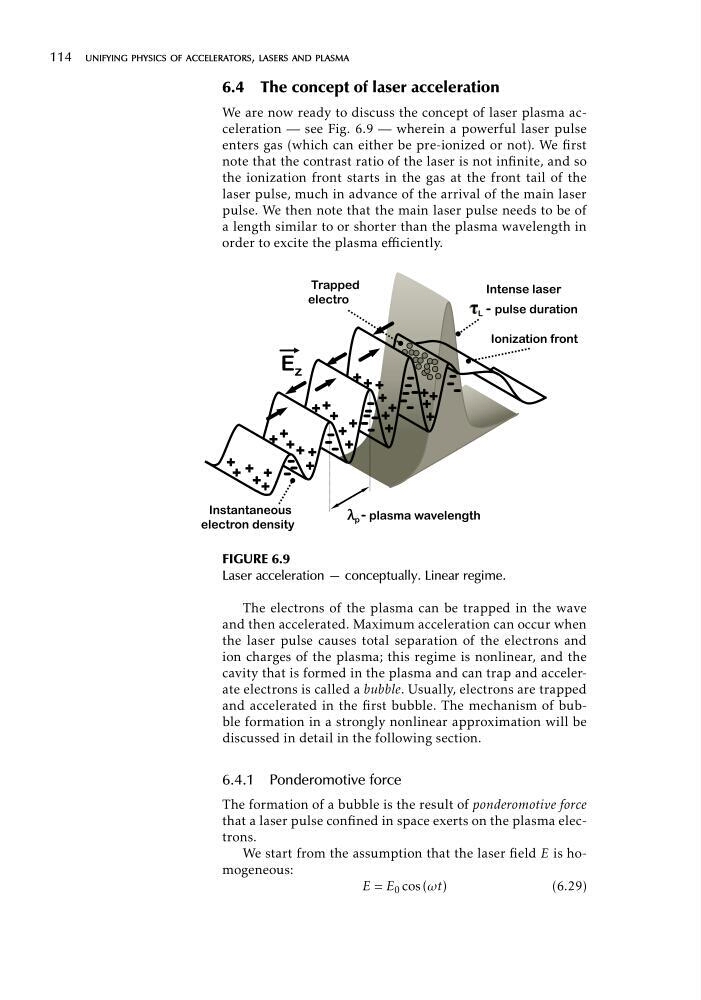
We are now ready to discuss the concept of laser plasma acceleration — see Fig. 6.9 — wherein a powerful laser pulse
enters gas (which can either be pre-ionized or not). We first
note that the contrast ratio of the laser is not infinite, and so
the ionization front starts in the gas at the front tail of the
laser pulse, much in advance of the arrival of the main laser
pulse. We then note that the main laser pulse needs to be of
a length similar to or shorter than the plasma wavelength in
order to excite the plasma efficiently.
FIGURE 6.9
Laser acceleration — conceptually. Linear regime.
The electrons of the plasma can be trapped in the wave
and then accelerated. Maximum acceleration can occur when
the laser pulse causes total separation of the electrons and
ion charges of the plasma; this regime is nonlinear, and the
cavity that is formed in the plasma and can trap and accelerate electrons is called a bubble. Usually, electrons are trapped
and accelerated in the first bubble. The mechanism of bubble formation in a strongly nonlinear approximation will be
discussed in detail in the following section.
6.4.1 Ponderomotive force
The formation of a bubble is the result of ponderomotive force
that a laser pulse confined in space exerts on the plasma electrons.
We start from the assumption that the laser field E is homogeneous:
E = E 0 cos (ωt)
(6.29)
6.4 The concept of laser acceleration
We are now ready to discuss the concept of laser plasma acceleration — see Fig. 6.9 — wherein a powerful laser pulse
enters gas (which can either be pre-ionized or not). We first
note that the contrast ratio of the laser is not infinite, and so
the ionization front starts in the gas at the front tail of the
laser pulse, much in advance of the arrival of the main laser
pulse. We then note that the main laser pulse needs to be of
a length similar to or shorter than the plasma wavelength in
order to excite the plasma efficiently.
FIGURE 6.9
Laser acceleration — conceptually. Linear regime.
The electrons of the plasma can be trapped in the wave
and then accelerated. Maximum acceleration can occur when
the laser pulse causes total separation of the electrons and
ion charges of the plasma; this regime is nonlinear, and the
cavity that is formed in the plasma and can trap and accelerate electrons is called a bubble. Usually, electrons are trapped
and accelerated in the first bubble. The mechanism of bubble formation in a strongly nonlinear approximation will be
discussed in detail in the following section.
6.4.1 Ponderomotive force
The formation of a bubble is the result of ponderomotive force
that a laser pulse confined in space exerts on the plasma electrons.
We start from the assumption that the laser field E is homogeneous:
E = E 0 cos (ωt)
(6.29)