

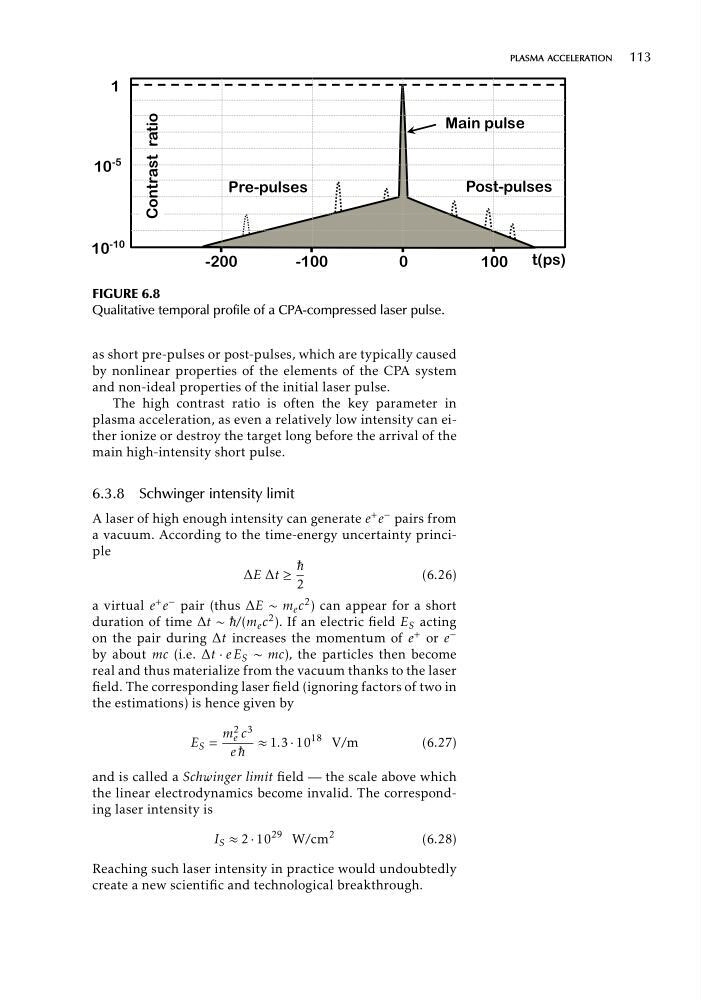
FIGURE 6.8
&RQWUDVWUDWLR
3UHSXOVHV
3RVWSXOVHV
0DLQSXOVH
WSV
Qualitative temporal profile of a CPA-compressed laser pulse.
plasma acceleration 113
as short pre-pulses or post-pulses, which are typically caused
by nonlinear properties of the elements of the CPA system
and non-ideal properties of the initial laser pulse.
The high contrast ratio is often the key parameter in
plasma acceleration, as even a relatively low intensity can either ionize or destroy the target long before the arrival of the
main high-intensity short pulse.
6.3.8 Schwinger intensity limit
+
A laser of high enough intensity can generate e e − pairs from
a vacuum. According to the time-energy uncertainty principle
n
ΔE Δt ≥
(6.26)
2
+
a virtual e e − pair (thus ΔE ∼ m e c 2 ) can appear for a short
duration of time Δt ∼ n/(m e c 2 ). If an electric field E S acting
+
−
on the pair during Δt increases the momentum of e or e
by about mc (i.e. Δt · e E S ∼ mc), the particles then become
real and thus materialize from the vacuum thanks to the laser
field. The corresponding laser field (ignoring factors of two in
the estimations) is hence given by
2 3
m c ≈ 1.3 · 10
18
e
E S =
V/m
(6.27)
e n
and is called a Schwinger limit field — the scale above which
the linear electrodynamics become invalid. The corresponding laser intensity is
I S ≈ 2 · 10
29 W/cm
2
(6.28)
Reaching such laser intensity in practice would undoubtedly
create a new scientific and technological breakthrough.
&RQWUDVWUDWLR
3UHSXOVHV
3RVWSXOVHV
0DLQSXOVH
WSV
Qualitative temporal profile of a CPA-compressed laser pulse.
plasma acceleration 113
as short pre-pulses or post-pulses, which are typically caused
by nonlinear properties of the elements of the CPA system
and non-ideal properties of the initial laser pulse.
The high contrast ratio is often the key parameter in
plasma acceleration, as even a relatively low intensity can either ionize or destroy the target long before the arrival of the
main high-intensity short pulse.
6.3.8 Schwinger intensity limit
+
A laser of high enough intensity can generate e e − pairs from
a vacuum. According to the time-energy uncertainty principle
n
ΔE Δt ≥
(6.26)
2
+
a virtual e e − pair (thus ΔE ∼ m e c 2 ) can appear for a short
duration of time Δt ∼ n/(m e c 2 ). If an electric field E S acting
+
−
on the pair during Δt increases the momentum of e or e
by about mc (i.e. Δt · e E S ∼ mc), the particles then become
real and thus materialize from the vacuum thanks to the laser
field. The corresponding laser field (ignoring factors of two in
the estimations) is hence given by
2 3
m c ≈ 1.3 · 10
18
e
E S =
V/m
(6.27)
e n
and is called a Schwinger limit field — the scale above which
the linear electrodynamics become invalid. The corresponding laser intensity is
I S ≈ 2 · 10
29 W/cm
2
(6.28)
Reaching such laser intensity in practice would undoubtedly
create a new scientific and technological breakthrough.