

112 unifying physics of accelerators, lasers and plasma
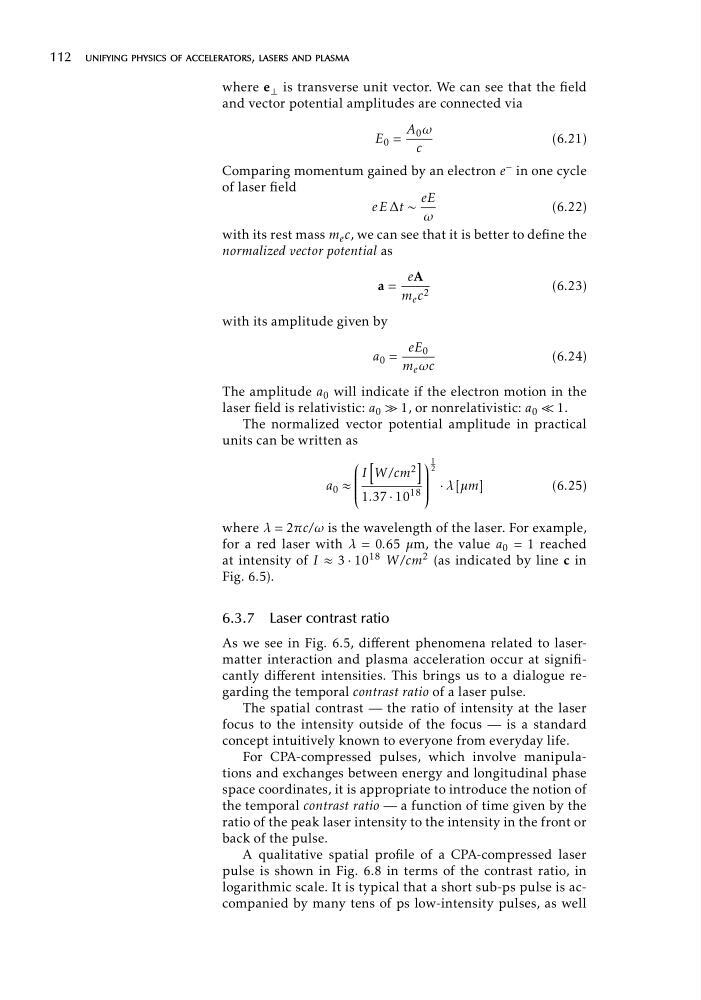
where e ⊥ is transverse unit vector. We can see that the field
and vector potential amplitudes are connected via
A 0 ω
E 0 =
(6.21)
c
Comparing momentum gained by an electron e − in one cycle
of laser field
eE
e E Δt ∼
(6.22)
ω
with its rest mass m e c, we can see that it is better to define the
normalized vector potential as
eA
a =
2
(6.23)
m e c
with its amplitude given by
eE 0
a 0 =
(6.24)
m e ωc
The amplitude a 0 will indicate if the electron motion in the
laser field is relativistic: a 0 » 1, or nonrelativistic: a 0 « 1.
The normalized vector potential amplitude in practical
units can be written as
⎛ [
] ⎞ 1
⎜
⎟
⎜ I W /cm 2 ⎟
2
⎜
⎟
⎜
⎟
a 0 ≈ ⎜
⎟ · λ [μm]
(6.25)
⎜
⎟
⎝ 1.37 · 10 18 ⎠
where λ = 2πc/ω is the wavelength of the laser. For example,
for a red laser with λ = 0.65 μm, the value a 0 = 1 reached
at intensity of I ≈ 3 · 10 18 W /cm 2 (as indicated by line c in
Fig. 6.5).
6.3.7 Laser contrast ratio
As we see in Fig. 6.5, different phenomena related to lasermatter interaction and plasma acceleration occur at significantly different intensities. This brings us to a dialogue regarding the temporal contrast ratio of a laser pulse.
The spatial contrast — the ratio of intensity at the laser
focus to the intensity outside of the focus — is a standard
concept intuitively known to everyone from everyday life.
For CPA-compressed pulses, which involve manipulations and exchanges between energy and longitudinal phase
space coordinates, it is appropriate to introduce the notion of
the temporal contrast ratio — a function of time given by the
ratio of the peak laser intensity to the intensity in the front or
back of the pulse.
A qualitative spatial profile of a CPA-compressed laser
pulse is shown in Fig. 6.8 in terms of the contrast ratio, in
logarithmic scale. It is typical that a short sub-ps pulse is accompanied by many tens of ps low-intensity pulses, as well
where e ⊥ is transverse unit vector. We can see that the field
and vector potential amplitudes are connected via
A 0 ω
E 0 =
(6.21)
c
Comparing momentum gained by an electron e − in one cycle
of laser field
eE
e E Δt ∼
(6.22)
ω
with its rest mass m e c, we can see that it is better to define the
normalized vector potential as
eA
a =
2
(6.23)
m e c
with its amplitude given by
eE 0
a 0 =
(6.24)
m e ωc
The amplitude a 0 will indicate if the electron motion in the
laser field is relativistic: a 0 » 1, or nonrelativistic: a 0 « 1.
The normalized vector potential amplitude in practical
units can be written as
⎛ [
] ⎞ 1
⎜
⎟
⎜ I W /cm 2 ⎟
2
⎜
⎟
⎜
⎟
a 0 ≈ ⎜
⎟ · λ [μm]
(6.25)
⎜
⎟
⎝ 1.37 · 10 18 ⎠
where λ = 2πc/ω is the wavelength of the laser. For example,
for a red laser with λ = 0.65 μm, the value a 0 = 1 reached
at intensity of I ≈ 3 · 10 18 W /cm 2 (as indicated by line c in
Fig. 6.5).
6.3.7 Laser contrast ratio
As we see in Fig. 6.5, different phenomena related to lasermatter interaction and plasma acceleration occur at significantly different intensities. This brings us to a dialogue regarding the temporal contrast ratio of a laser pulse.
The spatial contrast — the ratio of intensity at the laser
focus to the intensity outside of the focus — is a standard
concept intuitively known to everyone from everyday life.
For CPA-compressed pulses, which involve manipulations and exchanges between energy and longitudinal phase
space coordinates, it is appropriate to introduce the notion of
the temporal contrast ratio — a function of time given by the
ratio of the peak laser intensity to the intensity in the front or
back of the pulse.
A qualitative spatial profile of a CPA-compressed laser
pulse is shown in Fig. 6.8 in terms of the contrast ratio, in
logarithmic scale. It is typical that a short sub-ps pulse is accompanied by many tens of ps low-intensity pulses, as well