

plasma acceleration 111
9[
H [
[ PD[
[
( LRQ
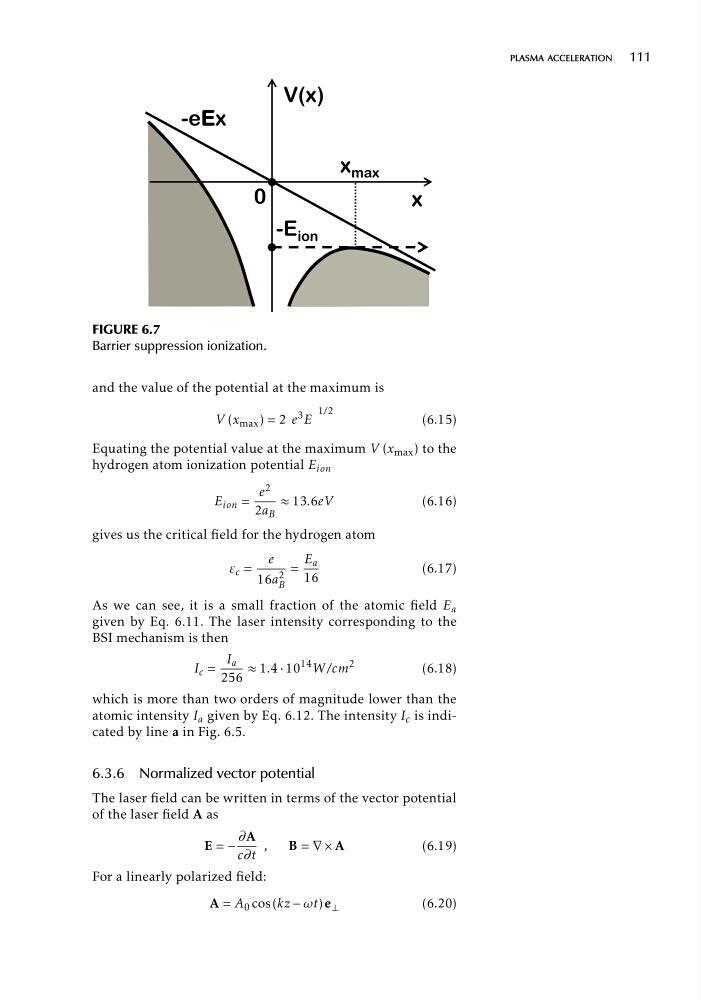
FIGURE 6.7
Barrier suppression ionization.
and the value of the potential at the maximum is
V (x max ) = 2
Equating the potential value at the
1
3
/2
e E
(6.15)
maximum V (x max ) to the
hydrogen atom ionization potential E ion
e 2
E ion =
13.6eV
(6.16)
2a B
≈
gives us the critical field for the hydrogen atom
e
E
=
a
ε c
=
(6.17)
16
2
a
16
B
As we can see, it is a small fraction of the atomic field E a
given by Eq. 6.11. The laser intensity corresponding to the
BSI mechanism is then
I a
14
2
I c =
≈ 1.4 · 10 W /cm
(6.18)
256
which is more than two orders of magnitude lower than the
atomic intensity I a given by Eq. 6.12. The intensity I c is indicated by line a in Fig. 6.5.
6.3.6 Normalized vector potential
The laser field can be written in terms of the vector potential
of the laser field A as
∂A
E = −
,
B =
c∂t
∇ × A
(6.19)
For a linearly polarized field:
A = A 0 cos (kz − ωt) e ⊥
(6.20)
9[
H [
[ PD[
[
( LRQ
FIGURE 6.7
Barrier suppression ionization.
and the value of the potential at the maximum is
V (x max ) = 2
Equating the potential value at the
1
3
/2
e E
(6.15)
maximum V (x max ) to the
hydrogen atom ionization potential E ion
e 2
E ion =
13.6eV
(6.16)
2a B
≈
gives us the critical field for the hydrogen atom
e
E
=
a
ε c
=
(6.17)
16
2
a
16
B
As we can see, it is a small fraction of the atomic field E a
given by Eq. 6.11. The laser intensity corresponding to the
BSI mechanism is then
I a
14
2
I c =
≈ 1.4 · 10 W /cm
(6.18)
256
which is more than two orders of magnitude lower than the
atomic intensity I a given by Eq. 6.12. The intensity I c is indicated by line a in Fig. 6.5.
6.3.6 Normalized vector potential
The laser field can be written in terms of the vector potential
of the laser field A as
∂A
E = −
,
B =
c∂t
∇ × A
(6.19)
For a linearly polarized field:
A = A 0 cos (kz − ωt) e ⊥
(6.20)