

110 unifying physics of accelerators, lasers and plasma
One more vital intensity limit relevant to Fig. 6.5 —
but not shown as it would be significantly off-scale (around
2 · 10 29 W/cm 2 ) — is the Schwinger intensity limit, which corresponds to the case when the laser field can produce e + e −
pairs from a vacuum (this will be discussed further in Section 6.3.8).
6.3.4 Types of ionization
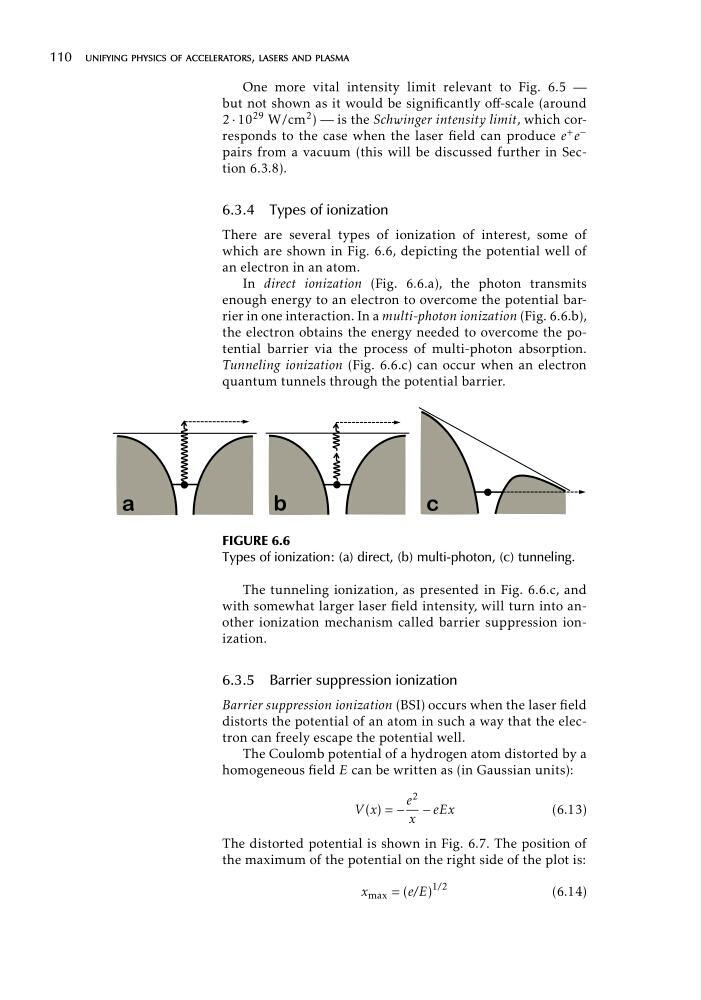
There are several types of ionization of interest, some of
which are shown in Fig. 6.6, depicting the potential well of
an electron in an atom.
In direct ionization (Fig. 6.6.a), the photon transmits
enough energy to an electron to overcome the potential barrier in one interaction. In a multi-photon ionization (Fig. 6.6.b),
the electron obtains the energy needed to overcome the potential barrier via the process of multi-photon absorption.
Tunneling ionization (Fig. 6.6.c) can occur when an electron
quantum tunnels through the potential barrier.
D
E
F
FIGURE 6.6
Types of ionization: (a) direct, (b) multi-photon, (c) tunneling.
The tunneling ionization, as presented in Fig. 6.6.c, and
with somewhat larger laser field intensity, will turn into another ionization mechanism called barrier suppression ionization.
6.3.5 Barrier suppression ionization
Barrier suppression ionization (BSI) occurs when the laser field
distorts the potential of an atom in such a way that the electron can freely escape the potential well.
The Coulomb potential of a hydrogen atom distorted by a
homogeneous field E can be written as (in Gaussian units):
2
e
V (x) = − − eEx
(6.13)
x
The distorted potential is shown in Fig. 6.7. The position of
the maximum of the potential on the right side of the plot is:
x max = (e/E)
1/2
(6.14)
One more vital intensity limit relevant to Fig. 6.5 —
but not shown as it would be significantly off-scale (around
2 · 10 29 W/cm 2 ) — is the Schwinger intensity limit, which corresponds to the case when the laser field can produce e + e −
pairs from a vacuum (this will be discussed further in Section 6.3.8).
6.3.4 Types of ionization
There are several types of ionization of interest, some of
which are shown in Fig. 6.6, depicting the potential well of
an electron in an atom.
In direct ionization (Fig. 6.6.a), the photon transmits
enough energy to an electron to overcome the potential barrier in one interaction. In a multi-photon ionization (Fig. 6.6.b),
the electron obtains the energy needed to overcome the potential barrier via the process of multi-photon absorption.
Tunneling ionization (Fig. 6.6.c) can occur when an electron
quantum tunnels through the potential barrier.
D
E
F
FIGURE 6.6
Types of ionization: (a) direct, (b) multi-photon, (c) tunneling.
The tunneling ionization, as presented in Fig. 6.6.c, and
with somewhat larger laser field intensity, will turn into another ionization mechanism called barrier suppression ionization.
6.3.5 Barrier suppression ionization
Barrier suppression ionization (BSI) occurs when the laser field
distorts the potential of an atom in such a way that the electron can freely escape the potential well.
The Coulomb potential of a hydrogen atom distorted by a
homogeneous field E can be written as (in Gaussian units):
2
e
V (x) = − − eEx
(6.13)
x
The distorted potential is shown in Fig. 6.7. The position of
the maximum of the potential on the right side of the plot is:
x max = (e/E)
1/2
(6.14)