

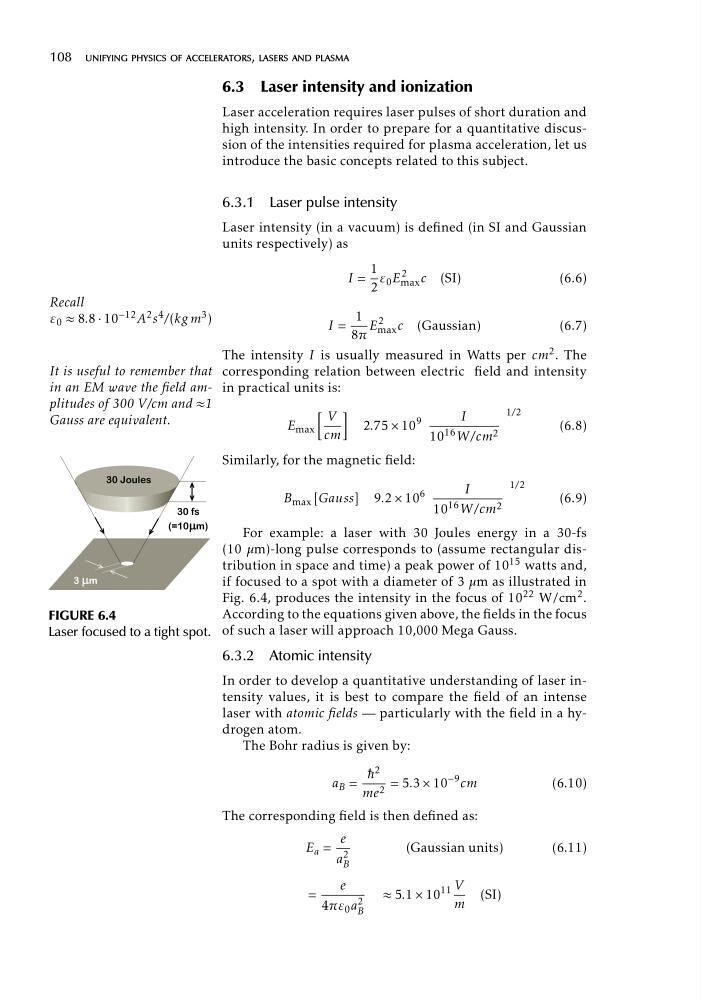
FIGURE 6.4
Laser focused to a tight spot.
108 unifying physics of accelerators, lasers and plasma
6.3 Laser intensity and ionization
Laser acceleration requires laser pulses of short duration and
high intensity. In order to prepare for a quantitative discussion of the intensities required for plasma acceleration, let us
introduce the basic concepts related to this subject.
6.3.1 Laser pulse intensity
Laser intensity (in a vacuum) is defined (in SI and Gaussian
units respectively) as
1
=
2
I
ε E c (SI)
(6.6)
2
0 max
Recall
ε 0 ≈ 8.8 · 10 −12 A 2 s 4 /(kg m 3 )
1
I =
2
E c (Gaussian)
(6.7)
8π
max
The intensity I is usually measured in Watts per cm 2 . The
It is useful to remember that corresponding relation between electric field and intensity
in an EM wave the field am- in practical units is:
plitudes of 300 V/cm and
equivalent.
≈1
Gauss are
[ V
]
9
I
1/2
E max
� 2.75 × 10
(6.8)
cm
10 16 W /cm 2
Similarly, for the magnetic field:
1 2
I
/
B max [Gauss] � 9.2 × 10
6
(6.9)
10 16 W /cm 2
For example: a laser with 30 Joules energy in a 30-fs
(10 μm)-long pulse corresponds to (assume rectangular distribution in space and time) a peak power of 10 15 watts and,
if focused to a spot with a diameter of 3 μm as illustrated in
Fig. 6.4, produces the intensity in the focus of 10 22 W/cm 2 .
According to the equations given above, the fields in the focus
of such a laser will approach 10,000 Mega Gauss.
6.3.2 Atomic intensity
In order to develop a quantitative understanding of laser intensity values, it is best to compare the field of an intense
laser with atomic fields — particularly with the field in a hydrogen atom.
The Bohr radius is given by:
n 2
a B =
= 5
9
.3 × 10
− cm
(6.10)
me 2
The corresponding field is then defined as:
e
E a =
(Gaussian units)
(6.11)
2
a B
e
V
=
5.1 10
11
(SI)
4
2
πε 0 a B
≈
×
m
Laser focused to a tight spot.
108 unifying physics of accelerators, lasers and plasma
6.3 Laser intensity and ionization
Laser acceleration requires laser pulses of short duration and
high intensity. In order to prepare for a quantitative discussion of the intensities required for plasma acceleration, let us
introduce the basic concepts related to this subject.
6.3.1 Laser pulse intensity
Laser intensity (in a vacuum) is defined (in SI and Gaussian
units respectively) as
1
=
2
I
ε E c (SI)
(6.6)
2
0 max
Recall
ε 0 ≈ 8.8 · 10 −12 A 2 s 4 /(kg m 3 )
1
I =
2
E c (Gaussian)
(6.7)
8π
max
The intensity I is usually measured in Watts per cm 2 . The
It is useful to remember that corresponding relation between electric field and intensity
in an EM wave the field am- in practical units is:
plitudes of 300 V/cm and
equivalent.
≈1
Gauss are
[ V
]
9
I
1/2
E max
� 2.75 × 10
(6.8)
cm
10 16 W /cm 2
Similarly, for the magnetic field:
1 2
I
/
B max [Gauss] � 9.2 × 10
6
(6.9)
10 16 W /cm 2
For example: a laser with 30 Joules energy in a 30-fs
(10 μm)-long pulse corresponds to (assume rectangular distribution in space and time) a peak power of 10 15 watts and,
if focused to a spot with a diameter of 3 μm as illustrated in
Fig. 6.4, produces the intensity in the focus of 10 22 W/cm 2 .
According to the equations given above, the fields in the focus
of such a laser will approach 10,000 Mega Gauss.
6.3.2 Atomic intensity
In order to develop a quantitative understanding of laser intensity values, it is best to compare the field of an intense
laser with atomic fields — particularly with the field in a hydrogen atom.
The Bohr radius is given by:
n 2
a B =
= 5
9
.3 × 10
− cm
(6.10)
me 2
The corresponding field is then defined as:
e
E a =
(Gaussian units)
(6.11)
2
a B
e
V
=
5.1 10
11
(SI)
4
2
πε 0 a B
≈
×
m