

plasma acceleration 107
6.2 Early steps of plasma acceleration
We see that GeV/cm requires plasma with n=10 18 cm −3 . The
plasma wavelength
10 17 −3
c
cm
λ p =
or λ p ≈ 0.1mm
(6.5)
f p
n
−3
corresponding to a plasma density of 10 18 cm is around
λ p ≈ 30 μm (or around 100 fs). Thus, short sub-100-fs pulses
are needed to excite plasma towards GeV/cm accelerating
gradients.
In the absence of such short laser pulses, in the late 1970s
and early 1980s, other methods of plasma excitation were
suggested (by J.M. Dawson, 1979) such as the plasma beat
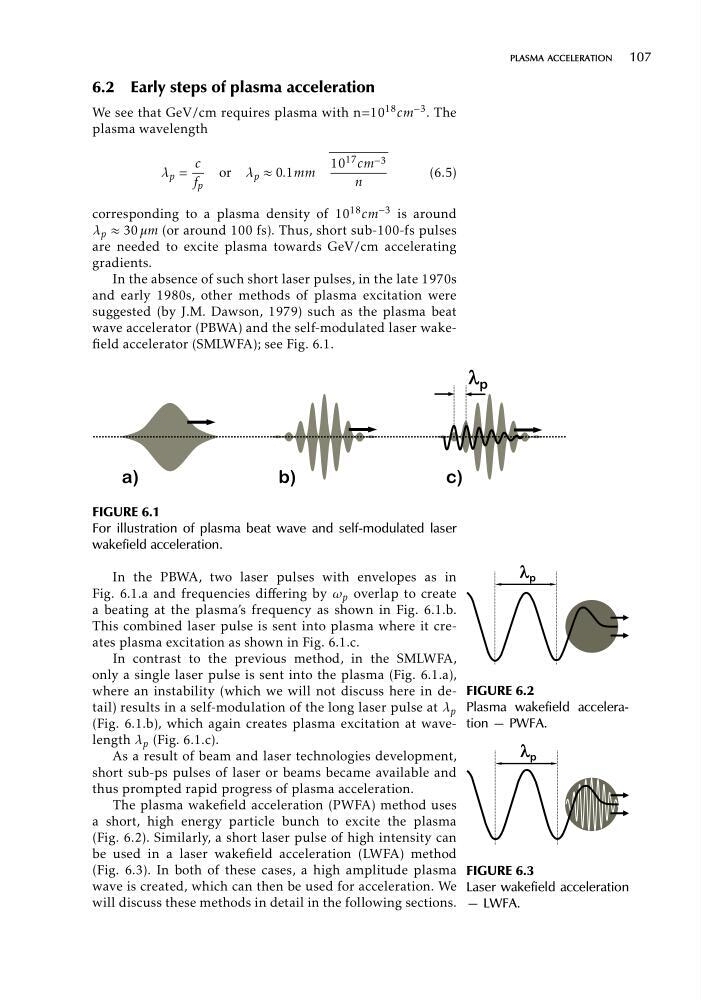
wave accelerator (PBWA) and the self-modulated laser wakefield accelerator (SMLWFA); see Fig. 6.1.
D
E
F
S
FIGURE 6.1
For illustration of plasma beat wave and self-modulated laser
wakefield acceleration.
In the PBWA, two laser pulses with envelopes as in
Fig. 6.1.a and frequencies differing by ω p overlap to create
a beating at the plasma’s frequency as shown in Fig. 6.1.b.
This combined laser pulse is sent into plasma where it creates plasma excitation as shown in Fig. 6.1.c.
In contrast to the previous method, in the SMLWFA,
only a single laser pulse is sent into the plasma (Fig. 6.1.a),
where an instability (which we will not discuss here in detail) results in a self-modulation of the long laser pulse at λ p
(Fig. 6.1.b), which again creates plasma excitation at wave t
length λ p (Fig. 6.1.c).
As a result of beam and laser technologies development,
short sub-ps pulses of laser or beams became available and
thus prompted rapid progress of plasma acceleration.
The plasma wakefield acceleration (PWFA) method uses
a short, high energy particle bunch to excite the plasma
(Fig. 6.2). Similarly, a short laser pulse of high intensity can
be used in a laser wakefield acceleration (LWFA) method
(Fig. 6.3). In both of these cases, a high amplitude plasma
wave is created, which can then be used for acceleration. We
will discuss these methods in detail in the following sections.
S
FIGURE 6.2
Plasma wakefield acceleraion — PWFA.
S
FIGURE 6.3
Laser wakefield acceleration
— LWFA.
6.2 Early steps of plasma acceleration
We see that GeV/cm requires plasma with n=10 18 cm −3 . The
plasma wavelength
10 17 −3
c
cm
λ p =
or λ p ≈ 0.1mm
(6.5)
f p
n
−3
corresponding to a plasma density of 10 18 cm is around
λ p ≈ 30 μm (or around 100 fs). Thus, short sub-100-fs pulses
are needed to excite plasma towards GeV/cm accelerating
gradients.
In the absence of such short laser pulses, in the late 1970s
and early 1980s, other methods of plasma excitation were
suggested (by J.M. Dawson, 1979) such as the plasma beat
wave accelerator (PBWA) and the self-modulated laser wakefield accelerator (SMLWFA); see Fig. 6.1.
D
E
F
S
FIGURE 6.1
For illustration of plasma beat wave and self-modulated laser
wakefield acceleration.
In the PBWA, two laser pulses with envelopes as in
Fig. 6.1.a and frequencies differing by ω p overlap to create
a beating at the plasma’s frequency as shown in Fig. 6.1.b.
This combined laser pulse is sent into plasma where it creates plasma excitation as shown in Fig. 6.1.c.
In contrast to the previous method, in the SMLWFA,
only a single laser pulse is sent into the plasma (Fig. 6.1.a),
where an instability (which we will not discuss here in detail) results in a self-modulation of the long laser pulse at λ p
(Fig. 6.1.b), which again creates plasma excitation at wave t
length λ p (Fig. 6.1.c).
As a result of beam and laser technologies development,
short sub-ps pulses of laser or beams became available and
thus prompted rapid progress of plasma acceleration.
The plasma wakefield acceleration (PWFA) method uses
a short, high energy particle bunch to excite the plasma
(Fig. 6.2). Similarly, a short laser pulse of high intensity can
be used in a laser wakefield acceleration (LWFA) method
(Fig. 6.3). In both of these cases, a high amplitude plasma
wave is created, which can then be used for acceleration. We
will discuss these methods in detail in the following sections.
S
FIGURE 6.2
Plasma wakefield acceleraion — PWFA.
S
FIGURE 6.3
Laser wakefield acceleration
— LWFA.