

100 unifying physics of accelerators, lasers and plasma
dreds of turns), i.e., such oscillations are very slow. The synchrotron tune is connected to the synchrotron frequency as
follows
2πT rev
Q S =
(5.52)
ω S
where T rev is the period of revolution around the orbit. Typically, Q S « 1.
In contrast, transverse betatron oscillations, in circular accelerators with strong focusing, are necessarily fast (there are
usually many tens or hundreds of oscillations per revolution
period). The betatron tune is defined as the number of oscillations around the ring or the ratio of the betatron frequency
to the revolution frequency
μ
1
ds '
Q =
=
2π 2π β(s ' )
where the integral is taken along the accelerator circumference. Typically, Q » 1.
[
4 V 4 V
4
7 UHY
7 UHY
7 UHY
7 UHY
W
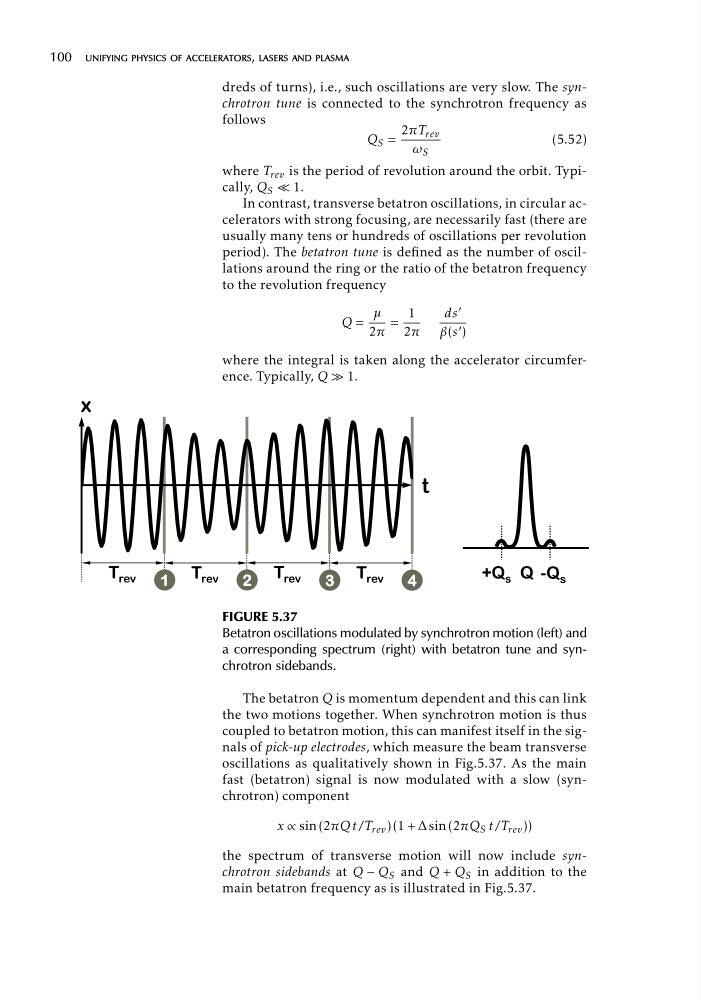
FIGURE 5.37
Betatron oscillations modulated by synchrotron motion (left) and
a corresponding spectrum (right) with betatron tune and synchrotron sidebands.
The betatron Q is momentum dependent and this can link
the two motions together. When synchrotron motion is thus
coupled to betatron motion, this can manifest itself in the signals of pick-up electrodes, which measure the beam transverse
oscillations as qualitatively shown in Fig.5.37. As the main
fast (betatron) signal is now modulated with a slow (synchrotron) component
x ∝ sin (2πQ t /T rev ) (1 + Δ sin (2πQ S t /T rev ))
the spectrum of transverse motion will now include synchrotron sidebands at Q − Q S and Q + Q S in addition to the
main betatron frequency as is illustrated in Fig.5.37.
dreds of turns), i.e., such oscillations are very slow. The synchrotron tune is connected to the synchrotron frequency as
follows
2πT rev
Q S =
(5.52)
ω S
where T rev is the period of revolution around the orbit. Typically, Q S « 1.
In contrast, transverse betatron oscillations, in circular accelerators with strong focusing, are necessarily fast (there are
usually many tens or hundreds of oscillations per revolution
period). The betatron tune is defined as the number of oscillations around the ring or the ratio of the betatron frequency
to the revolution frequency
μ
1
ds '
Q =
=
2π 2π β(s ' )
where the integral is taken along the accelerator circumference. Typically, Q » 1.
[
4 V 4 V
4
7 UHY
7 UHY
7 UHY
7 UHY
W
FIGURE 5.37
Betatron oscillations modulated by synchrotron motion (left) and
a corresponding spectrum (right) with betatron tune and synchrotron sidebands.
The betatron Q is momentum dependent and this can link
the two motions together. When synchrotron motion is thus
coupled to betatron motion, this can manifest itself in the signals of pick-up electrodes, which measure the beam transverse
oscillations as qualitatively shown in Fig.5.37. As the main
fast (betatron) signal is now modulated with a slow (synchrotron) component
x ∝ sin (2πQ t /T rev ) (1 + Δ sin (2πQ S t /T rev ))
the spectrum of transverse motion will now include synchrotron sidebands at Q − Q S and Q + Q S in addition to the
main betatron frequency as is illustrated in Fig.5.37.