

conventional acceleration 99
of the potential where U flattens and passes through a local
maximum, creating conditions for certain trajectories to take
an arbitrarily long time for passing through the saddle point
region. The trajectory that originates from the vicinity of the
saddle point and separates the stable area from an unstable
area is called the separatrix.
5.5.4 RF potential — nonlinearity and adiabaticity
The RF potential, as we can see in Eqs.5.51, is intrinsically
nonlinear. Particles that are located close to the separatrix
will have longer periods of oscillations and will therefore lag
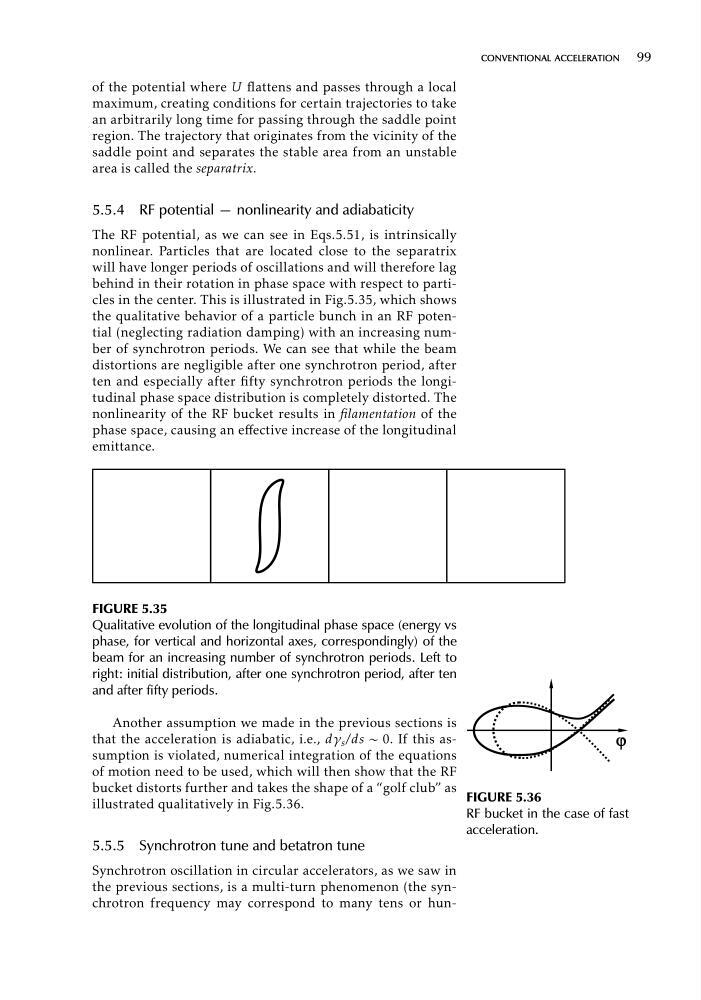
behind in their rotation in phase space with respect to particles in the center. This is illustrated in Fig.5.35, which shows
the qualitative behavior of a particle bunch in an RF potential (neglecting radiation damping) with an increasing number of synchrotron periods. We can see that while the beam
distortions are negligible after one synchrotron period, after
ten and especially after fifty synchrotron periods the longitudinal phase space distribution is completely distorted. The
nonlinearity of the RF bucket results in filamentation of the
phase space, causing an effective increase of the longitudinal
emittance.
FIGURE 5.35
Qualitative evolution of the longitudinal phase space (energy vs
phase, for vertical and horizontal axes, correspondingly) of the
beam for an increasing number of synchrotron periods. Left to
right: initial distribution, after one synchrotron period, after ten
and after fifty periods.
Another assumption we made in the previous sections is
that the acceleration is adiabatic, i.e., dγ s /ds 0. If this assumption is violated, numerical integration of
∼
the equations
of motion need to be used, which will then show that the RF
bucket distorts further and takes the shape of a “golf club” as
illustrated qualitatively in Fig.5.36.
5.5.5 Synchrotron tune and betatron tune
Synchrotron oscillation in circular accelerators, as we saw in
the previous sections, is a multi-turn phenomenon (the synchrotron frequency may correspond to many tens or hunFIGURE 5.36
RF bucket in the case of fast
acceleration.
of the potential where U flattens and passes through a local
maximum, creating conditions for certain trajectories to take
an arbitrarily long time for passing through the saddle point
region. The trajectory that originates from the vicinity of the
saddle point and separates the stable area from an unstable
area is called the separatrix.
5.5.4 RF potential — nonlinearity and adiabaticity
The RF potential, as we can see in Eqs.5.51, is intrinsically
nonlinear. Particles that are located close to the separatrix
will have longer periods of oscillations and will therefore lag
behind in their rotation in phase space with respect to particles in the center. This is illustrated in Fig.5.35, which shows
the qualitative behavior of a particle bunch in an RF potential (neglecting radiation damping) with an increasing number of synchrotron periods. We can see that while the beam
distortions are negligible after one synchrotron period, after
ten and especially after fifty synchrotron periods the longitudinal phase space distribution is completely distorted. The
nonlinearity of the RF bucket results in filamentation of the
phase space, causing an effective increase of the longitudinal
emittance.
FIGURE 5.35
Qualitative evolution of the longitudinal phase space (energy vs
phase, for vertical and horizontal axes, correspondingly) of the
beam for an increasing number of synchrotron periods. Left to
right: initial distribution, after one synchrotron period, after ten
and after fifty periods.
Another assumption we made in the previous sections is
that the acceleration is adiabatic, i.e., dγ s /ds 0. If this assumption is violated, numerical integration of
∼
the equations
of motion need to be used, which will then show that the RF
bucket distorts further and takes the shape of a “golf club” as
illustrated qualitatively in Fig.5.36.
5.5.5 Synchrotron tune and betatron tune
Synchrotron oscillation in circular accelerators, as we saw in
the previous sections, is a multi-turn phenomenon (the synchrotron frequency may correspond to many tens or hunFIGURE 5.36
RF bucket in the case of fast
acceleration.