

98 unifying physics of accelerators, lasers and plasma
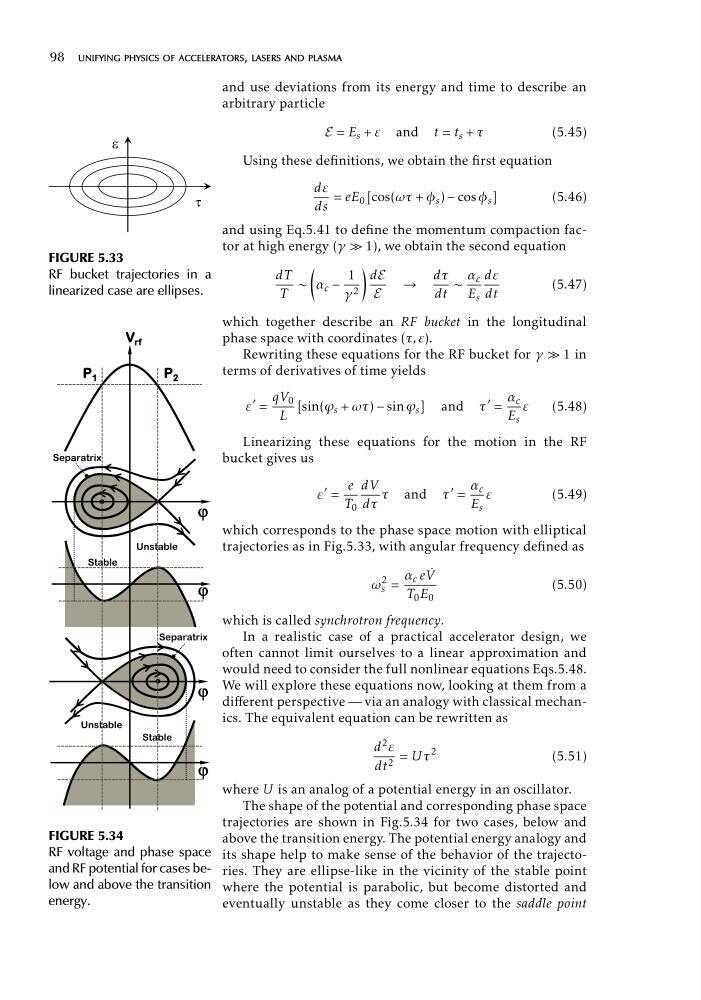
FIGURE 5.33
RF bucket trajectories in a
linearized case are ellipses.
3
3
6HSDUDWUL[
8QVWDEOH
6WDEOH
6HSDUDWUL[
8QVWDEOH
6WDEOH
FIGURE 5.34
RF voltage and phase space
and RF potential for cases below and above the transition
energy.
and use deviations from its energy and time to describe an
arbitrary particle
E = E s + ε and t = t s + τ
(5.45)
Using these definitions, we obtain the first equation
dε = eE 0 [cos(ωτ + φ s ) − cos φ s ]
(5.46)
ds
and using Eq.5.41 to define the momentum compaction factor at high energy (γ » 1), we obtain the second equation
(
)
dT
1 dE
dτ α c dε
∼ α c −
→
∼
(5.47)
T
γ 2 E
dt
E s dt
which together describe an RF bucket in the longitudinal
phase space with coordinates (τ, ε).
Rewriting these equations for the RF bucket for γ » 1 in
terms of derivatives of time yields
qV 0
α c
ε
' =
[sin(ϕ s + ωτ) − sin ϕ s ] and τ
' = ε
(5.48)
L
E s
Linearizing these equations for the motion in the RF
bucket gives us
ε
'
e dV
τ
'
α c
=
τ and
= ε
(5.49)
T 0 dτ
E s
which corresponds to the phase space motion with elliptical
trajectories as in Fig.5.33, with angular frequency defined as
α c eV ˙
ω
2 =
(5.50)
s
T 0 E 0
which is called synchrotron frequency.
In a realistic case of a practical accelerator design, we
often cannot limit ourselves to a linear approximation and
would need to consider the full nonlinear equations Eqs.5.48.
We will explore these equations now, looking at them from a
different perspective — via an analogy with classical mechanics. The equivalent equation can be rewritten as
d 2 ε = Uτ
2
(5.51)
dt 2
where U is an analog of a potential energy in an oscillator.
The shape of the potential and corresponding phase space
trajectories are shown in Fig.5.34 for two cases, below and
above the transition energy. The potential energy analogy and
its shape help to make sense of the behavior of the trajectories. They are ellipse-like in the vicinity of the stable point
where the potential is parabolic, but become distorted and
eventually unstable as they come closer to the saddle point
FIGURE 5.33
RF bucket trajectories in a
linearized case are ellipses.
3
3
6HSDUDWUL[
8QVWDEOH
6WDEOH
6HSDUDWUL[
8QVWDEOH
6WDEOH
FIGURE 5.34
RF voltage and phase space
and RF potential for cases below and above the transition
energy.
and use deviations from its energy and time to describe an
arbitrary particle
E = E s + ε and t = t s + τ
(5.45)
Using these definitions, we obtain the first equation
dε = eE 0 [cos(ωτ + φ s ) − cos φ s ]
(5.46)
ds
and using Eq.5.41 to define the momentum compaction factor at high energy (γ » 1), we obtain the second equation
(
)
dT
1 dE
dτ α c dε
∼ α c −
→
∼
(5.47)
T
γ 2 E
dt
E s dt
which together describe an RF bucket in the longitudinal
phase space with coordinates (τ, ε).
Rewriting these equations for the RF bucket for γ » 1 in
terms of derivatives of time yields
qV 0
α c
ε
' =
[sin(ϕ s + ωτ) − sin ϕ s ] and τ
' = ε
(5.48)
L
E s
Linearizing these equations for the motion in the RF
bucket gives us
ε
'
e dV
τ
'
α c
=
τ and
= ε
(5.49)
T 0 dτ
E s
which corresponds to the phase space motion with elliptical
trajectories as in Fig.5.33, with angular frequency defined as
α c eV ˙
ω
2 =
(5.50)
s
T 0 E 0
which is called synchrotron frequency.
In a realistic case of a practical accelerator design, we
often cannot limit ourselves to a linear approximation and
would need to consider the full nonlinear equations Eqs.5.48.
We will explore these equations now, looking at them from a
different perspective — via an analogy with classical mechanics. The equivalent equation can be rewritten as
d 2 ε = Uτ
2
(5.51)
dt 2
where U is an analog of a potential energy in an oscillator.
The shape of the potential and corresponding phase space
trajectories are shown in Fig.5.34 for two cases, below and
above the transition energy. The potential energy analogy and
its shape help to make sense of the behavior of the trajectories. They are ellipse-like in the vicinity of the stable point
where the potential is parabolic, but become distorted and
eventually unstable as they come closer to the saddle point