

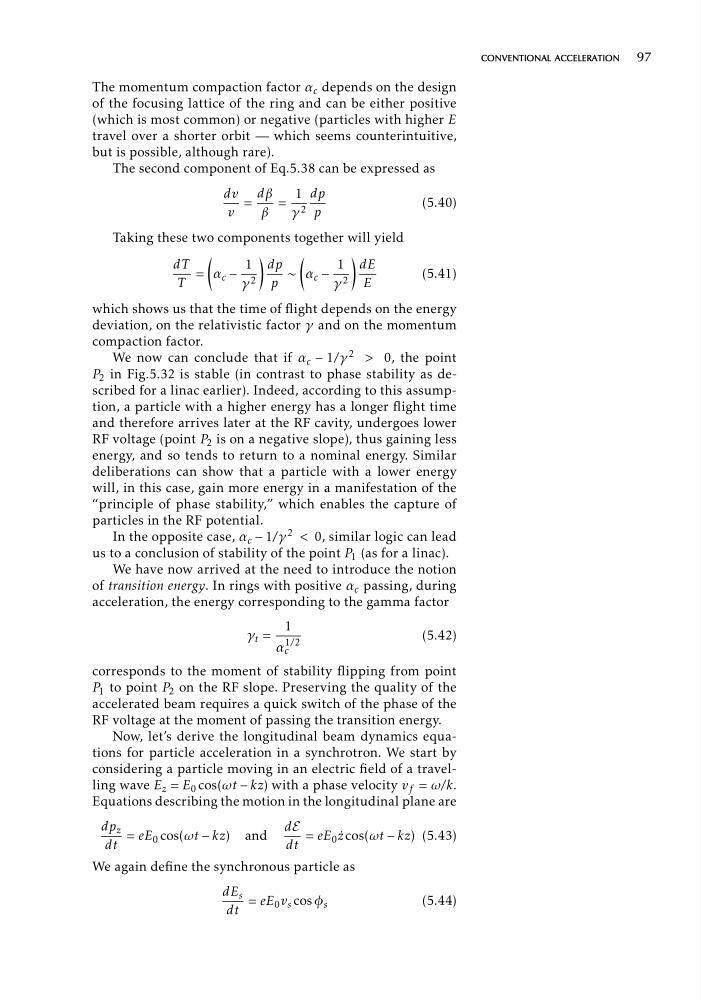
The momentum compaction factor α c depends on the design
of the focusing lattice of the ring and can be either positive
(which is most common) or negative (particles with higher E
travel over a shorter orbit — which seems counterintuitive,
but is possible, although rare).
The second component of Eq.5.38 can be expressed as
dv dβ
1 dp
=
=
(5.40)
v
β
γ 2 p
Taking these two components together will yield
(
)
(
)
dT
1 dp
1 dE
= α c −
∼ α c −
(5.41)
T
γ 2 p
γ 2 E
which shows us that the time of flight depends on the energy
deviation, on the relativistic factor γ and on the momentum
compaction factor.
We now can conclude that if α c − 1/γ 2 > 0, the point
P 2 in Fig.5.32 is stable (in contrast to phase stability as described for a linac earlier). Indeed, according to this assumption, a particle with a higher energy has a longer flight time
and therefore arrives later at the RF cavity, undergoes lower
RF voltage (point P 2 is on a negative slope), thus gaining less
energy, and so tends to return to a nominal energy. Similar
deliberations can show that a particle with a lower energy
will, in this case, gain more energy in a manifestation of the
“principle of phase stability,” which enables the capture of
particles in the RF potential.
In the opposite case, α c − 1/γ 2 < 0, similar logic can lead
us to a conclusion of stability of the point P 1 (as for a linac).
We have now arrived at the need to introduce the notion
of transition energy. In rings with positive α c passing, during
acceleration, the energy corresponding to the gamma factor
1
γ t =
(5.42)
α
1/2
c
corresponds to the moment of stability flipping from point
P 1 to point P 2 on the RF slope. Preserving the quality of the
accelerated beam requires a quick switch of the phase of the
RF voltage at the moment of passing the transition energy.
Now, let’s derive the longitudinal beam dynamics equations for particle acceleration in a synchrotron. We start by
considering a particle moving in an electric field of a travelling wave E z = E 0 cos(ωt − kz) with a phase velocity v f = ω/k.
Equations describing the motion in the longitudinal plane are
dp z
dE
= eE 0 cos(ωt − kz) and
= eE 0 z˙ cos(ωt − kz) (5.43)
dt
dt
We again define the synchronous particle as
dE s = eE 0 v s cos φ s
(5.44)
dt
conventional acceleration 97
of the focusing lattice of the ring and can be either positive
(which is most common) or negative (particles with higher E
travel over a shorter orbit — which seems counterintuitive,
but is possible, although rare).
The second component of Eq.5.38 can be expressed as
dv dβ
1 dp
=
=
(5.40)
v
β
γ 2 p
Taking these two components together will yield
(
)
(
)
dT
1 dp
1 dE
= α c −
∼ α c −
(5.41)
T
γ 2 p
γ 2 E
which shows us that the time of flight depends on the energy
deviation, on the relativistic factor γ and on the momentum
compaction factor.
We now can conclude that if α c − 1/γ 2 > 0, the point
P 2 in Fig.5.32 is stable (in contrast to phase stability as described for a linac earlier). Indeed, according to this assumption, a particle with a higher energy has a longer flight time
and therefore arrives later at the RF cavity, undergoes lower
RF voltage (point P 2 is on a negative slope), thus gaining less
energy, and so tends to return to a nominal energy. Similar
deliberations can show that a particle with a lower energy
will, in this case, gain more energy in a manifestation of the
“principle of phase stability,” which enables the capture of
particles in the RF potential.
In the opposite case, α c − 1/γ 2 < 0, similar logic can lead
us to a conclusion of stability of the point P 1 (as for a linac).
We have now arrived at the need to introduce the notion
of transition energy. In rings with positive α c passing, during
acceleration, the energy corresponding to the gamma factor
1
γ t =
(5.42)
α
1/2
c
corresponds to the moment of stability flipping from point
P 1 to point P 2 on the RF slope. Preserving the quality of the
accelerated beam requires a quick switch of the phase of the
RF voltage at the moment of passing the transition energy.
Now, let’s derive the longitudinal beam dynamics equations for particle acceleration in a synchrotron. We start by
considering a particle moving in an electric field of a travelling wave E z = E 0 cos(ωt − kz) with a phase velocity v f = ω/k.
Equations describing the motion in the longitudinal plane are
dp z
dE
= eE 0 cos(ωt − kz) and
= eE 0 z˙ cos(ωt − kz) (5.43)
dt
dt
We again define the synchronous particle as
dE s = eE 0 v s cos φ s
(5.44)
dt
conventional acceleration 97